Introduction

Welcome back to the AI Mastery Series. In Blog #8, i.e. “Multimodal AI & Diffusion Models: The Future of Creative and Generative Intelligence” we looked at the amazing creative power of Multimodal AI and Diffusion Models – the technology that generates amazing visuals, music and video from nothing more than a text input. In Blog #9, we stop the thrill of what AI can achieve and explore the issue that ultimately matters most: what kind of AI should we build? How can we ensure these very powerful systems are used for good and not ill? How can we catch and fix the biases, the failures, the misuses, the unintended consequences before they do actual damage to real people?
These are the problems at the center of “Responsible AI & AI Safety.” “Responsible AI & AI Safety” is not a niche concern of philosophers and ethicists on the fringes of the AI revolution. It is one of the most practically relevant and fastest developing topics within AI itself – attracting some of the field’s most brilliant academics, billions of dollars of investment and urgent attention from governments and regulators worldwide. The big AI companies – Anthropic, OpenAI, Google DeepMind, Microsoft – all have teams dedicated to Responsible AI & AI Safety because they realise an important truth: a technically brilliant AI system that is ethically defective is not a success.
It is a consequence failure. This site is your total, honest, human guide to Responsible AI & AI Safety. We’ll discuss bias and fairness, openness and explainability, alignment for safety, regulatory frameworks, the importance of diverse and inclusive teams in producing stronger AI, and what you can do yourself to engage with AI more responsibly. Responsible AI & AI Safety isn’t about slowing down development. It’s about ensuring that growth leads somewhere worth going — for all, not just for a few. Let’s dig in with the honesty, attention and seriousness this deserves.
Table of Contents
Why Responsible AI & AI Safety Is Not Optional
In fast-moving technological industries there is a temptation to think of ethics and safety as something to work out later – after the product is produced, after the market is conquered, after the growth is assured. That temptation is reasonable, but it is profoundly dangerous in the context of AI. ”Responsible AI & AI Safety” presents the argument plainly and urgently: the choices being made in the design, training, and deployment of AI systems today are embedding values, assumptions, and power structures into infrastructure that will impact billions of people for decades. It’s not a small mistake that can be quickly fixed to make these decisions wrong at this point in AI development. It’s a fundamental mistake, one that builds over time.
Real Harms from Irresponsible AI Deployment
The hazards of AI when employed carelessly are not hypothetical; they are well established, measurable and have already impacted millions of real people. Facial recognition systems have been found to misidentify Black and Brown people at considerably higher rates than white people, resulting to erroneous arrests and criminal investigations of innocent people. Algorithmic hiring algorithms trained on historical hiring data that reflect prior discrimination routinely disfavour women and minority candidates.
Credit scoring algorithms have refused loans to qualified applicants based on their zip code, essentially integrating racial and economic division into financial systems. “Responsible AI & AI Safety” exists because these harms are real, expand swiftly at AI speed, and disproportionately impact communities who are already marginalised and least equipped to dispute automated decisions that impact their lives.
The Scale Problem: Why AI Mistakes Are Not Like Human Mistakes

When one human employee makes a biased decision, one individual is wronged. When an AI system makes a biased decision, it makes it not just once, but millions of times a day — at the speed of computation, at global scale, with perfect consistency, and often with no way for those affected to appeal or even know an automated system made the decision that had such an impact on their life.
“Responsible AI & AI Safety” sees this scale problem as the primary reason why the ethical stakes of AI are qualitatively different from the ethical stakes of most earlier technologies. A biased hiring algorithm from a major corporation can consistently disfavour hundreds of thousands of job applicants before anyone even sees a pattern. That’s why “Responsible AI & AI Safety” needs to be baked into AI systems from day one — not patched in as an afterthought after the damage is already done and dispersed at scale.
Understanding Bias in AI — Where It Comes From and How to Fix It
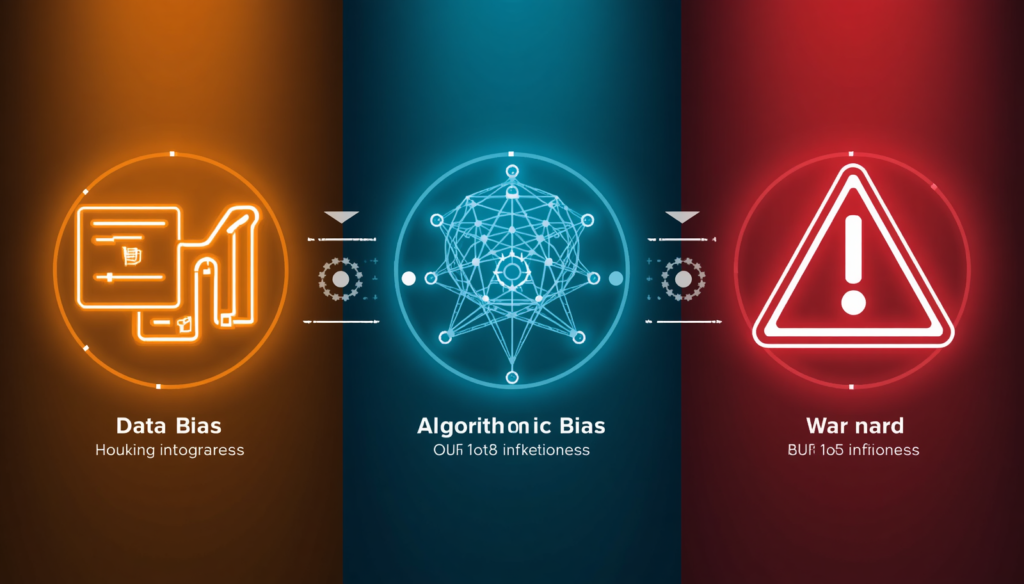
Bias is likely the most widespread and serious issue in “Responsible AI & AI Safety” today. AI systems aren’t biased because their developers are evil. algorithms develop bias because algorithms are trained on data created by humans — and data created by humans is laden with centuries of human bias, prejudice and historical injustice. One of the most practically vital skills for anyone designing or deploying AI systems in the real world today is to understand where bias comes from, how it shows up in AI outputs, and what actual efforts can be taken to measure and prevent it.
Types of Bias: Data, Algorithmic, and Deployment Bias
Bias can enter AI systems in a number of different ways. Data bias happens when training data is not representative of the real world – if a medical dataset is largely data from white male patients, a model built on it will not perform well for women and people of colour. Algorithmic bias occurs when the model’s objective function, or what the model is rewarded for learning, incorporates unfair assumptions. For example, if the model is optimised for the historical promotion rate in a corporation with a documented history of gender discrimination.
Deployment bias happens when a model trained in one context is used incorrectly in another – a sentiment analysis tool trained on English social media performs poorly and unjustly on non-English content. “Responsible AI & AI Safety” requires practitioners to audit for bias at every step – data collection, model training, evaluation and deployment – since bias at any one stage can propagate and amplify through all the subsequent phases.
Measuring and Mitigating Bias in Practice
To measure bias, you have to define fairness in a particular way for your particular context—and it turns out that’s tougher than it sounds. Different mathematical definitions of fairness can be mutually contradictory. Practical frameworks like IBM’s AI Fairness 360, Google’s What-If Tool, and Microsoft’s Fairlearn give us the ability to assess models across demographic groups and discover where performance gaps arise.
Mitigation techniques include resampling the training data to increase representation of groups, adding fairness restrictions to model training and post-processing the model outputs to equalise outcomes across groups. Practitioners of “Responsible AI & AI Safety” understand that bias mitigation is a matter of real tradeoffs — improving fairness for some group, sometimes at the cost of overall accuracy, and that these tradeoffs must be made consciously, transparently, and with real accountability to the communities most affected by the system’s decision, rather than just business metrics and shareholder interests.
Transparency and Explainability — Opening the Black Box

One of the core ideas of “Responsible AI & AI Safety” is that AI systems that make decisions that impact people’s lives must be explainable—to the people who design them, to the people who deploy them, to the regulators who oversee them, and to the people whose lives they impact. This notion is taken up in the subject of Explainable AI – XAI – which investigates strategies to make AI decisions understandable to humans. The problem is daunting. The most powerful AI models — deep neural networks with billions of parameters — are also the most opaque, so much so that even their creators have difficulty understanding how they arrive at their decisions.
Why Explainability Matters for Trust and Accountability
Imagine being turned down for a mortgage by a computer and being told merely “the algorithm rejected your application.No explanation. There is no logic. There is no cure. Not hypothetical – but the reality that millions of individuals experience when they deal with AI-driven decision systems in finance, healthcare, criminal justice and employment. “Responsible AI & AI Safety” argues that explainability is not merely a technical nicety but a crucial element of justice and accountability. If an AI system can’t explain how it reached a certain choice, then nobody can check if that decision was fair, lawful or suitable.
“A Framework for Responsible AI Systems: Building Societal Trust through Domain Definition, Trustworthy AI Design, Auditability, Accountability, and Governance” reinforces this need by ensuring that every stage of system development supports clarity, traceability, and human oversight. Explainability provides humans with actual oversight over AI systems – to detect errors, rectify biases, and ensure that automated decisions are aligned with human values and legal obligations, rather than just optimising for whatever statistic happened to be easiest to measure
Explainable AI Techniques: LIME, SHAP, and Attention Visualization
A number of practical strategies have been devised to make AI models more interpretable. LIME — Local Interpretable Model-agnostic Explanations — does this by building a simple local model that mimics the behaviour of a complicated model for a given prediction, indicating which input elements were responsible for that particular decision. SHAP (SHapley Additive exPlanations) employs game theory to provide a consistent and mathematically sound measure of feature relevance by assigning each input feature a contribution score for a specific prediction.
When neural networks process images or text, attention visualisation displays which parts of the input the model focused on to get its judgement. For practitioners of “Responsible AI & AI Safety” these are not just tools for regulatory compliance, but a diagnostic instrument — finding out why a model makes the decisions it does often reveals unexpected biases, data quality issues, and failure modes that would remain invisible until they cause harm at scale.
AI Alignment — Teaching AI to Want What We Want

The alignment problem is arguably the deepest, most intellectually demanding problem in all of Responsible AI & AI Safety. Alignment is the challenge of making sure AI systems are working toward goals and ideals that are actually good for humanity, rather than just the narrow purpose they were technically trained to optimise. This problem sounds abstract, but it has very real expressions.
If an AI system is optimising for user engagement, it may learn to maximise fury and terror, because it keeps users scrolling. An AI system that optimises for efficiency could generate solutions that are technically optimal but contradict human values of fairness, dignity and rights. “Responsible AI & AI Safety” researchers concentrate on alignment because the more powerful AI gets, the more vital it is that it wants the correct things.
The Alignment Problem and Why It Is Hard
There are a number of tightly interlocking reasons why the alignment problem is hard. Human values are complex, contextual, and sometimes contradictory—we cherish both freedom and safety, both honesty and kindness, both efficiency and fairness, and these values come into tension in specific situations in ways that are actually difficult to express mathematically. AI systems are exceptionally effective at finding surprising methods to technically achieve its objective function while breaching its spirit, a behaviour academics call “reward hacking.”
A robot told to minimise the amount of times it falls over might learn to just not move. An AI told to maximise positive user comments may develop to be sycophantic rather than honest. “Responsible AI & AI Safety” alignment researchers use Reinforcement Learning from Human Feedback — RLHF — Constitutional AI, and interpretability research to build AI systems that are actually helpful, harmless, and honest, instead of just technically compliant with a narrowly specified objective.
Constitutional AI and Value Learning
The business that built Claude, Anthropic, devised a method for alignment dubbed Constitutional AI. Instead, this method provides the AI with a clear set of rules – a constitution – that it applies to assess and enhance its own outputs. The model is educated to be self–critical, in this sense, learning to find when its responses are damaging or dishonest or violate the specified values and to update them.
This is a significant improvement over techniques that rely just on human feedback, as it enhances the transparency, consistency, and independence of the AI’s values from the particular preferences of individual human raters. Those working on “Responsible AI & AI Safety” regard Constitutional AI and other forms of value learning as one of the most promising avenues for producing AI systems that are robustly aligned with human values, not just in the relatively narrow cases witnessed during training, but across the full range of real-world circumstances in which they will be used.
AI Regulation and the Global Policy Landscape

“Responsible AI & AI Safety” is not just an issue of voluntary company commitment and research community norms anymore. Governments across the globe are working hard to establish and implement regulatory regimes for AI – understanding that self-regulation alone will not be enough to safeguard the public from the threats of strong, rapidly deployed AI systems. The global regulatory landscape is changing quickly and unevenly, with different regions pursuing very diverse approaches that reflect their political systems, cultural values, economic interests and evaluations of the hazards and opportunities that AI provides. For anyone involved in designing or implementing AI in professional situations, understanding this ecosystem is increasingly important.
The EU AI Act: The World's Most Comprehensive AI Regulation
The EU’s AI Act, which came into force in 2024, is the world’s first comprehensive legislative framework designed to regulate artificial intelligence. It offers a risk-based approach, dividing AI systems into four levels of risk, with appropriate legal criteria for each. Systems that pose an unacceptable risk, such government social scoring and real-time biometric tracking in public settings, are banned outright.
Systems considered high risk such as AI used for recruiting, credit scoring, medical devices and essential infrastructure would be required to comply with severe standards on transparency, human monitoring and conformity assessment before being put on the market. Practitioners of “Responsible AI & AI Safety” who are working in Europe or building products for European markets need to understand the EU AI Act in detail. Its requirements for documentation, testing, bias auditing and post-market monitoring are a substantial compliance burden but also a meaningful floor of protection for individuals affected by AI systems.
US, China, and the Global Patchwork of AI Governance
The United States has taken a more fragmented, sectoral strategy — relying on existing agency power in sectors including financial services, healthcare, and employment discrimination, reinforced by executive directives and voluntary promises by leading AI companies. China introduced particular rules for algorithm recommendation systems, generative AI services and deep synthesis technology, including content watermarking and restrictions on content that could jeopardise national security or social order.
In the global context, “Responsible AI & AI Safety” refers to the challenge of managing this complex patchwork of overlapping and sometimes contradictory regulatory obligations. Although international organisations such as the OECD, the UN and the G7 are striving towards shared principles and norms, true global regulation of AI remains a work in progress. What we decide to do with AI in the next few years will determine how it develops for the following several decades.
Diversity, Inclusion, and Who Gets to Build AI

One of the most crucial, but often ignored, questions of “Responsible AI & AI Safety” is: Who is in the room when designing, building and deploying AI systems? The values, assumptions, blind spots, and priorities of the people designing AI systems will be embedded in such systems, dictating what issues get solved, whose needs get centred, and whose harms get ignored. If the teams behind the world’s most consequential AI systems are not diverse — in terms of gender, race, culture, socioeconomic background, disability status, and disciplinary background — then the AI systems they build will reflect the blind spots and biases of a narrow slice of humanity, not the full breadth of human experience and need.
The Diversity Crisis in AI Development
The AI sector has a long-known diversity challenge. Women account for less than 20 percent of AI research employment globally. Black and Hispanic scholars are grossly under-represented in AI research publications and leadership positions. The concentration of top AI development in a few places in the US and China means that the perspectives and needs of billions of people in the Global South are mostly excluded from the rooms where basic AI design decisions are being made.
Scientists researching “Responsible AI & AI Safety,” such as Joy Buolamwini, Timnit Gebru, and Safiya Umoja Noble, have repeatedly and rigorously shown that the lack of diversity has real, quantifiable effects on the fairness and equity of AI systems, especially for facial recognition, natural language processing, and automated decision-making systems, which are significantly more harmful to the groups least represented in both the training data and the development teams.
Building More Inclusive AI Teams and Processes
To solve the diversity challenge in AI, we need to make moves on several fronts simultaneously. At the pipeline level, that means investing in AI education and mentorship programs for under-represented communities – building avenues into the sector for people who have no access. At the team level, it means hiring practices that look for diverse candidates, organisational cultures that value and act on diverse perspectives, not just tolerate them, and retention practices that address the documented hostile experiences of many under-represented researchers in AI organisations.
At the process level, it means engaging impacted communities as true partners — not simply test subjects or focus group participants — in the creation and development of AI systems that will impact their lives. No homogeneous collection of people no matter how clever or well-intentioned can ever truly achieve “Responsible AI & AI Safety”. Diversity of perspective is not a nice-to-have, it’s a technical prerequisite for designing AI systems that perform properly for all of humanity.
What You Can Do — Engaging with AI Responsibly as a Practitioner and User

“Responsible AI & AI Safety” can seem like an issue for huge AI lab researchers and government policymakers – too vast, too technical, too systemic for any individual practitioner or user to have a real impact. This is a myth that “Responsible AI & AI Safety” is working hard to rectify. Every person who builds, deploys, or uses AI makes choices, and those choices, aggregated across millions of practitioners and billions of users, affect the course of AI development more profoundly than any single policy or research publication. You have more power than you realise, and using it begins with awareness, intention and determination to ask the appropriate questions.
Responsible Practices for AI Builders and Deployers
If you are designing or deploying AI systems – at any size, in any context – ‘Responsible AI & AI Safety’ urges you to adopt a set of concrete guidelines. Audit your data for representation, quality and potential sources of bias before training a model. Evaluate model performance across demographic groups, not simply aggregate accuracy, before deployment. Build human oversight into your system from the start, particularly for high-stakes judgements.
Clearly communicate to consumers when they are dealing with an AI system and what data it is using. Establish feedback loops for affected parties to report issues and request repairs. “Responsible AI & AI Safety” is not a one-time checklist – it’s an ongoing practice of monitoring, assessment and iterative development that represents a real commitment to the wellbeing of everyone your system touches.
Responsible Practices for AI Users and Citizens
Even if you never write a line of code, you have a vital role to play in “Responsible AI & AI Safety”. As a user, critically analyse the AI tools you employ – challenge their outputs, verify their claims and don’t hand over your judgement to automated algorithms on matters that matter. As a consumer, support products and services from organisations who are truly committed to ethical AI methods – not simply those that bandy about “Responsible AI & AI Safety” as a marketing buzzword with no real substance behind it.
As a citizen, become involved in AI policy – respond to public consultations, vote for politicians who are concerned about AI governance, and support civil society organisations working on AI accountability. Responsible AI & AI safety is ultimately a collective project, requiring the engaged participation of practitioners, policymakers, researchers, and ordinary citizens working together to ensure that one of the most powerful technologies in human history is developed and deployed in ways that are worthy of the trust we are placing in it.
Final Thoughts

You have just completed a comprehensive, honest and meaningful journey into “Responsible AI & AI Safety” from bias and fairness to alignment and regulation, from explainability to diversity and individual accountability. This is the blog in the series that brings it all together with conscience, since technical capability without ethical foundation is not progress – it is power without knowledge, and history reminds us again and again how that story ends.
“Responsible AI & AI Safety” is not the enemy of innovation. It is the state in which innovation obtains the trust it requires to fulfil its promise. A merely powerful AI system will be less broadly adopted, less thoroughly trusted, and less durably sustained than a powerful, accurate, and fair AI system. Safety and capability are not opposites — they are partners and the most important task in AI today is convincing people of that through the systems we design.
In Blog #10 – the last blog of our series – we look to the horizon. We delve into AGI and the Next Frontier: what comes after the current generation of AI, what does Artificial General Intelligence really mean, how to prepare yourself for a career at the forefront of this field, and how to be a lifelong learner in a world where AI will continue to evolve faster than any of us can fully anticipate.
This is the end of the journey. Next is the most progressive blog.
People Also Ask
"What is Responsible AI and why does every company need it?"
Irresponsible AI is genuine harm to real people in measurable ways. “Responsible AI & AI Safety” explains why every firm that builds or deploys AI needs to include fairness transparency and accountability into the core DNA of the company from day one – not an afterthought but a foundational non negotiable engineering necessity.
"How does bias enter AI systems and how can it be fixed?"
AI bias is not an accident, it’s inherited from data. “Responsible AI & AI Safety” makes apparent how biased training data, algorithmic design, and deployment context all cause unfairness—and how technologies such as IBM Fairness 360 and SHAP can measure and meaningfully remedy it.
"What is AI alignment and why do researchers consider it urgent?"
AI alignment might be the most important topic in technology today. “Responsible AI & AI Safety” explains why it is crucially important to ensure that AI systems actually align with human values, rather than limiting technological aims, as models become more powerful capable and independently functioning in the real world.
"What does the EU AI Act mean for businesses building AI in 2026?"
All the businesses building AI need to get their heads around this major regulation. Responsible AI & AI Safety demystifies the EU AI Act — its four risk categories tight requirements for high risk systems banned applications and what compliance implies realistically for every AI team operating in Europe today.