Introduction
Language is the most powerful tool humans have yet for a machine words are just meaningless symbols unless they have mathematical shape. This is precisely what “Word Embeddings & Vectors” achieve – they transform raw words into rich numerical representations that capture meaning, context, and relationships in a format that AI systems can compute, compare, and reason with. “Word Embeddings & Vectors” have revolutionised the way machines interpret human language from the groundbreaking Word2Vec model that Google released in 2013 to the contextual embeddings that drive today’s massive language models.
Without this technology, the present applications of AI, such as semantic search, recommendation engines, machine translation and sentiment analysis would not exist at the degree of sophistication we see today. In this blog, we cover every detail of “Word Embeddings & Vectors” – from their mathematical foundation to their most advanced usage – providing every AI enthusiast a comprehensive, actionable, and deeply insightful understanding of the hidden language that powers all modern artificial intelligence systems.
Table of Contents
What Are Word Embeddings & Vectors?
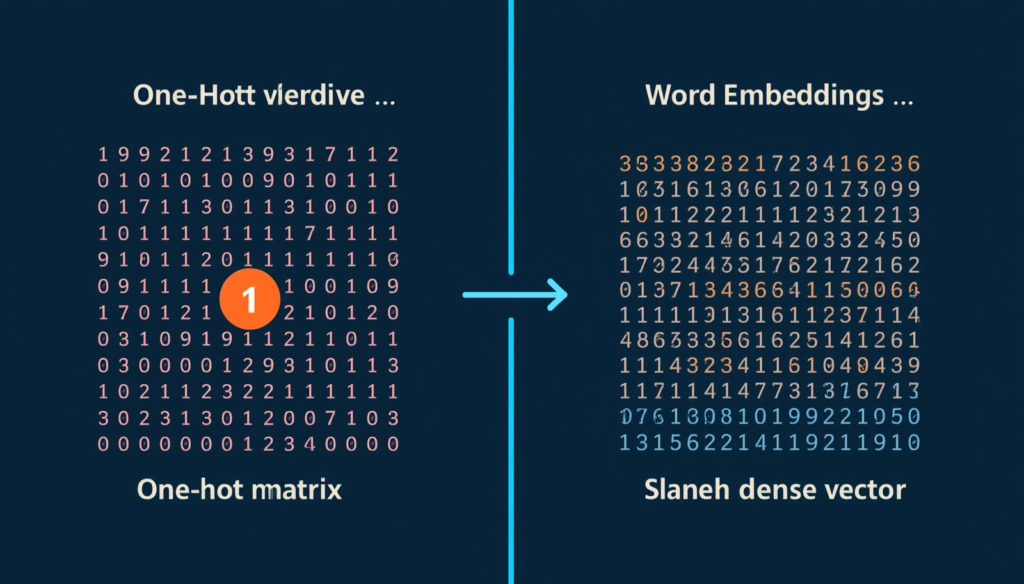
At the most basic level, “Word Embeddings & Vectors” are dense numerical representations of words in a continuous and high dimensional mathematical space. “Word Embeddings & Vectors” brings words with comparable meanings near in this mathematical space, unlike the typical one-hot encoding feature representation, where each word is a sparse binary vector with no semantic information. Geometrically, “dog” will be close to “cat” and “puppy” but far away from “automobile” or “democracy.”
The proximity of these words in the geometric space directly conveys semantic similarity, allowing AI models to learn that related words have related meanings. “Word Embeddings in NLP” is the foundational discipline that transforms this geometric proximity into genuine machine intelligence — making it the single most important conceptual leap between raw text processing and true AI language understanding at production scale. Word Embeddings & Vectors are the fundamental building blocks upon which almost all modern NLP systems are built — from the simplest text classifier to the most powerful large language model in existence today.
The Mathematics Behind Word Embeddings & Vectors
The mathematics of “Word Embeddings & Vectors” is based on linear algebra and high-dimensional geometry, and is both elegant and immensely effective for AI applications. Each word is represented as a dense vector — 50 to 1024 dimensions are usual — with each dimension representing a learnt latent aspect of the term’s meaning and usage patterns. “Word Embeddings & Vectors” are trained so that the cosine similarity of two vectors corresponds to the semantic similarity of the respective words.
A classic example of how “Word Embeddings & Vectors” work is the vector equation: King − Man + Woman ≈ Queen . This equation is a reflection of the fact that the mathematical relationships between vectors are similar to the conceptual relationships between the words they represent, thus enabling truly intelligent algebraic reasoning over language at an unprecedented scale.
One-Hot Encoding vs Word Embeddings & Vectors
Before the age of “Word Embeddings & Vectors”, the predominant approach for expressing words was one-hot encoding. It’s a straightforward technique where each word in the vocabulary is given a unique binary vector, including a single 1 and zeros for all other positions. While one-hot encoding is easy to create, it has catastrophic constraints that Word Embeddings & Vectors entirely overcomes. One-hot vectors are huge (as big as the whole vocabulary) and carry no semantic information whatsoever.
The vectors for “cat” and “kitten” are totally orthogonal in one-hot space despite being semantically extremely close. “Word Embeddings & Vectors” are a joint solution to both problems by creating small dense vectors that directly encode semantic similarity as geometric proximity such that models can generalise to related words and concepts with drastically improved performance on every downstream NLP task.
How Word Embeddings & Vectors Are Trained
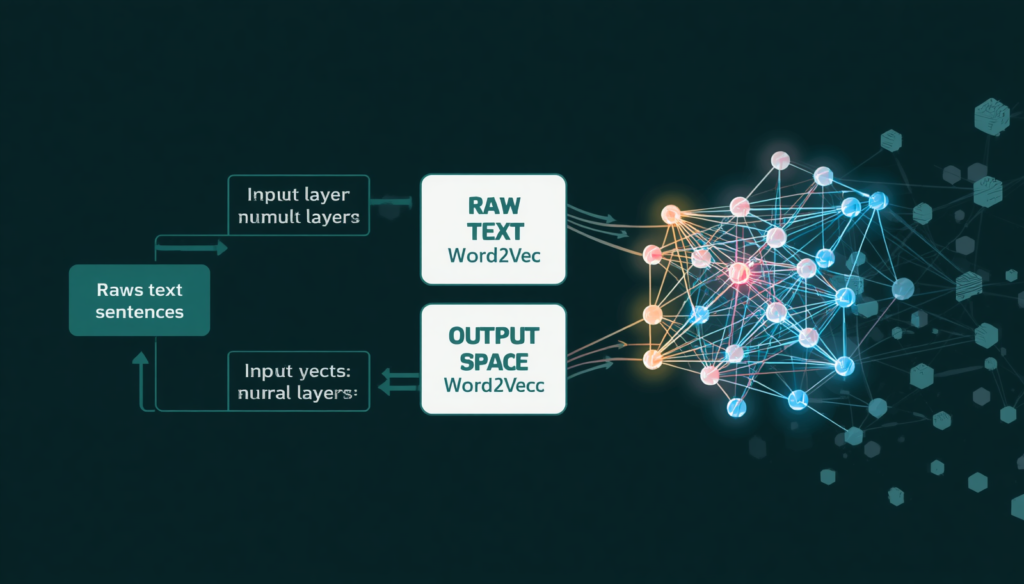
Training ‘Word Embeddings & Vectors’ is one of the most elegant implementations of unsupervised machine learning in the whole field of AI. The underlying idea is the distributional hypothesis: words that occur in comparable settings tend to have similar meanings. The model is trained to predict a target word given its context words, or context words given a target word.
This enables the model to learn to generate “Word Embeddings & Vectors” where semantically similar words naturally cluster together in the vector space. This training requires no human-labeled data – the training signal is all from statistical patterns in raw text. The resulting “Word Embeddings & Vectors” encode an astonishing amount of world knowledge merely from the statistical regularities of how humans use language over billions of phrases.
The Word2Vec Algorithm and Word Embeddings & Vectors
Word2Vec is the landmark algorithm that took the “Word Embeddings & Vectors” into mainstream NLP and remains one of the most prominent contributions in the history of artificial intelligence research. Word2Vec, introduced by Tomas Mikolov et al. at Google in 2013, trains a shallow two-layer neural network on two complimentary tasks: Continuous Bag of Words, which predicts a target word from surrounding context words, and Skip-Gram, which predicts context words from a target word.
Word2Vec’s “Word Embeddings & Vectors” have a remarkable ability to capture semantic and syntactic regularities – not simply meaning similarity, but grammatical relations such as pluralisation, verb tenses, and comparative forms. Even now, the Skip-Gram model with negative sampling (SGNS) still remains one of the most computationally efficient approaches to produce high quality “Word Embeddings & Vectors” from big text corpora.
GloVe and FastText for Word Embeddings & Vectors
Word2Vec was the first to open this field, but two key followers, GloVe and FastText, took “Word Embeddings & Vectors” farther in complementary and very impactful ways. GloVe from Stanford trains on the global word co-occurrence matrix instead of local context windows, and produces “Word Embeddings & Vectors” that are more representative of the semantic relationships throughout the entire corpus. FastText from Facebook AI Research is fundamentally different .
It treats each word as a bag of character n-grams , hence it can produce meaningful “ Word Embeddings & Vectors ” for misspelt words , rare words , and morphological variants that Word2Vec and GloVe simply cannot . For social media text, domain specific jargon or languages with rich morphology (like Turkish and Finnish), FastText’s character-level “Word Embeddings & Vectors” consistently outperform word-level methods by significant and measurable margin on all the standard evaluation benchmarks.
The Vector Space and Semantic Relationships

The most striking aspect of “Word Embeddings and Vectors” is that the mathematical structure of the vector space stores the semantic structure of human language in ways that are directly observable and usable for AI tasks. When words are mapped into this high dimensional space, clusters of semantically similar words emerge naturally – countries cluster together, occupations cluster together, emotions cluster together.
Word Embeddings & Vectors also encode analogical relationships as linear vector translations, e.g. the direction from “man” to “woman” is approximately the same as the direction from “king” to “queen”, from “actor” to “actress”, and from “waiter” to “waitress”. This deep structural trait of “Word Embeddings and Vectors” is what allows AI models to do real semantic reasoning via algebraic manipulation of vectors, enabling capabilities that were absolutely unattainable with previous word representation methods.
Semantic Similarity Through Word Embeddings & Vectors
One of the most powerful and extensively utilised applications of “Word Embeddings and Vectors” in real-world AI systems is measuring semantic similarity. The cosine similarity of two word vectors is simply the dot product of two vectors divided by the product of their magnitudes . Practitioners can calculate how semantically similar any two words or phrases are on an accurate numerical scale from -1 to 1 . This is achievable using “Word Embeddings & Vectors”, as the semantically equivalent words are trained to point in similar directions in the vector space.
This power enables practical applications such as document search engines that return results based on meaning rather than keywords, recommendation systems that recommend items related to the user preferences, and duplicate detection systems that find paraphrased content in large collections of documents. Word Embeddings and Vectors have made semantic similarity a computationally tractable and dependable metric for industrial AI systems.
Analogy Reasoning with Word Embeddings & Vectors
Analogy Reasoning is one of the most recognised and intellectually engaging capacities enabled by “Word Embeddings & Vectors” in artificial intelligence systems. The classic demonstration King − Man + Woman = Queen shows that “Word Embeddings & Vectors” not only encode the word meanings but also the relationships between the concepts as geometric transformations in the vector space. This means that AI systems can solve analogies of the type “A is to B as C is to ?” using simple vector arithmetic, and produce solutions that are compatible with human judgement over thousands of test instances.
“Word Embeddings and Vectors” also encode syntactic parallels – “run is to running as swim is to swimming” – showing that the vector space retains grammatical structure as well as semantic value. These analogy capabilities of “Word Embeddings and Vectors” provided academics with the first convincing evidence that dense vector representations convey structured linguistic knowledge, and not just statistical co-occurrence patterns.
Contextual Word Embeddings & Vectors
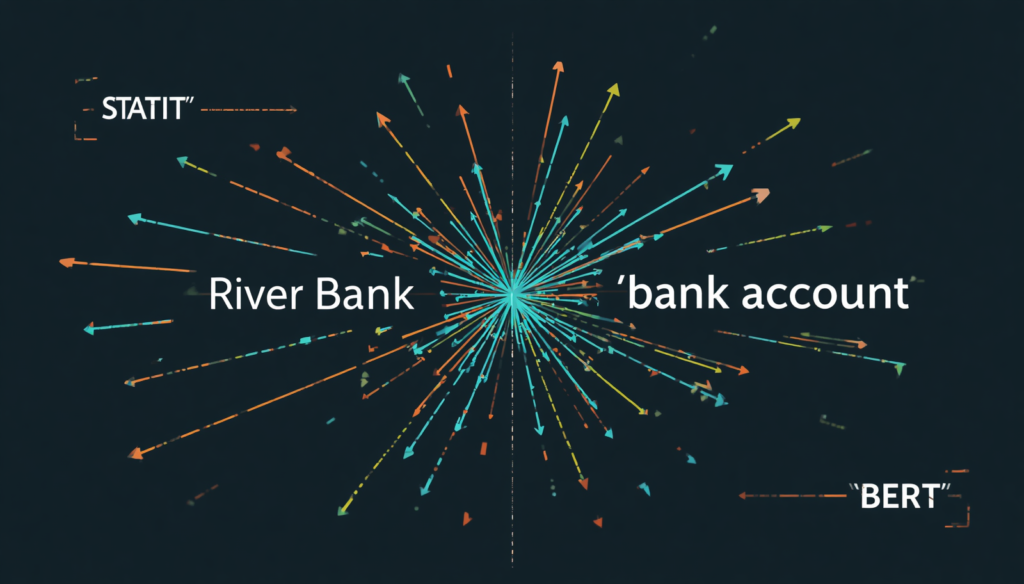
Traditional static “Word Embeddings & Vectors” like Word2Vec and GloVe assign a single fixed vector to each word regardless of context. For example, the term “bank” gets the same vector whether it is used in a sentence about finance, or a sentence about a river. This fundamental restriction was overcome with the inclusion of contextual “Word Embeddings and Vectors” where each word is assigned a different vector depending on the context in which it appears.
ELMo, BERT, GPT etc are contextual “Word Embeddings and Vectors”. They take the whole sentence and pass it through deep transformer layers to produce a representation of the word in context. That context awareness is what gives modern large language models their amazing capacity to deal with ambiguity, sarcasm and nuanced meaning with near-human accuracy and reliability.
ELMo and the Birth of Contextual Word Embeddings & Vectors
The breakthrough model that first proved the power of contextual “Word Embeddings & Vectors” to alter NLP tasks was ELMo (Embeddings from Language Models). Allen Institute for AI released ELMo in 2018, which creates word representations by passing text through a deep bidirectional LSTM network that reads the sentence in both directions, from left to right and right to left. The resulting “Word Embeddings and Vectors” for each word also contain information from the full surrounding sentence, so that ELMo is capable of generating distinct representations for “bank” in “river bank” versus “bank account.”
The addition of the contextual “Word Embeddings and Vectors” from ELMo as features to existing NLP models led to dramatic improvements on every standard benchmark — named entity recognition, sentiment analysis, question answering, and coreference resolution — convincingly showing that the magic in earlier static embedding approaches was the context-sensitivity.
BERT Transforming Word Embeddings & Vectors
In 2018, Google released BERT (Bidirectional Encoder Representations from Transformers) and elevated contextual “Word Embeddings & Vectors” to a whole new level of intricacy and potential. In contrast to ELMO’s LSTM-based technique, BERT uses a deep transformer architecture with self-attention mechanisms, which consider all words in a phrase at the same time when creating “Word Embeddings & Vectors” for each location.
BERT was pre-trained on two tasks – Masked Language Modelling (where random words are masked and predicted) and Next Sentence Prediction – giving it rich contextual “Word Embeddings & Vectors” that transfer powerfully to nearly any downstream NLP work with minimal fine-tuning. When BERT was released it simultaneously set new state-of-the-art records on eleven NLP benchmarks and totally changed the way the whole research community addressed the problem of generating high-quality “Word Embeddings and Vectors” for real-world language comprehension applications.
Applications of Word Embeddings & Vectors
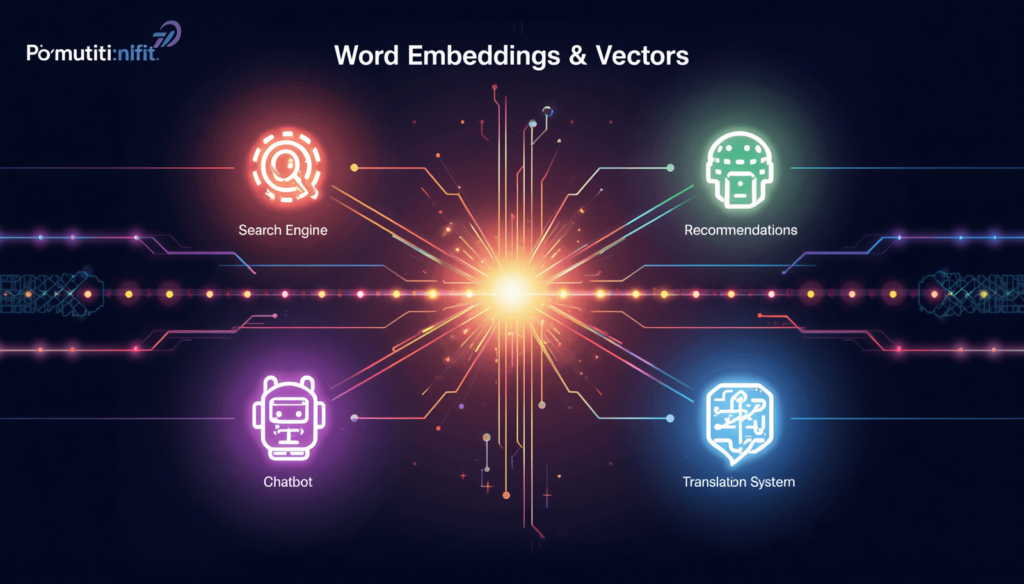
The practical influence of “Word Embeddings & Vectors” is not only in the academic sector but also in all the commercial AI applications that deal with language today. Search engines employ “Word Embeddings & Vectors” to find semantically relevant documents, instead of merely keyword matching. Used by recommendation engines to determine things comparable to those a user has liked in the past.
Word Embeddings and Vectors help chatbots and virtual assistants to understand the user’s intent whether it is conveyed in an unexpected or casual way. Embeddings are used in machine translation systems to represent the semantic spaces of multiple languages. Spam detection, fraud analysis, medical record mining, legal document assessment — all of these important commercial applications are basically powered by “Word Embeddings and Vectors” silently and dependably functioning behind the scenes in production systems all around the world.
Semantic Search Powered by Word Embeddings & Vectors
Semantic search is among the most economically important applications of “Word Embeddings & Vectors” changing information retrieval from keyword matching to true meaning based understanding. Traditional search engines match publications against requests by looking for exact word matches. For example, a search for “automobile safety” might not find a very relevant article that uses the word “car” instead of “automobile.”
A beautiful solution to this problem is semantic search that uses “Word Embeddings & Vectors” to encode the query and all pages as vectors and then retrieve those with the best cosine similarity scores, regardless of the precise words used. Search engines like Google, Bing and enterprise search engines are all built around different forms of “Word Embeddings and Vectors” to provide their semantic search capabilities, meaning they can deliver search results that are far more relevant to what the user intends rather than just matching keywords at a surface level within indexed documents.
Recommendation Systems Using Word Embeddings & Vectors
Another game-changing use of “Word Embeddings & Vectors” affecting billions of people everyday is Recommendation systems in e-commerce, streaming and social media platforms. Platforms can represent user interaction histories as sequences of things and apply Word2Vec-style training algorithms to produce ‘Word Embeddings & Vectors’ for products, movies, songs, and articles, capturing their semantic and behavioural similarities.
Netflix employs embeddings-based recommendations to propose shows similar to ones you’ve viewed. “Word Embeddings and Vectors” is used by Amazon to recommend products that are typically bought or seen in the same browsing session. Spotify employs embeddings to power its Discover Weekly playlist. The beauty of the application of “Word Embeddings and Vectors” to recommendation is that the same arithmetic that captures word similarity also captures item similarity, making it an incredibly versatile and powerful technique across a wide range of commercial areas.
Challenges and Limitations of Word Embeddings & Vectors
Word Embeddings & Vectors are powerful and wonderful, but they have serious restrictions that all AI practitioners need to grasp to use them ethically and successfully. Static embeddings cannot capture polysemy (words with numerous meanings) – each word is assigned a single average vector which inadequately captures any of the possible meanings. Word-level embedding models do not provide representations for out-of-vocabulary words. “Word Embeddings and Vectors” trained on biased text corpora absorb and magnify social biases .
Gender, racial and cultural prejudices have been documented in widely used embedding models . Training high quality “Word Embeddings and Vectors” over vast corpora involves high costs of computation, which requires high hardware resources. Understanding these limits is critical for designing NLP systems that are accurate and efficient, but also fair, resilient and trustworthy in all real-world deployment environments and across varied user communities.
Bias Problems in Word Embeddings & Vectors
One of the most serious and well-documented problems of “Word Embeddings & Vectors” is bias. The issue is attracting significant attention from AI ethicists, regulators and civil society organisations around the world. “Word Embeddings and Vectors” are trained on human-generated text, which reflects historical and societal biases, and hence they necessarily learn and reinforce such biases in their geometric structure. The famous study by Bolukbasi et al. proved that the word embeddings and vectors used associated the word “man” with vocations such as “engineer” and “programmer”, but “woman” is associated with “homemaker” and “nurse”, directly reflecting the gender prejudices inherent in the training corpus.
These biased “Word Embeddings & Vectors” subsequently disseminate discrimination to downstream applications like resume screening, loan approval and content recommendation systems. Several debiasing strategies such as hard debiasing, soft debiasing and counterfactual data augmentation have been presented, however the topic of totally removing bias from Word Embeddings & Vectors is still an open and pressing research problem.
Domain Adaptation of Word Embeddings & Vectors
General purpose “Word Embeddings & Vectors” trained on web text or Wikipedia do not perform well when applied to specialised fields such as medical, law or finance where the technical vocabulary and semantic relations are quite different from everyday English. For example, a general “Word Embeddings & Vectors” model may not know that “MI” in the clinical literature is “myocardial infarction,” or that “bear” in financial records is a market trend.
Domain-adapted “Word Embeddings and Vectors” trained on specialised corpora — PubMed papers for biomedical NLP, SEC filings for financial NLP, court judgements for legal NLP — consistently outperform general embeddings on domain-specific tasks by large margins. Therefore practitioners building production NLP systems for specialised industries must either invest in domain-specific ‘Word Embeddings and Vectors’ or fine-tune general embeddings on domain text to achieve the accuracy levels required for reliable real-world deployment in high-stakes professional environments.
The Future of Word Embeddings & Vectors
There are several intriguing research directions that are shaping the future of “Word Embeddings & Vectors” that promise to overcome current constraints and open up totally new capabilities for AI language processing systems. Models like CLIP and DALL-E are already coming out with multimodal embeddings that embed text, graphics, audio and video into a common vector space. To address new words, trendy slang, and developing concepts, dynamic embeddings that update in real time as language evolves are being researched.
Key to bringing AI to the edge devices with limited computational resources are efficient “Word Embeddings and Vectors” with same performance but drastically less parameters. > “As powerfully explored in Word to Vec for Sentiment Analysis: Unleashing the Power of Empathy, Joy, and 7 Key Words, the next generation of Word Embeddings and Vectors will not only be computationally efficient but also emotionally and semantically interpretable — making AI systems genuinely transparent, trustworthy, and aligned with deeply human values and understanding.” Another active frontier are interpretable “Word Embeddings and Vectors” where the dimensions correlate to human-understandable notions, promising to make AI language systems more visible, debuggable and trustworthy for all stakeholders.
Multimodal Word Embeddings & Vectors
The most exciting frontier in the development of “Word Embeddings & Vectors” are multimodal embeddings, which take the idea of semantic vector spaces beyond language to images, audio and video in a common mathematical setting. Models such as OpenAI’s CLIP demonstrate that “Word Embeddings & Vectors” of text and images may be trained in a common space together such that the model can locate photos that correspond to text descriptions and vice versa with astonishing precision.
This cross-modal functionality of “Word Embeddings and Vectors” underpins breakthrough applications such as visual question answering, image captioning, text-to-image generation, and multimodal search engines that fetch results across diverse media types at the same time. The ambitious goal of multimodal “Word Embeddings and Vectors” is to create a universal semantic space, where the same geometric region corresponds to any concept, whether it be expressed as text, image, sound, or video, thus allowing AI systems to reason fluidly and seamlessly across all modalities of human communication and expression.
Large Language Models and Word Embeddings & Vectors
The link between large language models and “Word Embeddings & Vectors” is the most important breakthrough in the history of NLP, since models like GPT-4, Claude and Gemini have advanced contextual embeddings to levels of sophistication and scale that were previously unfathomable. These models build “Word Embeddings & Vectors” with thousands of dimensions trained on trillions of tokens of text to generate representations that encode not just semantic similarities, but complex reasoning patterns, factual knowledge and even procedural knowledge.
In these huge models, “word embeddings and vectors” are so rich that they offer extraordinary emergent capabilities — in-context learning, chain-of-thought reasoning, and zero-shot task generalisation — that were utterly unforeseen and unpredicted by earlier embedding research. So the future of “Word Embeddings and Vectors” is connected to the future of large language models itself. Each generation of such models generates richer, more competent and generalisable vector representations of human language and knowledge.
People Also Ask
What are Word Embeddings and Vectors and why do they matter for AI?
They give mathematical meaning to the devices. Word Embeddings and Vectors convert raw words into dense numerical representations capturing the semantic linkages; enabling search, translation and many modern NLP applications beautifully.
How are Word Embeddings and Vectors trained using Word2Vec?
Word2Vec predicts words given context. “Word Embeddings and Vectors” are learned by training neural networks on billions of phrases, where the vectors of semantically comparable words are adjacent to each other in the geometry of high-dimensional space.
What is the difference between static and contextual Word Embeddings and Vectors?
Static delivers one vector per word, always. These “Word Embeddings & Vectors” fluctuate with the context of surrounding sentences. Contextual models like BERT allow AI to brilliantly work with ambiguous words with several diverse meanings.
How do Word Embeddings andVectors power real-world AI applications today?
From search to daily recommendations. “Word Embeddings and Vectors” are the engines behind semantic search, personalised recommendations, intelligent chatbots, and machine translation technologies used by billions of people across every major platform in the world.