Introduction
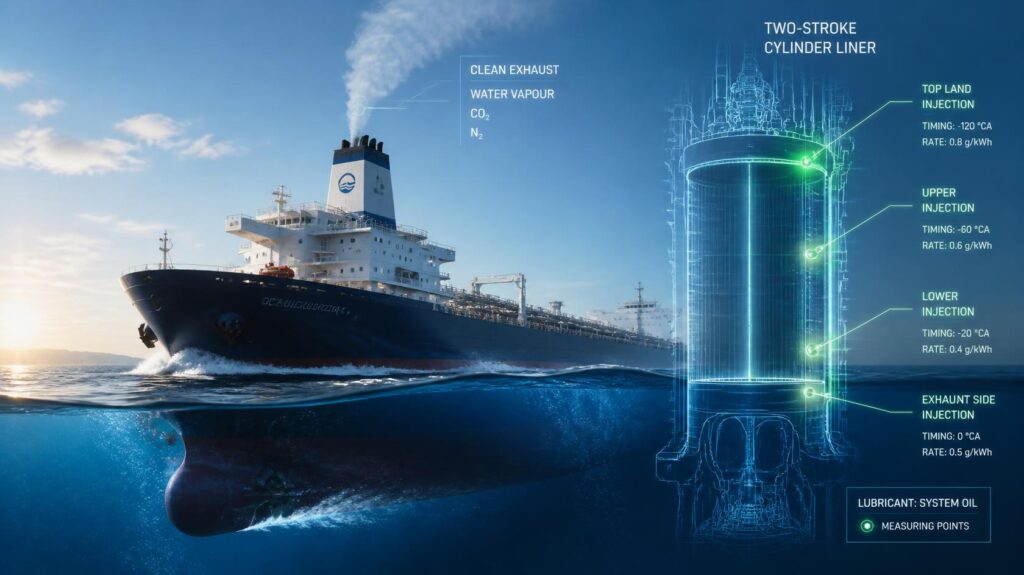
The tightening of international maritime carbon intensity metrics has raised the engine room from a mechanical maintenance floor to a driver of corporate compliance. Major capital retrofits target primary propulsion plants. The compounded environmental penalty of over-lubricated cylinder liners is often missed by technical superintendents. The heart of this operational balancing act is “Cylinder Lubrication Management”: Reducing Unburned Hydrocarbon Smoke to Protect Your AER Score Safely.
As demonstrated by advanced systems like the MAN Alpha Lubricator: Electronic Cylinder Lubrication, over-feeding of cylinder oil not only leads to wastage of expensive lubricant, but the excess not burnt in the cylinder is swept into the exhaust stream, resulting in secondary particle emissions and hydrocarbon smoke that fraudulently exaggerate the carbon intensity indicators. Systematic “Cylinder Lubrication Management” helps operators to optimise oil feed rates, protect piston ring packs from catastrophic liner wear and preserve the vessel’s yearly efficiency rating
Table of Contents
The Environmental Penalty of Excess Cylinder Oil Consumption
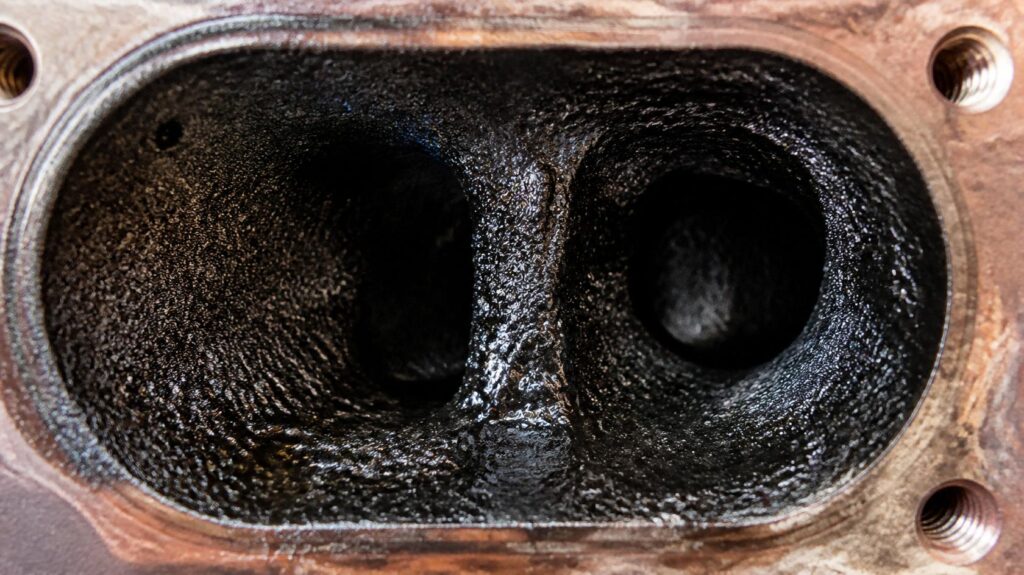
For decades, conventional marine engineering practice has over-lubricated as inexpensive insurance against catastrophic cylinder liner scuffing and premature piston ring wear. But the new environmental paradigm entirely upended this historical thinking as the secondary carbon output of using too much cylinder lubricants is now penalised. If too much heavy alkaline cylinder oil is injected and the piston ring pack is not able to sweep the complete amount, extra oil is forced into the high temperature combustion zone. Target-oriented “Cylinder Lubrication Management” implementation reduces this unburned hydrocarbon carryover, minimising localised exhaust fouling and protecting the ship’s environmental status.
The Physics of Unburned Hydrocarbon Carryover
When the cylinder oil feed rates are higher than the appropriate tribological boundary layer requirement, the high temperatures of expanding gas phase lead to partial pyrolysis of the surplus lubricant. Incomplete combustion of fuel results in volatile unburned hydrocarbons being discharged directly into the scavenge ports and exhaust gas piping networks. These continuous hydrocarbon carryovers without strict ‘Cylinder Lubrication Management’ create dense smoke and particulate matter depositing on turbocharger turbine blades and exhaust gas economisers. The “Cylinder Lubrication Management” avoids lubricant pyrolysis and assures the complete combustion of the fuel and clean passages of exhaust gases at any engine load.
Ash Formation and Exhaust Gas Economizer Fouling
Cylinder lubricants with high base number (BN) contain metallic detergent additives, mainly calcium carbonates, for neutralisation of corrosive acid condensation. If too much cylinder oil is burnt in the combustion chamber, these inorganic additives become hard particles of calcium sulphate ash which go down the exhaust stream. By practicing diligent ‘Cylinder Lubrication Management’ the amount of ash deposition on downstream exhaust gas economiser tubes is reduced. The reduced ash build-up keeps the thermal efficiency of the waste heat recovery at its optimum level. If this is not kept up, secondary fuel use can increase, bringing the vessel’s yearly efficiency ratio dangerously close to the compliance threshold.
Tribological Dynamics of Piston Ring and Liner Interfaces
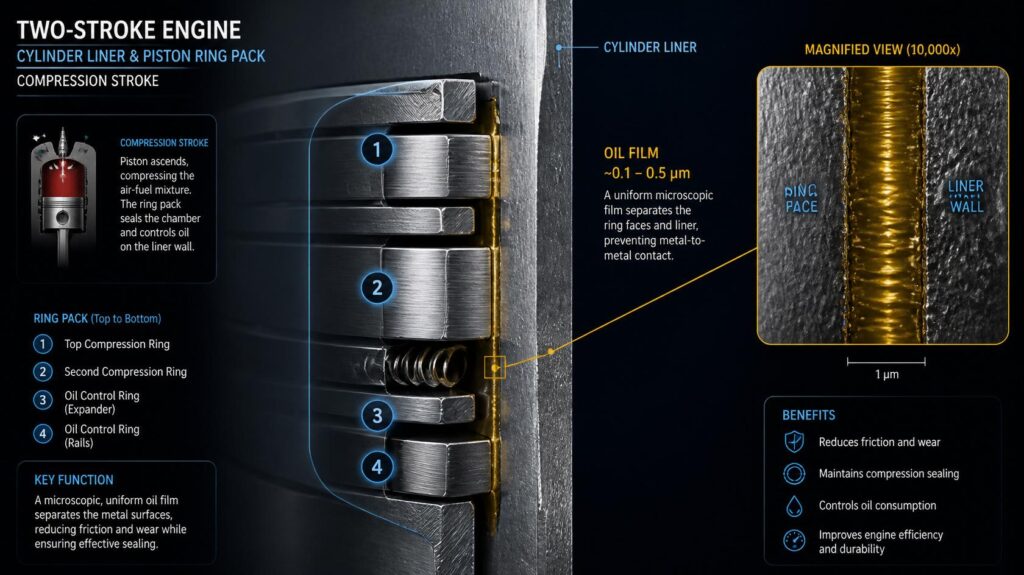
The basic mechanical purpose of two-stroke engine lubrication is to maintain the hydrodynamic film thickness between the moving piston rings and cylinder liner walls. However, tribological stability is a fine balance; too low an oil content results in metal-to-metal contact and quick liner scuffing, while too high an oil content results in hydraulic ring locking and carbon packing. The old mechanical ratchets have been replaced with modern electronic lubrication systems that provide micro-doses of oil straight into the ring pack at the precise crank angle. Moving to advanced “Cylinder Lubrication Management” preserves mechanical protection while oil consumption can be decreased by as much as 50%.
Preventing Cold Corrosion Without Ash Accumulation
When the temperature of the wall of the liner falls below the acid dew point, corrosive sulphuric acid condensate is formed from the use of sulfur-containing fuels in engines. Effective “Cylinder Lubrication Management” fits the base number of the cylinder oil and the precise feed rate to the exact fuel sulphur content and the engine operating load. This precise chemical neutralisation stops corrosion without overloading the combustion chamber with excess additives. “Cylinder Lubrication Management” employs adaptive algorithm controls to enable technical teams to achieve and maintain ideal liner surface conditions in response to varying trade routes and changing fuel quality.
Eliminating Ring Pack Bore Polish and Deposits
Excessive lubricant build-up in the piston ring grooves results in the formation of hard carbon deposits behind the rings, inhibiting their radial mobility and causing ring sticking. As the piston reciprocates, these hard deposits scrape against the liner wall and cause catastrophic bore polishing and damage the liner’s oil-retaining hone marks. The “Cylinder Lubrication Management” is performed systematically to balance the lubricant dosage with the actual evaporation and mechanical sweep losses. The “Cylinder Lubrication Management” system controls the dose to guarantee clean ring grooves and the free flexing of the piston rings to ensure exact gas sealing against the high combustion pressures.
Retrofitting Electronic Pulse-Lubrication Systems
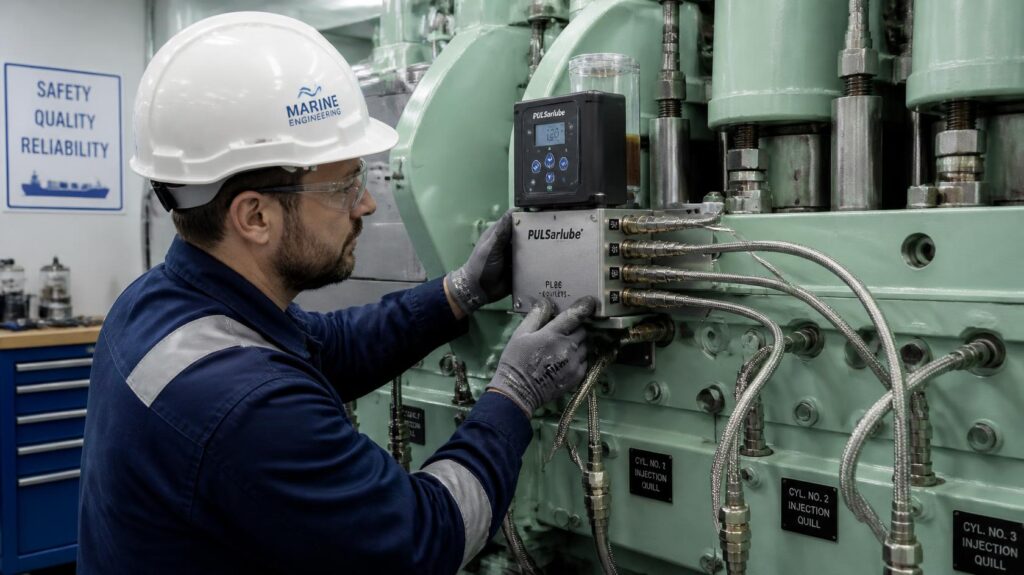
One of the most effective vessel improvements that can be made for immediate operating savings is the upgrading of vintage mechanical lubricator pumps to state-of-the-art electronic pulse-lubrication retrofits. There are electronic systems that use high pressure hydraulic servo oil or solenoid powered injectors to atomise the cylinder oil directly into the piston ring package at the correct upward stroke. This controlled distribution eliminates the waste of large amounts of oil from older mechanical systems that spray oil indiscriminately across the exhaust ports. Cylinder Lubrication Management” is brought into a precise and fully automated discipline by electronic retrofits.
High-Pressure Atomization and Direct Ring Pack Delivery
Electronic pulse lubrication systems supply cylinder lubricant at high pressure (often above 35 bar) in a fine spray mist which directly coats the piston rings as they pass the injection quills. This direct distribution method contrasts with older drip systems where as much as 40 percent of the oil is sent straight through the exhaust valves unburned. The use of pulse technology in the “Cylinder Lubrication Management” system ensures optimal efficiency of lubricant delivery. With “Cylinder Lubrication Management”, technical managers can safely reduce baseline feed rates from 1.1 g/kWh to as low as 0.6 g/kWh for consistent circumferential oil coverage.
Load-Dependent and Sulfur-Adaptive Feed Control
Current pulse lubrication control units are directly interfaced with the Engine Control System (ECS) to calculate real-time engine load, crankshaft position and fuel mass flow. When the vessel is operating in slow steaming modes, the electronic controller automatically reduces the cylinder oil injection volume exactly in proportion to the reduced fuel burn. The automated algorithms are incorporated into the daily “Cylinder Lubrication Management” to remove human error and delays in manual adjustments. Under ‘Cylinder Lubrication Management’ components are protected during fast load alterations and over-lubrication is avoided during long anchorage or port stays by constant load dependent adjustments.
Analyzing Scavenge Drain Oil for Precise Feed Rate Optimization

There is no way to set up a successful cylinder lubrication program without continuous real-time feedback on the chemical and physical condition inside the cylinder liner. Scavenge space drain oil analysis gives critical diagnostic information such as residual base number (BN), iron wear content (corrosive and abrasive), and water contamination. Technical superintendents have to change from static manufacturer suggested feed rates to dynamic feed rate optimisation based on routine drain oil analysis. The addition of a scavenge drain test to the “Cylinder Lubrication Management” allows for a safe reduction in the feed rate without the risk of metal-to-metal contact.
Setting Baseline Target Parameters for Residual Base Number
Engineers can track the residual BN in scavenge drain oil to confirm that the cylinder lubricant being supplied is neutralising sulphuric acid effectively, but not leaving behind excess unreacted base. A target residual BN of 15 to 25 mg KOH/g means the chemical balance in the combustion area is optimum. These goal values, integrated into the routine Cylinder Lubrication Management, will avoid acid-induced cold corrosion and alkaline-induced deposit deposition. With BN tracking applied to “Cylinder Lubrication Management” the technical teams are confident to reduce the feed rates to minimal safe limits.
Monitoring Corrosive and Abrasive Iron Wear Trends
Quantifying the total iron concentration in the scavenge drain samples helps engineers to differentiate between chemical corrosion (corrosive wear) and mechanical contact (abrasive wear). sudden spikes in metallic iron particles indicate inadequate lubricant film thickness and require rapid adjustment of quill time or feed dosage. The combination of iron monitoring with “Cylinder Lubrication Management” provides an early-warning system that identifies liner wear before structural damage. Under “Cylinder Lubrication Management”, this data-driven precision allows ship managers to maximise component life and minimise daily lubrication expenditures.
The Direct Impact of Reduced Hydrocarbon Smoke on AER Compliance
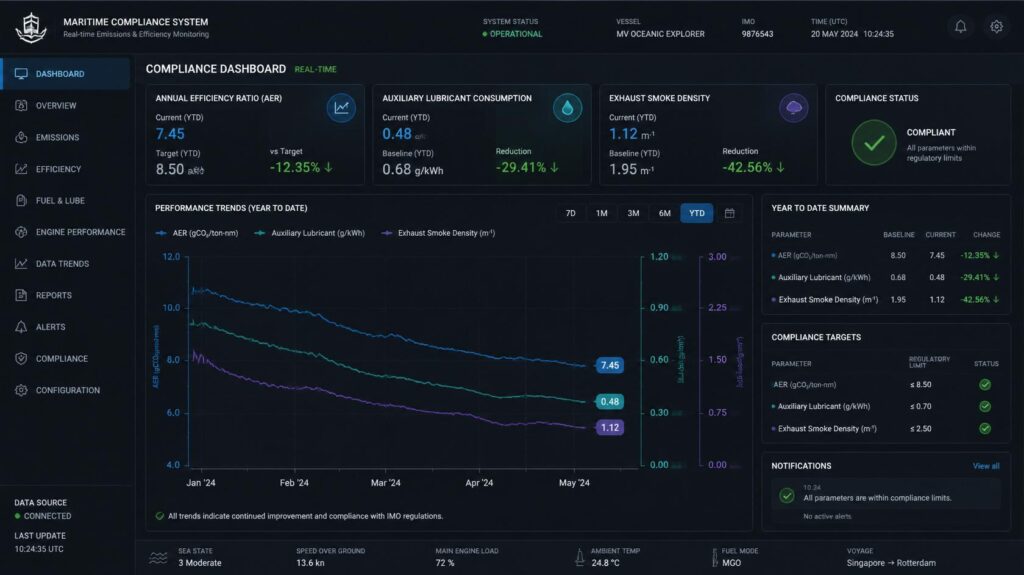
The Annual Efficiency Ratio (AER) is a measure of operational carbon intensity on a vessel, calculated as total carbon emissions divided by deadweight tonnage multiplied by distance travelled. The major part of this computation is based on the consumption of main engine fuel oil, although secondary emissions from the use of auxiliary lubricants add directly to the total carbon mass emissions. Smoke of unburned hydrocarbons exiting the funnel stack is wasted chemical energy and reduces the AER score of the vessel. The use of systematic “Cylinder Lubrication Management” leads to a reduction in secondary lubricant burn and a measurable increase in the vessel’s annual environmental rating.
Eliminating Secondary Carbon Output from Auxiliary Lubricant Burn
Depending upon the kind of combustion chamber, each litre of cylinder lubricant burnt produces around 3.0 kg of CO2 equivalent emissions, as well as particulate matter and unburned hydrocarbons. For a large container vessel or bulk carrier using 300 litres of cylinder oil per day, over-lubrication can contribute hundreds of tonnes of needless carbon emissions each year. Aggressive implementation of “Cylinder Lubrication Management” considerably reduces this supplemental carbon source. One way to cost-effectively reduce total annual emissions without affecting commercial sailing speeds is to minimise needless oil burn through “Cylinder Lubrication Management.
Safeguarding Vessel Rating Stability and Market Value
Environmental compliance ratings in international frameworks are greater for those vessels that maintain clean, smoke-free exhaust profiles through optimised combustion and lubrication. Leading charterers are actively screening fleet assets against verified carbon metrics and paying premium time-charter rates for highly efficient tonnage. “Cylinder Lubrication Management” as part of routine operating procedures protects the asset from rating downgrades that could lead to commercial isolation. By proactively introducing “Cylinder Lubrication Management” you are demonstrating to charterers and financial institutions that the vessel is being run to the highest technical and environmental standards.
Overhauling Injection Quills and Calibration of Electronic Lubricators
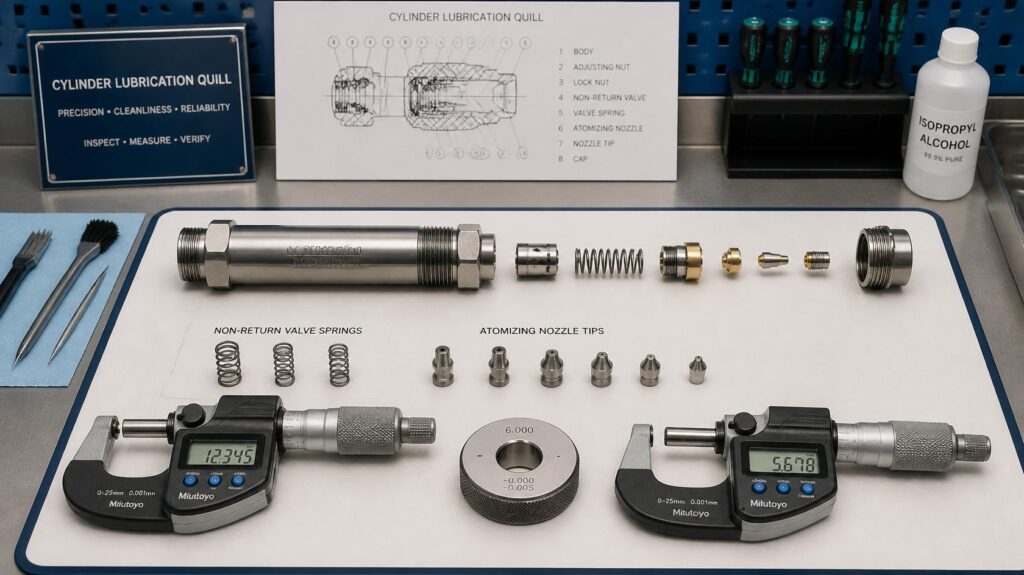
To achieve the most efficiency from an electronic pulse-lubrication system it is required to stick to planned overhaul procedures for injection quills, non-return valves and hydraulic lubricator blocks. Thousands of hours of operation can block quill nozzle orifices with carbon deposits and damage non-return valve springs such that high pressure combustion gas can blast back into the lubrication lines. Standardised “Cylinder Lubrication Management” maintenance routines provide correct hydraulic dosing pressure so that each pulse of injection delivers its calibrated volume of lubricant to the ring pack.
Overhauling Injection Quills and Atomizing Nozzles
If the injection quills are clogged or leaking, the atomisation process is disturbed, and the cylinder oil will flow down the liner wall instead of being atomised into a fine mist over the piston rings. Each quill has to be pressure tested to check opening pressures, and the spray patterns checked during planned maintenance overhauls.’ Including quill testing as part of normal “Cylinder Lubrication Management” procedures can ensure replacement units are up to original manufacturing specs. “Cylinder Lubrication Management” provides clean, fully functional quills, eliminating localised dry areas on the liner and premature cylinder wear.
Calibrating Solenoid Actuators and Feedback Sensors
Electronic lubricator blocks are based on high speed solenoid valves and inductive position sensors to monitor the piston stroke displacement and timing feedback. Electrical resistance drift or mechanical wear inside the solenoid enclosure can produce slight timing errors that destroy injection precision. Routine “Cylinder Lubrication Management” involves electronic sensor Zero Point calibration and solenoid response testing via the Main Operating Panel. Precise sensor calibration in “Cylinder Lubrication Management” gives the engine control unit full control over the timing and amount of lubricant in all sea conditions.
Modernizing Fleet-Wide Lubrication Governance Beyond 2026

Long-term management of commercial marine fleets necessitates a shift from isolated shipboard decision making to centralised cloud-based lubricant governance systems. Automated telemetry networks are being installed so that shore-side technical departments can monitor real-time cylinder oil consumption, feed rates and scavenge drain analysis data across whole fleets. This live operational data, when merged into centralised analytics systems, enables technical managers to impose common optimisation standards. Embedding “Cylinder Lubrication Management” as a basic pillar of corporate sustainability assures long-term adherence to the rising global decarbonisation targets.
Implementing Cloud-Based Telemetry and Live Feed Monitoring
Daily cylinder oil consumption figures are immediately visible when shipboard electronic lubricators are connected to cloud analytics platforms. Automated algorithms correlate actual feed rates to fuel sulphur levels, engine load curves and historical drain-oil analysis data. With live data streams, “Cylinder Lubrication Management” can identify operational irregularities in real time and enable superintendents to address over-lubrication before it affects the compliance records. Cloud-enabled “Cylinder Lubrication Management” delivers validated, auditable data trails for flag state verifiers and environmental auditors.
Building Resilience Against Tightening Decarbonization Rules
As global reduction hurdles get tighter with 2030 net-zero targets approaching, every aspect of vessel efficiency will face more scrutiny from regulators and charterers alike. Those ship management businesses who proactively optimise their auxiliary systems today will have a clear edge over unprepared operators. When combined with engine room precision tools like Proportional Valve Calibration: Fine-Tuning Electronic Two-Stroke Injection Profiles to Cut Carbon Output, an emphasis on “Cylinder Lubrication Management” in fleet operations results in immediate savings in fuel and lubricant costs and a lasting reduction in carbon emissions. Ongoing investment in ‘Cylinder Lubrication Management’ will ensure the long term commercial viability and asset value of commercial tonnage in an increasingly regulated market.
Conclusion

To successfully meet the demanding operating requirements of modern ships, there needs to be a steadfast dedication to precise engineering and the elimination of secondary emissions. With ever tightening regulatory regimes, disregarding the accumulating environmental damage from excessive cylinder oil feed rates is no longer an option. The sure approach to quick compliance is to upgrade to electronic pulse lubrication retrofits, do routine scavenge drain oil analysis and enforce continual “Cylinder Lubrication Management.” And keeping lubrication accuracy as a high priority remains one of the best and lowest risk operational ways to reduce unburned hydrocarbon smoke, to safeguard piston ring packs and to have a compliant AER score.
People Also Ask
How does excessive cylinder oil feed rate harm a vessel's AER score?
Any extra cylinder oil will be partially burnt in the combustion space giving rise to unburned hydrocarbon smoke and carbon emissions. Practicing “Cylinder Lubrication Management” will eliminate excess oil burn and directly reduce the total output of carbon mass, protecting the vessel’s AER score.
Can electronic pulse-lubrication retrofits really cut cylinder oil feed rates by 50%?
Yes. The electronic pulse-lubrication systems spray atomised oil straight into the ring pack at exact crank angles, eliminating wastage. Safe feed rate reductions from ~1.1 g/kWh to 0.6 g/kWh when executing “Cylinder Lubrication Management” are made possible by pulse retrofits.
What is the ideal residual Base Number (BN) target in scavenge drain oil analysis?
A desirable residual BN in scavenge drain oil is 15 to 25 mg KOH/g. To maintain this aim, systematic \”Cylinder Lubrication Management\” is required to achieve complete acid neutralisation without formation of hard calcium ash deposits on piston crowns or exhaust valves.
How does Cylinder Lubrication Management prevent engine bore polishing?
Too much lubrication leads to hard carbon deposits forming in the piston ring grooves. This causes rings to be forced up against the liner wall. Proper management of cylinder lubrication, matching the oil dose to the real evaporation rates keeps the ring grooves clean and prevents catastrophic liner bore polish.