Introduction
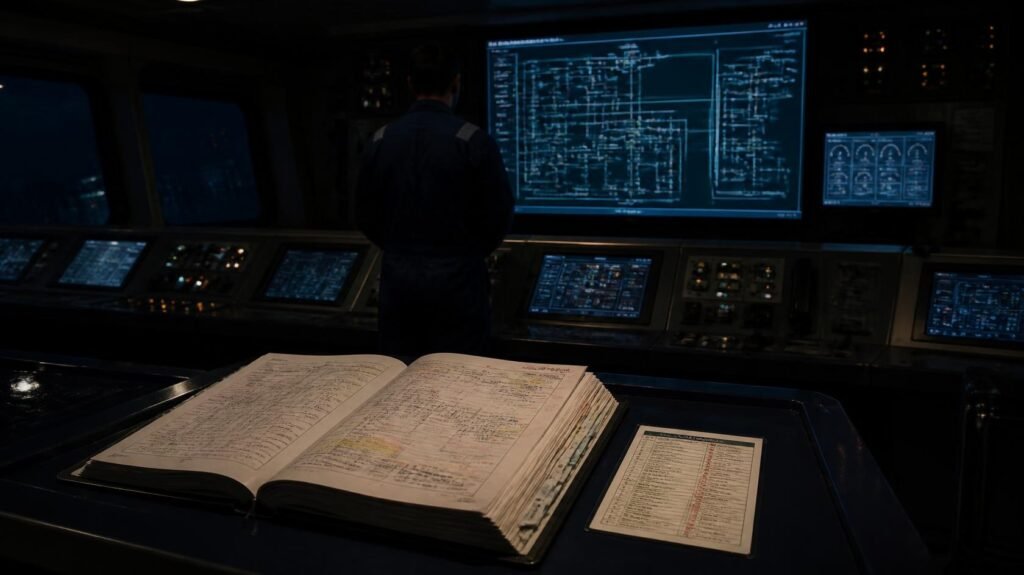
One document determines whether an ammonia-fuelled ship may sail and it’s not the class certificate. It is the safety case for the ammonia fuel: the reasoned, demonstrated argument that this engine room, with these systems and these staff, is no less safe than a standard oil powered installation. The industry discourse around ammonia is nowhere near it. We talk about engine orders and bunkering hubs and green corridors and offtake agreements. We rarely address the several hundred pages an owner must compile in order for a flag administration to accept a design that is not completely described in any rulebook.
There is a reason behind the stillness. Quote a clause and writing becomes easy. There is a fire detection clause. Lifeboats have their caveat. There is no ammonia fuel safety case, because the IMO purposely decided not to write one yet. The Interim Guidelines for the Safety of Ships Using Ammonia as Fuel (MSC.1/Circ.1687) were accepted at MSC 109 in December 2024 and issued in February 2025. By design it is goal focused. Not the pipe diameter, the sensor count, or the airlock position. It tells you what your fuel system has to do.
That’s disconcerting for a business based on prescriptive regulations. A superintendent who has spent twenty years making sure arrangements meet rules now needs to prove something harder: that a hazard that no one in the fleet has personally survived is lowered as low as practically practicable. Evidence has to be produced, not looked up. The checklist said nothing about this failure, with all its boxes checked, but the configuration was nonetheless risky because it had been created for a fuel that burns, not a fuel that poisons. An “ammonia fuel safety case” fails loudly in front of a surveyor, which is precisely why it works.
The following explains what the document actually is, where its legal authority comes from under the alternative design route, what flag administrations and class societies expect to find within, how the HAZID to ALARP chain provides the evidence, and what the finished dossier physically contains on delivery day.
Table of Contents
Why the checklist habit collapses when the fuel is toxic
The shipping business relies on prescribed compliance as prescriptions are cheap to audit. An “ammonia fuel safety case” cannot inherit that economy. The hazard is chronic and unseen, the exposure limits are orders of magnitude below the concentration where anything actually appears wrong, and the consequence of failure is a person instead of a fire. Checklists are ways of encoding settled experience and there is almost none for ammonia at fleet scale. The argument-building is engineering reasoning not form-filling and owners constantly misjudge that transition.
The ammonia fuel safety case starts where flammability thinking ends
In a normal engine room, all the instinct is set for ignition. Spark-resistant tools, hot surfaces, explosive limitations, flash point. Ammonia does burn but it burns poorly and grudgingly. It’s quite easy to close the flammability argument. The hardest file is one that the industry has no muscle memory for: acute toxicity. Occupational limit is about 25 ppm. Immediately dangerous to life and health about 300 ppm. A few thousand ppm kills in minutes. None of those thresholds appear on a fire orientated checklist, which is exactly why the IMO gave toxicity its own treatment in IMO-Circular-Ammonia-Interim-Guidelines-2025_02.pdf, thus an inherited one certifies the wrong hazard.
Why an ammonia fuel safety case must argue rather than confirm
A checklist answers a closed question: is the item there? A safety case deals with an open one: residual risk tolerable? How can you tell? That distinction impacts who wrote the document. A surveyor in possession of a form may be delegated the confirmation. The argument needs the naval architects, the process safety engineers, the engine designer, the operator and the crewing manager in one room. The text makes those parties reconcile and the reconciliation is the bulk of the value. Only when someone really puts down the dispute do the owners find differing design assumptions.
Inside MSC.1/Circ.1687 and what goal-based really means
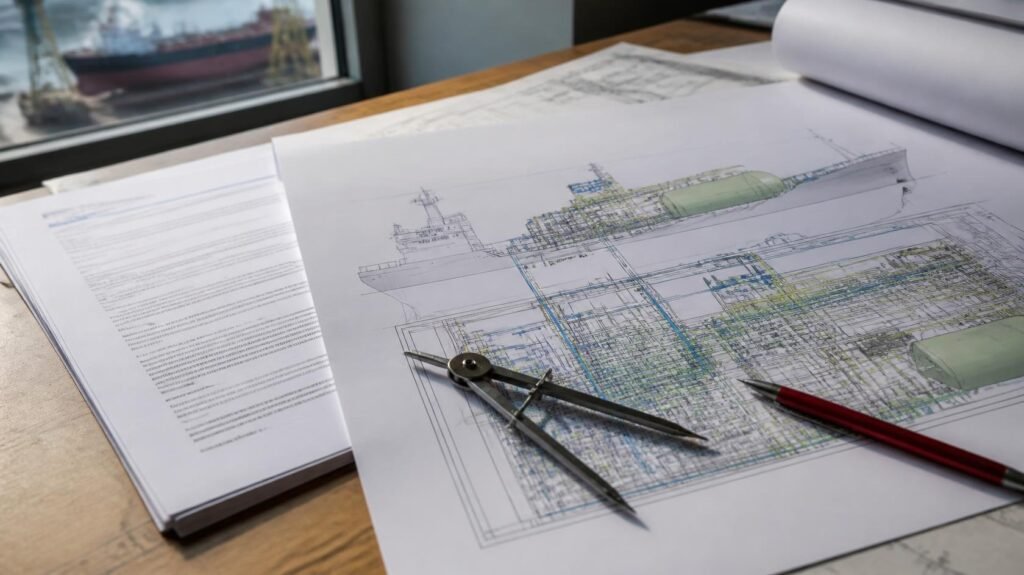
The interim rules are the foundation of any “ammonia fuel safety case” and are shorter and vaguer than many owners anticipate. They provide a goal and function-based framework including fuel containment, bunkering, fire safety, toxicity reduction and crew protection, in line with IGF Code and SOLAS principles, but not binding in itself. They ask that ammonia installations be at least as safe as equivalent oil-fired machines. How you convey it is your problem. This is exactly why the paper exists at all .
Goal-based drafting and the burden it places on the ammonia fuel safety case
Prescriptive rules pass the risk to the regulator. If you followed the rule and the ship went down anyway, then the rule was flawed. Goal-based rules shift the risk on the designer. MSC.1/Circ.1687 gives functional objectives and requires each project to demonstrate conformity on its own evidence, while candidly recognising that the rules are provisional and will be updated as experience in sailing accumulates. That interim status is not a loophole. This is the only place your submission will be viewed by individuals who never developed it, hence it is the only place where the reasons behind a given arrangement is recorded.
Toxic space, containment and the gaps your ammonia fuel safety case must fill
The circular uses intrinsically safer design concepts to reduce sources of release and introduces vocabulary that the industry did not need before, such as the concept of a hazardous area. What it does not do is provide answers to every practical question. The project mostly leaves the ventilation philosophy, treatment of ammonia produced, medical response provisioning and maintenance purging to the project. Every thing unsaid is a chapter you have to write yourself. Think of the circular as a table of contents for the argument that your project has to make rather than a spec you can build to directly.
The alternative design route under SOLAS II-1/55
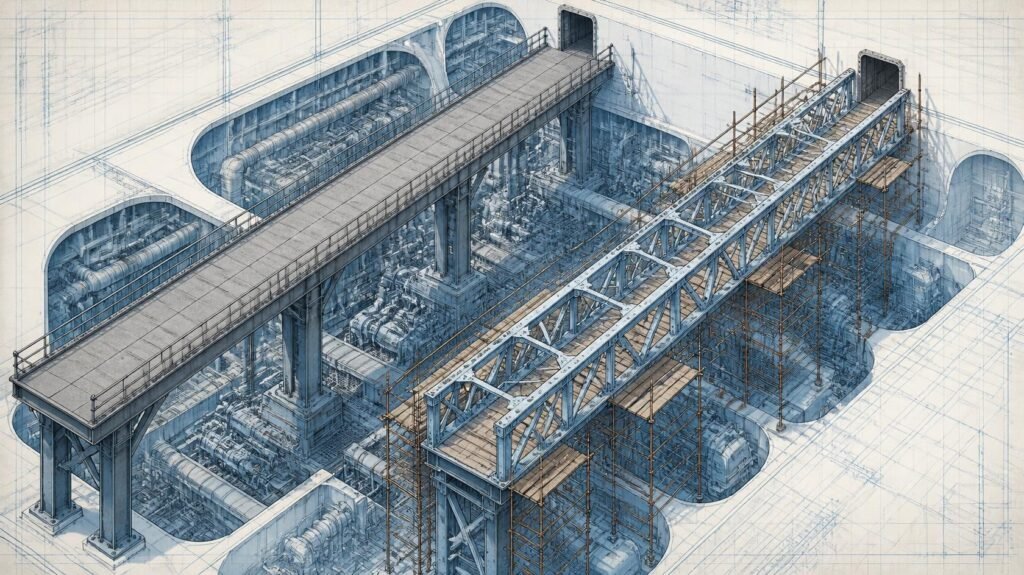
Since ammonia is not yet covered by prescriptive SOLAS legislation, most projects are approved under the alternative design and arrangements approach. II-2/17 Fire safety equal Machinery and electrical arrangements not complying with prescriptive requirements may be accepted where the safety is demonstrated to be equivalent and approved by the administration. MSC.1/Circ.1455 gives guidance on how such approvals should be managed. The “ammonia fuel safety case” is the technical contribution that supports this application, hence it should be structured purposefully to follow the order that circular sets forth.
What SOLAS II-1/55 actually permits an ammonia fuel safety case to do
The other design approach is often called a workaround. It isn’t. It is a formal, long established technique to permit an administration to adopt a unique arrangement where technology has outstripped prescriptive text. It lays out genuine and precise obligations. The departure must be specifically specified, equivalence must be proven by engineering study, and the approval is specific to that ship, not the concept in general. That’s why you can’t just wholesale copy a “ammonia fuel safety case” between sibling vessels without a written examination of everything that changed.
Demonstrating equivalence inside the ammonia fuel safety case
Equivalence is a relative statement and so requires a standard. MSC.1/Circ.1687 benchmarks against comparable traditional oil-fuelled machinery. That sounds easy until you quantify it, because the diesel baseline has decades of casualty data and your ammonia design has none. Most initiatives deal with this by combining quantitative risk assessment against acknowledged individual and societal risk standards with qualitative reasoning on intrinsically safer design. A credible “ammonia fuel safety case” is one that sets its benchmark in the open, acknowledges all data sources it draws from, and never masks engineering judgement as accurate computation.
What flag and class actually want to see
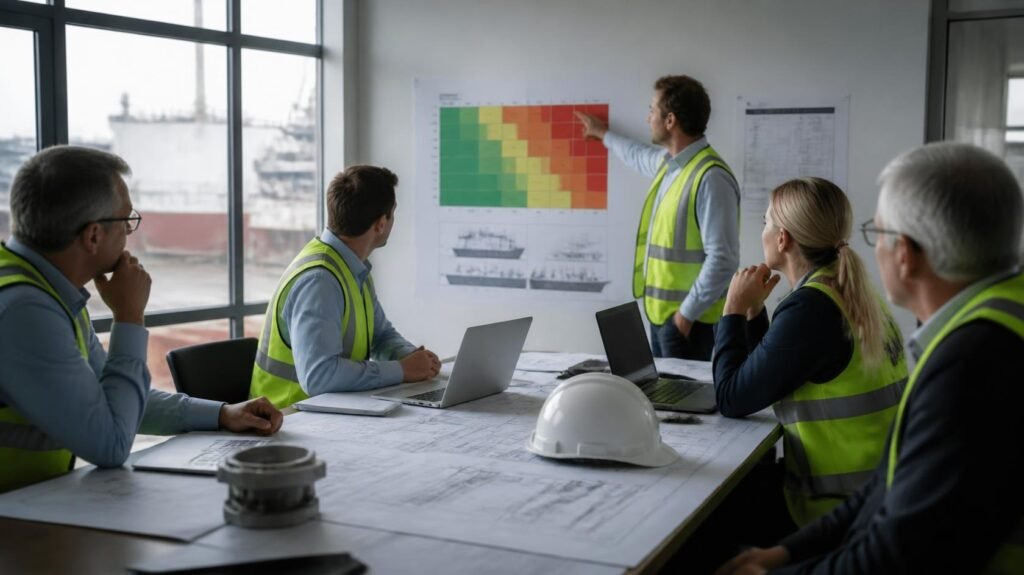
Flag and class read the identical “ammonia fuel safety case” for different reasons. The administration determines whether to award statutory equivalence and takes the regulatory exposure. Depending on the class society the arrangement may require approval and the vessel may need to participate in risk workshops as a technical participant. Owners who do one document for both audiences (without understanding that division) typically get two incompatible sets of comments and waste a quarter in rework, just when the yard is demanding frozen drawings and equipment orders.
The flag administration's reading of your ammonia fuel safety case
Flags differ widely in hunger and technological capacity. Some have in-house technical divisions and challenge assumptions directly. Others outsource to a recognised organization and merely check the summary. What they always want is traceability. They want the hazard identified, the control selected, the residual risk estimated and the acceptance decision signed by a named person of authority. An ‘ammonia fuel safety case’ that sets out conclusions without the trail that led to them will simply be returned unread and early informal engagement with the flag reliably shortens the eventual approval timeline.
What class societies expect from an ammonia fuel safety case
Class societies have been speedier than the treaty process, with DNV, Lloyd’s Register, ABS, Bureau Veritas and ClassNK publishing ammonia-fuelled notations and rule sets. Their engineers usually chair or attend your HAZID and HAZOP so class watches the logic as it happens and not just at submission. They want clear references to their regulations, for each workshop decision to be concluded with an auditable disposition and for there to be documentation that recommendations refused on grounds of cost are taken through a documented ALARP debate inside the “ammonia fuel safety case” and not just quietly discarded.
HAZID, HAZOP, QRA and ALARP as one continuous chain

Usually these four acronyms are purchased as separate deliverables from various consultancies. In a working “ammonia fuel safety case” they create a single chain. Each link takes the output of the last. HAZID finds risks. HAZOP evaluates the design against deviation. QRA gives statistics on what survives. ALARP determines what is tolerable. If any link in the chain is broken, the argument ceases to be evidence and becomes assertion. This is precisely the flaw that an expert surveyor is trained to identify above all else.
HAZID and HAZOP as the front end of the ammonia fuel safety case
HAZID is early and broad, hopefully at concept design, when you move a bulkhead it still costs a drawing not a block. It questions what could go wrong anyplace in the fuel system, from bunkering manifold to exhaust. HAZOP is narrow and later. It takes the piping and instrumentation diagram node by node against guidewords such as more, less, reverse and no flow. Both generate acts, that is the raw material of the “ammonia fuel safety case”. Workshops without rigorous recording of actions yield attendance records, not usable evidence.
QRA and ALARP as the closing argument of the ammonia fuel safety case
Quantitative risk assessment turns surviving risks into frequency and effects, usually by release modelling, toxic dispersion analysis and fatality estimation against individual and societal risk criteria. Then the difficult question for ALARP: is it wildly disproportionate to the benefit received to reduce it further for every danger that is left? This is as much a legal judgement as it is a technical one and it needs to be put down on paper in all its rationale intact. An “ammonia fuel safety case” is not closed when risk is zero (which is impossible), but when some responsible person has signed the disproportional argument.
Where owners actually break the chain
Review every review shows the same two links fail, and neither failure is novel. One is time, where the analysis is too late to inform the decision. The other is rigour when ALARP is asserted rather than shown. Both turn out a paper which seems thorough and satisfies no one who reads carefully. An ‘ammonia fuel safety case’ put together in this manner survives internal circulation, then collapses at the flag, sometimes at the worst point in an already pressured newbuilding timetable.
The late HAZOP problem inside the ammonia fuel safety case
A HAZOP after steel is cut is a formality with a budget. By then the arrangement is set, the yard has priced the contract, and any finding calling for relocation of a fuel preparation chamber will be met by a procedural control, not a design change. Procedural controls are the bottom of the hierarchy of controls for good reason, they rely on a weary person at 3 in the morning. Mitigations stacked like that are a schedule problem for safety clothing, and reviewers see that right away.
Asserted ALARP is the most common ammonia fuel safety case failure
Almost every application says “risks have been reduced to ALARP” which is meaningless in itself. ALARP is not a statement, it is a demonstration. It requires candidate risk reduction methods to be identified, costed, analysed for efficacy and approved or rejected with the disproportion explanation captured. This is where cost pressure most commonly trumps engineering , and this is exactly what reviewers look for . Paradoxically, a “ammonia fuel safety case” demonstrating the remedies you rejected, and explaining precisely why, is significantly more convincing than one showing solely accomplishments.
What a completed dossier physically contains
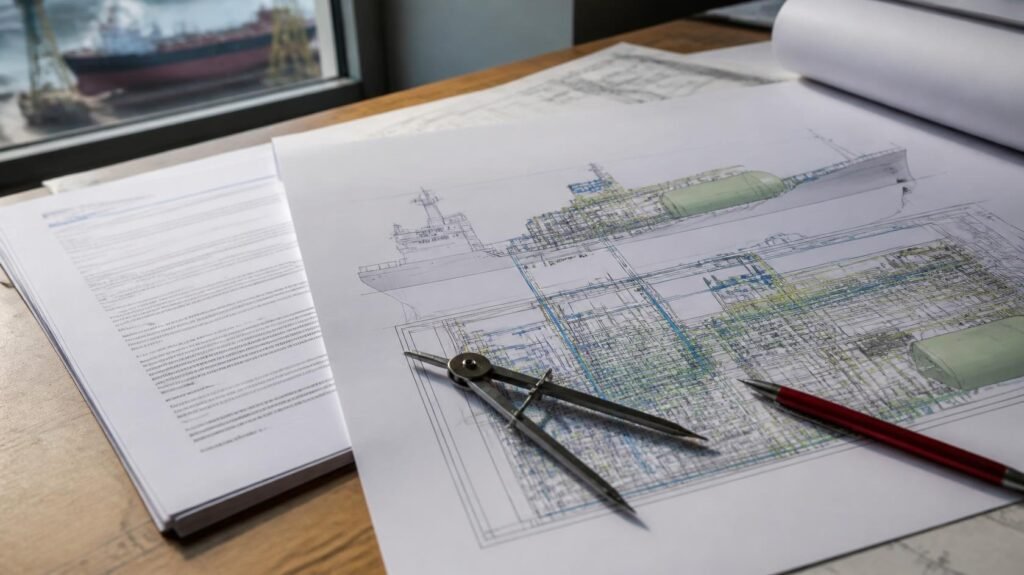
Owners often enquire what the deliverable looks like, expecting a single report. The mature ‘ammonia fuel safety case’ is a controlled document set, often a few hundred pages in a dozen component files, with a controlling summary that guides its way through the remainder. It is version controlled, it identifies its authors and approvers and it has an audit trail from workshop minute to closed action. If you can’t link conclusions back to the evidence they came from, all you have in your hand is a brochure.
The document set behind an ammonia fuel safety case
At a minimum, you should be expecting a summary and argument document, concept and detailed HAZID reports, HAZOP with a fully closed action register, QRA with dispersion modelling assumptions and inputs, ALARP demonstration register, hierarchy of controls justification, emergency response and escape philosophy, crew competence and manning assessment, materials and containment compatibility evidence and a bunkering interface and compatibility study. A well-built “ammonia fuel safety case” allows any reviewer to access the underlying information in two steps. It is a document control discipline, considerably more than a technical competence.
Keeping the ammonia fuel safety case alive after delivery
The most costly mistake is to treat the document as an approved item that goes into a drawer at handover. Each alteration, retrofit, bunkering port change, and considerable crew turnover can undo an assumption inside it. A mid-life dual-fuel conversion is the sharpest example, and Alternative Fuel Retrofitting: Evaluating the Engineering Viability of Dual-Fuel Conversions for Mid-Life Vessels shows how much of the original machinery arrangement such a project rewrites.
Assumptions about crew ability are particularly load bearing and silently erode. A live document has a nominated owner ashore, a review trigger list, and periodic revalidation cycle. Operators that set that discipline around the “ammonia fuel safety case” find the first ammonia vessel tough, and the second just a matter of details.
Conclusion
An ‘ammonia fuel safety case’ is not paper work wrapped around an engineering judgement. It’s an engineering choice. It’s written so other people can check it. No one blogs about it, because there is no clause to quote, only a shifting of the burden of evidence from regulator to owner. The underlying narrative of ammonia adoption is change. Build the ammonia fuel safety case early and keep the analytical chain unbroken and the checklist is finally what it should have always been: a downstream summary.
People Also Ask
Is an ammonia fuel safety case a legal requirement under SOLAS?
Not as a named instrument The obligation is indirect, as the alternative design approach under SOLAS II-1/55 requires demonstration of equivalency and this paper is what demonstrates it. However, in practice it is treated as de facto essential by flags and class societies.
When should work on the ammonia fuel safety case begin?
At concept design, before the general arrangement is finalised. Then early HAZID discoveries can still affordably move bulkheads. It began after the steel cutting and can only add procedural controls, the weakest and most expensive kind of mitigation accessible to any project wherever.
Can an ammonia fuel safety case be reused across sister ships?
Sort of. Hazard analysis and much of the modelling is transferable, but approval is for a particular ship, arrangement and operational profile. Any reuse of prior work must have a documented delta assessment in the trade route, bunkering ports, crewing arrangements and every design change.
Who should own the ammonia fuel safety case inside an owner's organisation?
Named person ashore with technical authority, normally fleet technical or HSEQ rather than newbuilding. Because the paperwork has to survive delivery. At handover the newbuilding teams separate, and an unowned document quietly rots into an unusable piece of history that no one reads.