Introduction
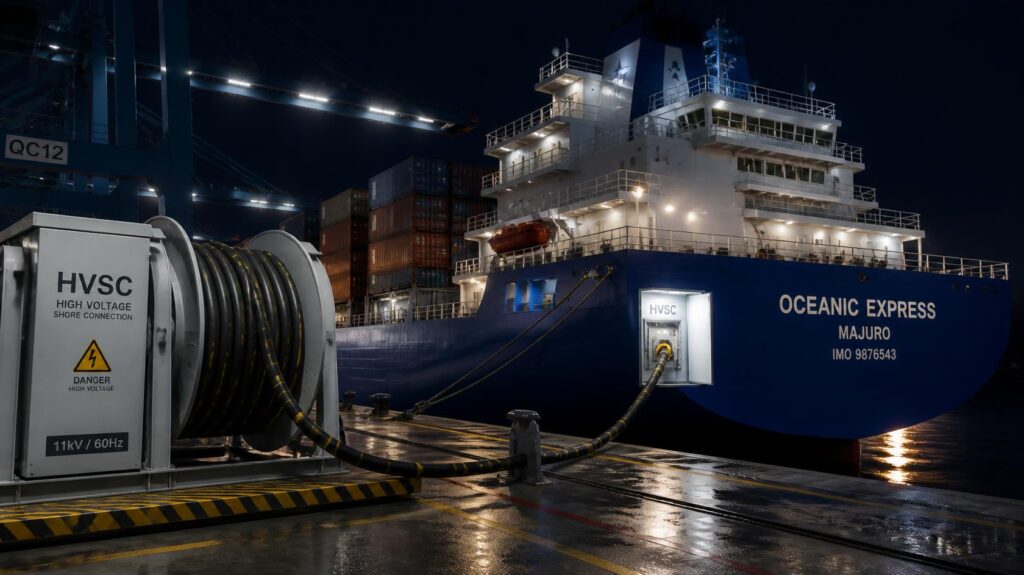
Port congestion and long mooring delays are a major structural impediment to commercial vessel compliance within modern international emissions accounting regimes. Auxiliary engines, running constantly to supply electrical power while a ship is at berth or at anchor, use fuel but do not provide any nautical miles of transit distance. The operational difficulty is solved by Alternative Marine Power Retrofits: Removing the “Zero-Distance” Anchor Penalty via Shore-Side Connectivity.
As highlighted in Assessing High-Voltage Shore Connection Safety: An In-Depth Study of Grounding Practices in Shore Power Systems, fitting onboard high voltage shore connection (HVSC) switchboards, motorised cable reels, step-down transformers and automated synchronisation controls allows vessel operators to shut down the diesel auxiliary generators entirely during port calls. Targeted “Alternative Marine Power Retrofits” provide for a smooth “cold ironing” that turns off portside engine emissions and protects the vessel’s Annual Efficiency Ratio (AER) index from harsh rating penalties.
The Heavy Mathematical Penalty of Stationary Fuel Consumption
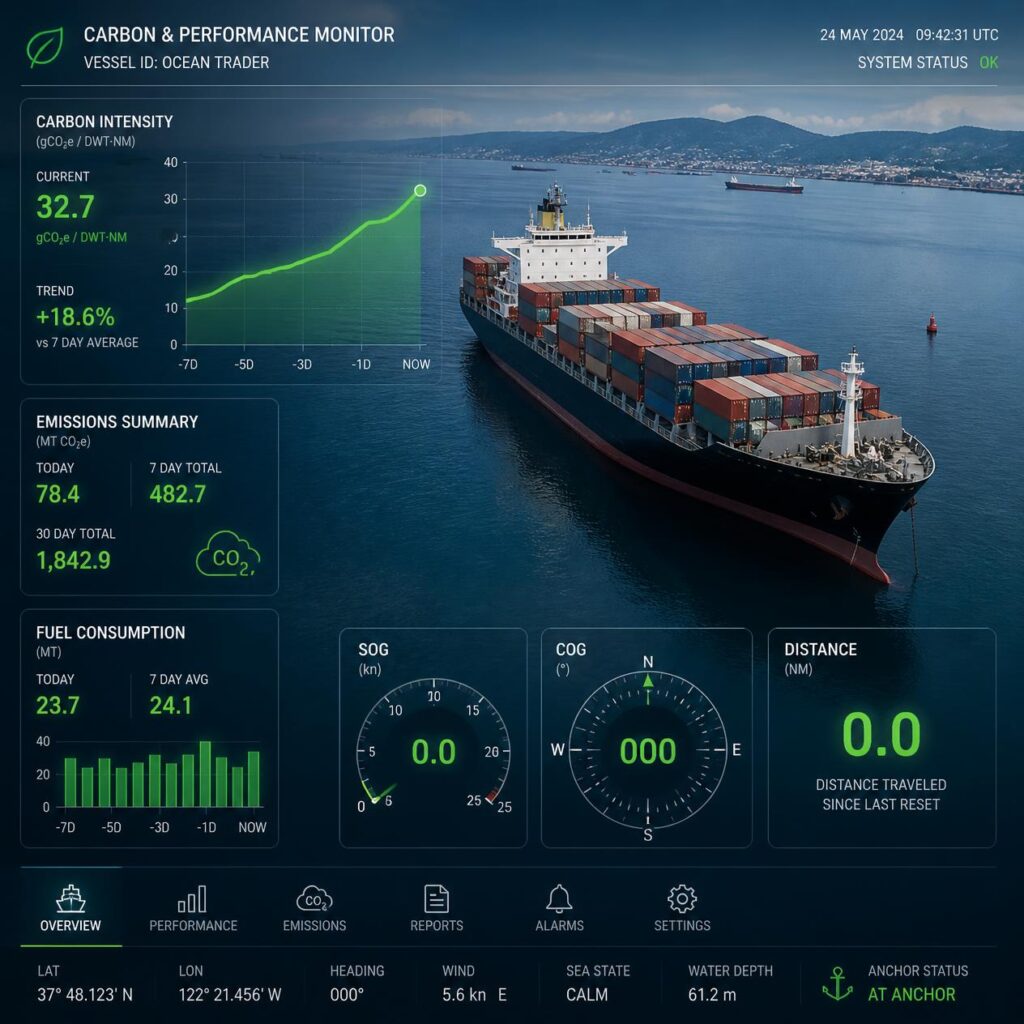
The Annual Efficiency Ratio framework assesses operational carbon intensity as the total mass of CO2 emissions divided by the product of deadweight tonnage and distance travelled. When a yacht is anchored or moored for long durations, the auxiliary diesel generators are continuously burning fuel to power hotel loads, ventilation fans and cargo reefer units. This zero-distance fuel burn is added to the numerator of the AER equation but does not contribute to its denominator, which accelerates yearly rating depreciation. The execution of systematic “Alternative Marine Power Retrofits” removes this mathematical trap allowing technical managers to reduce in-port emissions altogether through shore grid power connection.
Eliminating the Zero-Distance Fuel Burn Trap
When in port, auxiliary generators burn fuel oil, producing more than three tonnes of localised carbon dioxide emissions and particulate matter and nitrogen oxides for each metric tonne of fuel oil burnt. On huge container tankers or passenger ships that need multi-megawatt hotel electricity, port stays can use dozens of tonnes of petroleum without moving the ship a single meter. Ships can shut down auxiliary engines entirely while moored by installing suitable “Alternative Marine Power Retrofits.” Removing in-port combustion using “Alternative Marine Power Retrofits” protects the vessel’s carbon score from zero distance penalties.
Mitigating Port Congestion and Anchorage Delay Risks
Global supply chain bottlenecks often mean commercial tonnage has to wait at anchor for days before getting a berth, adding to daily auxiliary engine emissions. Conventional compliance solutions do not protect from these administrative delays and leave the vessel’s environmental rating subject to port congestion. “Alternative Marine Power Retrofits” enable fleet assets to connect directly with shore grids or off-shore power barges, as the infrastructure evolves. You will not suffer catastrophic downgrades to annual compliance ratings from extended port stays by using “Alternative Marine Power Retrofits”.
Onboard System Architecture for High-Voltage Shore Connections
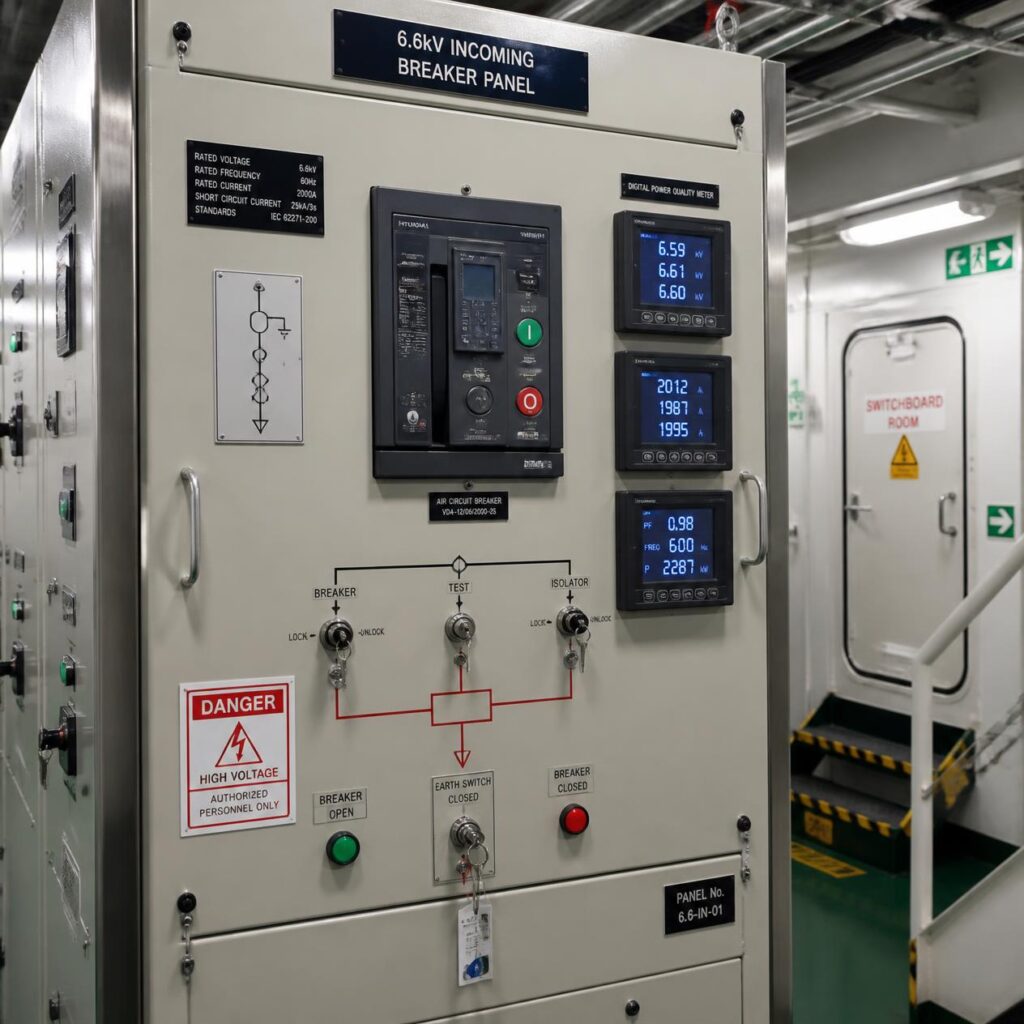
For existing ships, the installation of high-voltage shore connection infrastructure requires a robust electrical architecture constructed to international standards such as IEC/IEEE 80005-1. The shipboard system must be capable of accepting high voltage electrical power (normally 6.6 kV or 11 kV) direct from shore substations and to properly convert and distribute this power to the ship’s main switchboard. Important hardware elements are a dedicated HVSC switchboard (with step-down power transformers), interlock safety relays and automatic circuit breakers. Ships can be retrofitted with “Alternative Marine Power Retrofits” that provide the actual hardware to safely transfer high capacity energy.
Designing High-Voltage Switchboards and Step-Down Transformers
Shore power grids transmit energy at high medium voltage levels in an effort to reduce the width of the cables and the weight of copper while handling. The power is fed to the HVSC system onboard from dedicated medium voltage switchboards with vacuum circuit breakers and protection relays. The onboard step down transformers then down the voltage to conventional marine working levels, such 440V or 690V. Customised “Alternative Marine Power Retrofit” designs match transformer dimensions and cooling topologies to the entire electrical demand of the vessel. The incorporation of step-down units into “Alternative Marine Power Retrofits” allows a smooth power distribution with no overloading of shipboard sub-circuits.
Galvanic Isolation and Neutral Grounding Relays
Connecting the electrical ground of a floating vessel directly to a shore-side power grid creates severe electrical safety issues, including galvanic corrosion and circulation fault currents. Inclusion of a dedicated isolation transformer in the onboard system with Neutral Grounding Resistors (NGR) and neutral disconnect switches can eliminate these dangers. Galvanic protection is included in Alternative Marine Power Retrofits to isolate the hull of the vessel from stray DC currents and prevent catastrophic short circuits. “Alternative Marine Power Retrofits” discuss tight grounding methods protecting crew people and electrical devices during high-voltage cold ironing.
Motorized Cable Management Systems and Deck Receptacle Engineering
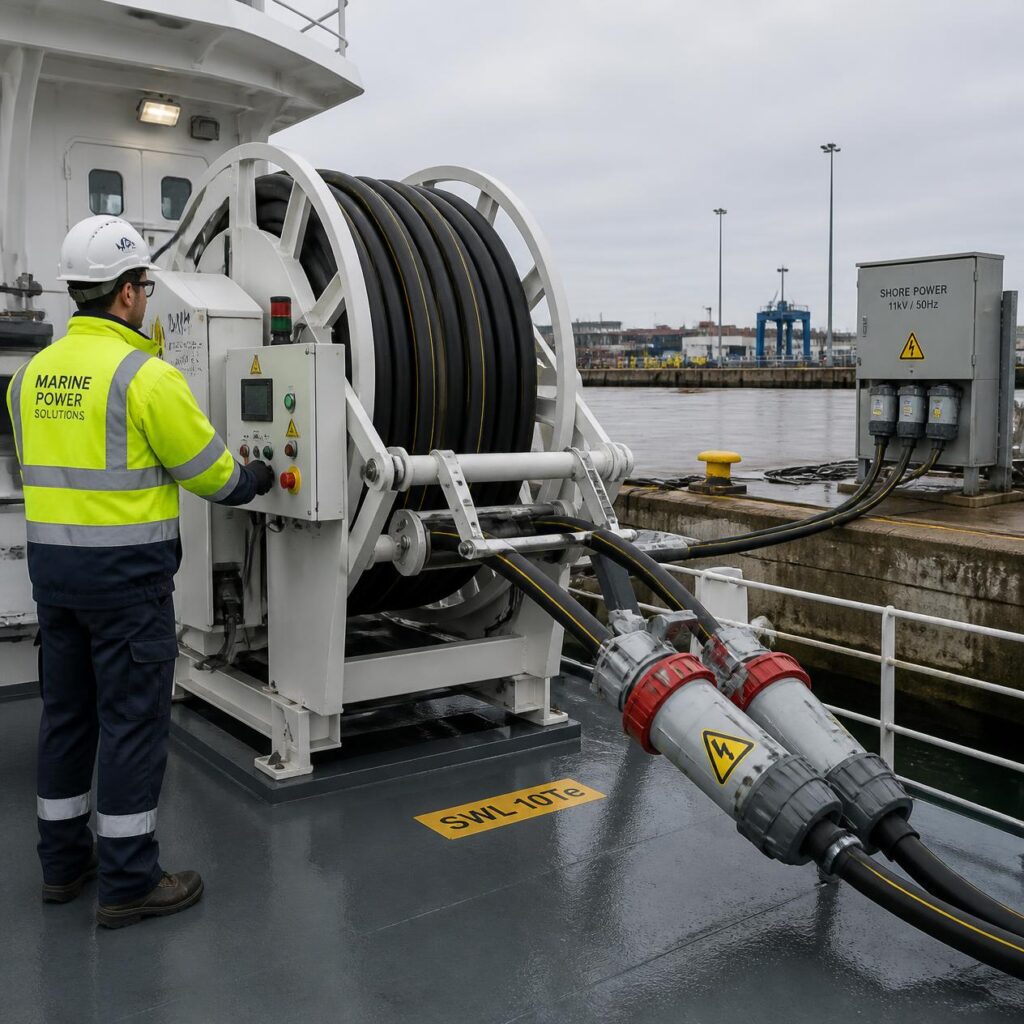
On open ship decks, massive multi-core high-voltage electrical cables necessitate the use of automated mechanical cable management systems (CMS) specifically built to survive extreme maritime environments. Flexible power cables are lowered or extended from the ship’s deck to the quay by cable reels or spools, to compensate for tidal shifts and variations in draft during cargo operations. Receptacle sockets shall have arc tested enclosures, mechanical safety interlocks and fiber-optic control cores to guarantee continuous pilot loop integrity prior to energising. “Alternative Marine Power Retrofits” with deck-mounted cable reels provide safe and efficient physical shore connection.
Motorized Cable Reels and Tidal Compensation Mechanics
Modern cable management systems utilise variable speed electric or hydraulic drives which automatically regulate the strain on the cable when the vessel lowers or rises with the tide. This continuous surveillance of the tension will prevent cables from dragging into the port waters or breaking under high tension during the unloading of cargo. Deck crews find it easier to dock and have less work to perform when motorised spools are installed as part of “Alternative Marine Power Retrofits.” The installation of “Alternative Marine Power Retrofits” automatic cable reels guarantees secure, resilient and unattended connectivity for the whole port call of the vessel.
Pilot Core Control and Equipotential Bonding Safeguards
Standard shore power cables comprise the main power conductors, dedicated pilot cores and fibre-optic connectors, providing a continuous safety interlock circuit. If a cable is unintentionally pulled or physically unplugged while live the pilot circuit opens immediately, tripping the main shore breaker before physical disconnection occurs. “Alternative Marine Power Retrofits” with automatic pilot interlocks prevent harmful high voltage electric arc flashes. The same electrical voltage between the hull and the quay is guarantyd by “Alternative Marine Power Retrofits”, making it absolutely safe for the crew.
Frequency Conversion and Seamless Power Synchronization
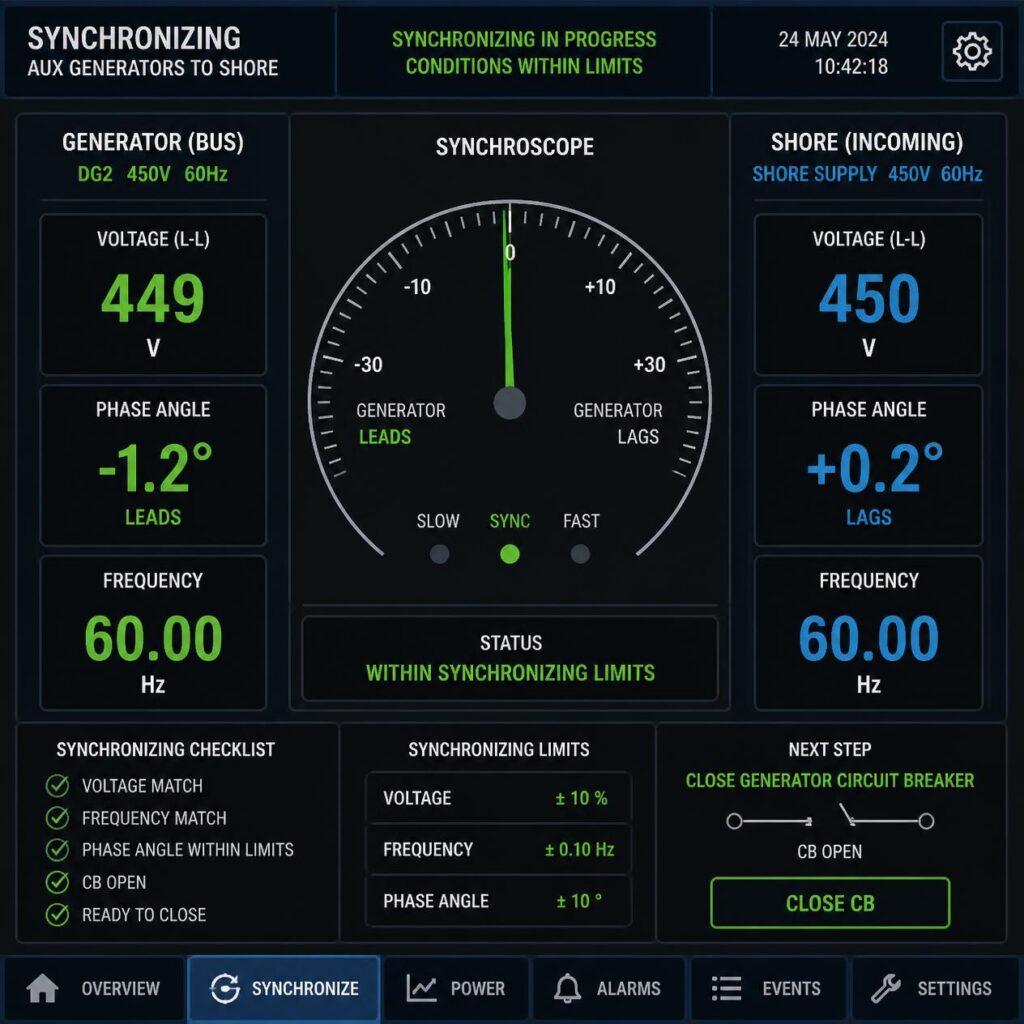
One of the biggest electrical compatibility challenges in global maritime operations is that commercial ports operate on either 50 Hz or 60 Hz shore grids, whereas shipboard electrical plants are set to certain frequencies. Shipboard equipment like pumps and compressors won’t work right . There is no way for a 60 Hz ship to connect to a 50 Hz grid without frequency conversion . The load transfer from operating auxiliary generators to shore power has to be done by short-time parallel synchronisation in an effort to avoid complete electrical blackouts. Advanced “Alternative Marine Power Retrofits” have removed frequency mismatches and enable seamless zero blackout power transfers to be implemented.
Managing 50 Hz to 60 Hz Frequency and Voltage Matching
Run the shipboard electrical grid on the wrong power frequency , and the induction motors and electronic controls will overheat and fail mechanically . Since no static frequency converters are available on shore-side substations, vessels are required to install converter units on board or to use containerised frequency conversion modules. “Alternative Marine Power Retrofits” that incorporate flexible frequency management enable ships to berth at any commercial terminal in the world, regardless of the local grid standard. Multi-frequency Alternative Marine Power Retrofits provide global trade flexibility and uninterrupted shore access.
Zero-Blackout Parallel Synchronization Protocols
To connect an incoming shore supply to an active shipboard bus bar, the phase sequence, voltage amplitude and frequency must all be within established thresholds. The running diesel generators are speed controlled by automated synchronisers to match the phase of the generator voltage with the incoming shore electricity prior to closing the shore breaker. In “Alternative Marine Power Retrofits” automated synchronisation allows a “bumpless” transfer of the ship’s electrical load. Closed-loop synchronisation with “Alternative Marine Power Retrofits” enables supplementary engines to be seamlessly turned down without disrupting vital navigation or cargo systems.
Regulatory Mandates and Regional Cold Ironing Enforcements
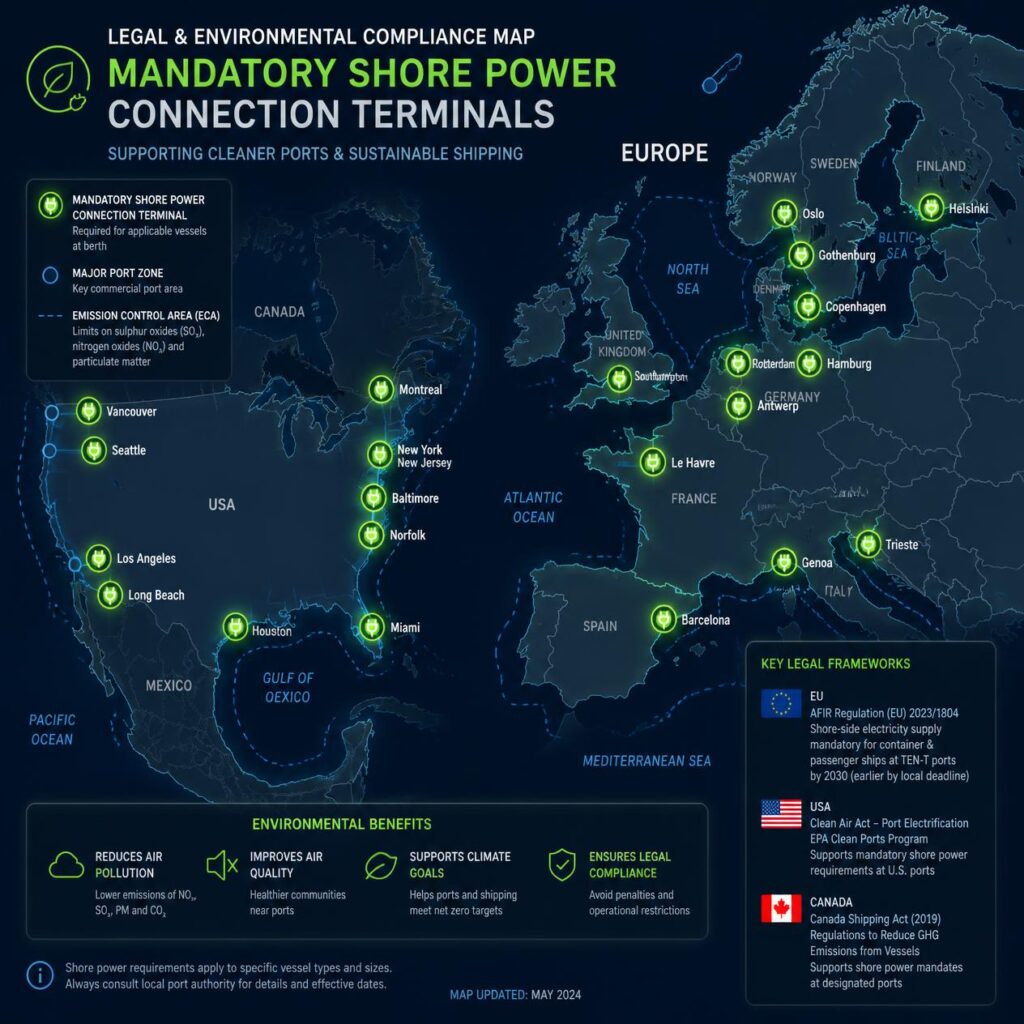
“The rapid uptake of shore power connectivity across key international trade corridors is being driven by regional environmental legislation. Regulatory regimes such as the European Union’s FuelEU Maritime and California’s CARB At-Berth Regulation require container, passenger and Ro-Ro vessels to plug into shore power when at berth. Non-compliance can result in large financial penalties, operational restrictions or refusal of access to ports. Certified Alternative Marine Power Retrofits enable shipowners to avoid regulatory non-compliance and to retain access for their ships to the main commercial markets.
Meeting EU FuelEU Maritime and CARB At-Berth Mandates
Strict regional air quality rules force ships stopping at major ports to remove in-port emissions or pay growing carbon charges. California’s CARB standards require near-zero emissions at berth while the EU requires use of shore power at the key ports of the TEN-T network. Standardised “Alternative Marine Power Retrofits” bring vessel infrastructure into alignment with these mandated regional compliance regimes. Utilising certified Alternative Marine Power Retrofits avoids hefty financial fines and retains the vessel’s eligibility to operate in premium commercial jurisdictions.
Securing Environmental Port Fee Discounts and Incentives
Major port authorities throughout the world give significant financial savings on port harbour dues for vessels having approved cold-ironing capabilities. Tonnage showing active use of shore power obtains high marks on the Environmental Ship Index (ESI), which translates into direct operational cost refunds. Implementing proven Alternative Marine Power Retrofits saves money right away by reducing port invoicing costs. The use of tried and tested “Alternative Marine Power Retrofits” improves the company sustainability indicators and makes the asset much more attractive to green charterers.
Capital Expenditure, Operational Savings, and Payback Cycles
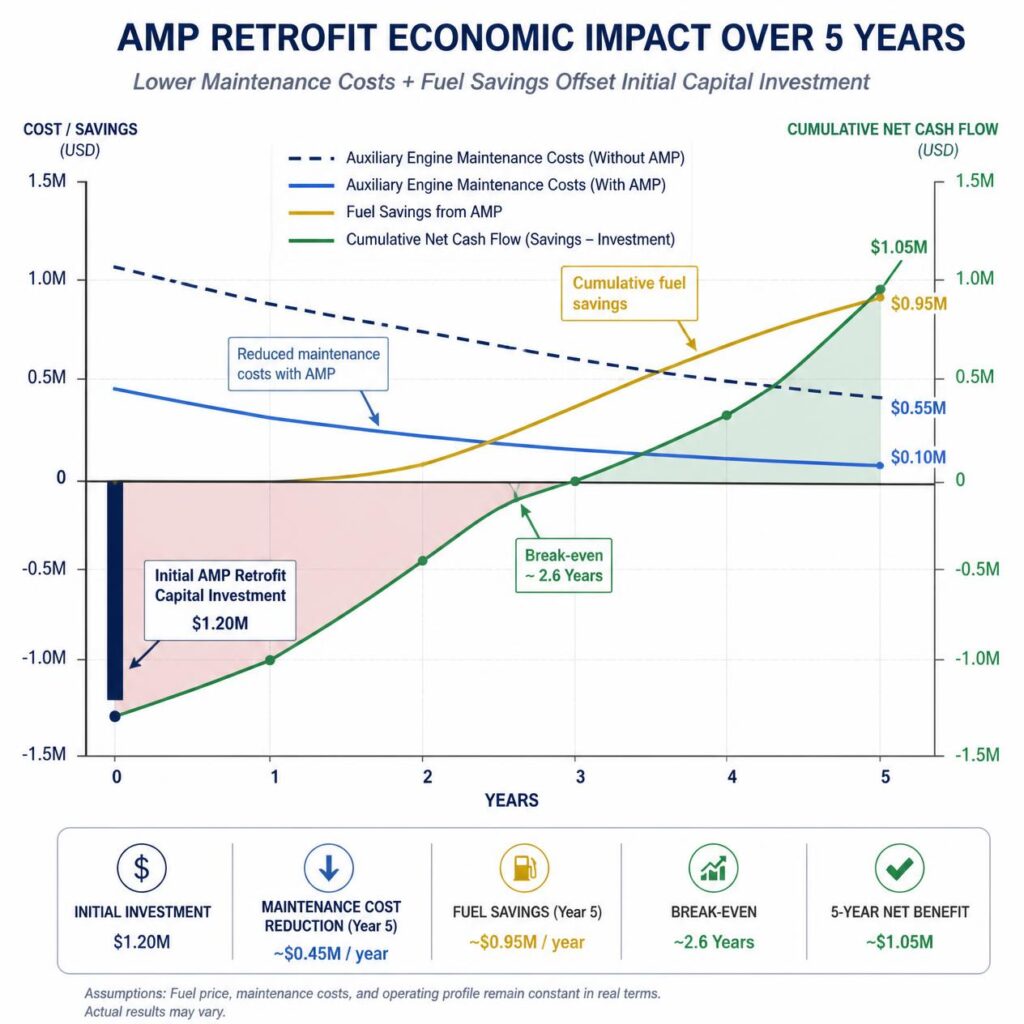
The retrofitting of existing vessels with high voltage shore connection equipment needs significant up-front capital expenditure in the form of hardware buying, structural alterations to the deck and installation during dry-dock. However, the substitution of expensive onboard marine petrol oil (MGO) or ultra-low sulphur fuel oil burning with cheap grid energy leads to huge savings in daily operational costs during long port stays. In addition to this, the auxiliary generator shutdown minimises engine running hours, increases maintenance intervals and reduces overhaul costs. “Alternative Marine Power Retrofits” offer substantial financial returns and eliminate zero-distance carbon emissions.
Calculating Fuel Savings and Electricity Cost Differentials
The main economic benefit of cold ironing is the difference between the cost of refined marine fuels used in tiny onboard engines and bulk utility power supplied by shore grids. “Electrical fuel savings quickly add up to hundreds of thousands of dollars on vessels spending 50 to 100 days in port per year,” says Kwan. Specially designed “Alternative Marine Power Retrofits” can realise the greatest operational savings at every shore power equipped berth. Economical “Alternative Marine Power Retrofits” are implemented for rapid capital recovery within three to five years of continuous service.
Extending Auxiliary Engine Overhaul Intervals and Lifespans
At low or varying loads during port visits, auxiliary diesel engines might suffer from incomplete combustion, carbon build-up and quick lubricating oil degradation. When in port, you can turn down your generators, which greatly reduces the total number of hours your engines are running and can stretch thousands of hours between overhauls (TBO). Add long-term maintenance savings to “Alternative Marine Power Retrofits” to reduce lube oil and replacement parts consumption. “Alternative Marine Power Retrofits” extend generator life, preserving essential engine room capital assets.
Future-Proofing Fleet Infrastructure for Grid Decarbonization
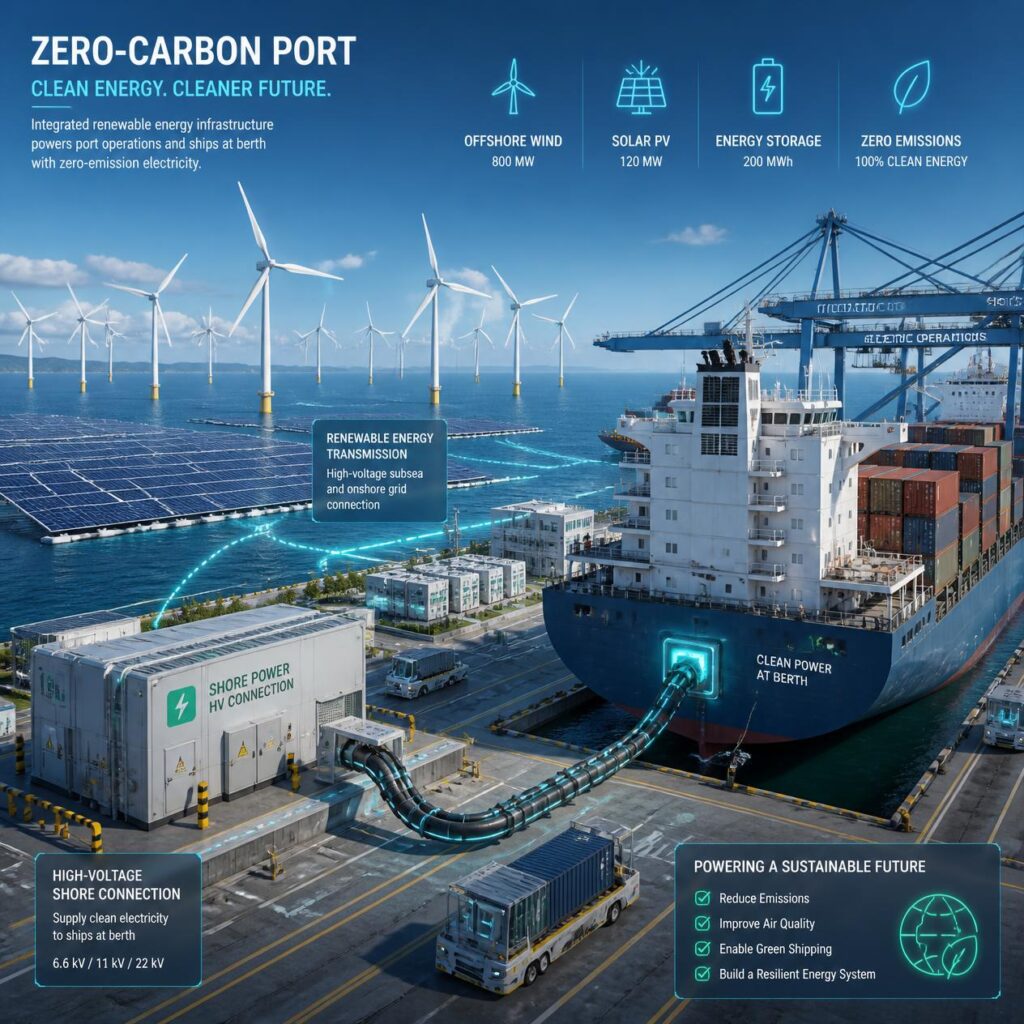
As the land-based electricity grid is fed increasingly by renewable sources – wind, solar, and hydro – the net environmental benefit of cold ironing increases exponentially. Shore power. Connecting ships to zero-carbon shore power grids removes both net lifecycle carbon emissions and local air pollution at port. Additionally, the shore connection infrastructure onboard may be altered to charge hybrid battery energy storage systems or to support shore-to-ship microgrids. “Alternative Marine Power Retrofits” to upgrade assets with scalable options for long-term operational resilience in the ongoing global energy transition
Leveraging Terrestrial Green Energy Grids
Connecting a vessel to a clean renewable energy powered grid means a ship can be a zero emission asset while in port. This total absence of port-side combustion delivers an immediate benefit under lifecycle carbon accounting schemes such as FuelEU Maritime. Modern “Alternative Marine Power Retrofits” are designed to communicate with the smart grid, so vessels can adjust their power intake based on real-time grid carbon intensity. Flexible “Alternative Marine Power Retrofits” create a direct connection between marine transport and green energy infrastructure.
Integrating Battery Storage Charging Capabilities
The next generation of shore power connections is designed not just to power hotel loads, but also to charge massive on-board battery energy storage systems (BESS). Hybrid and completely electric vessels charge their energy storage banks during brief port calls using high-capacity shore power connectors, enabling zero-emission harbour transits.
When deployed alongside thermal management solutions like Waste Heat Recovery Systems: Capturing Thermal Exhaust Loss to Unburden Auxiliary Boiler Fuel Burn, multi-functional “Alternative Marine Power Retrofits” are being developed to prepare fleet assets for future hybrid propulsion improvements. Commercial shipping fleets stay competitive, compliant and commercially viable for 2030 and beyond with the push for scalable “Alternative Marine Power Retrofits”
Conclusion
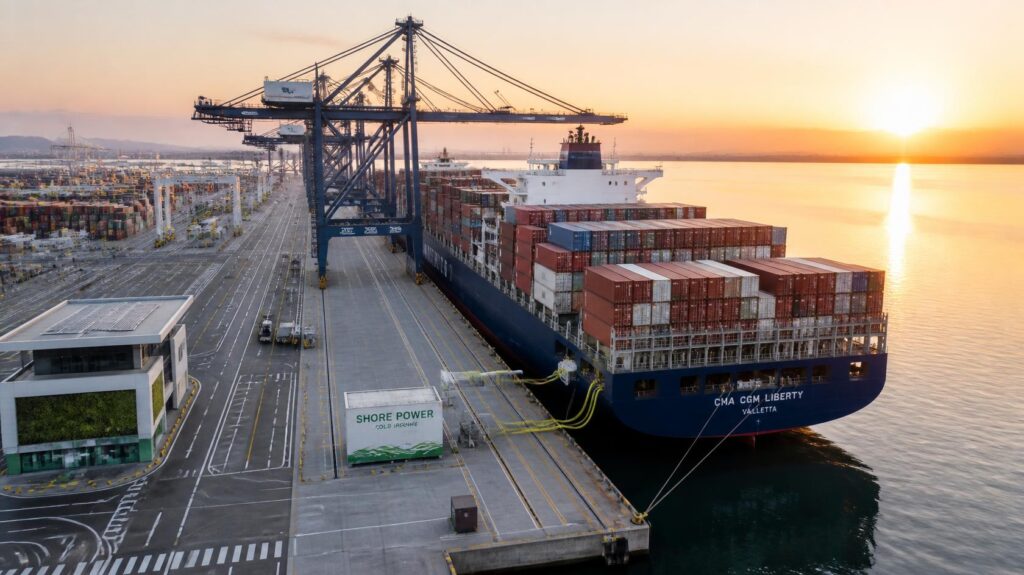
For modern ship management teams, a vital priority is the removal of the harsh zero distance compliance penalty attached to stationary port fuel burn. With worldwide pollution standards tightening and regional cold ironing restrictions coming into place, it is no longer commercially viable to run auxiliary engines continually while at berth. The installation of High Voltage Shore Connection switchboards, motorised cable reels and automatic synchronisation systems allow warships to turn off auxiliary diesel engines completely when in port. “Alternative Marine Power Retrofits” means immediate savings on fuel costs, longer life for auxiliary engines, and protection of the vessel’s AER rating.
People Also Ask
How do Alternative Marine Power Retrofits eliminate the zero-distance AER penalty?
“Alternative Marine Power Retrofits” allow vessels to link into shore grids and totally turn off auxiliary generators when in port. This removes static fuel consumption, so that emissions at zero distance do not skew the AER estimate.
What main hardware components are included in Alternative Marine Power Retrofits?
Standard “Alternative Marine Power Retrofits” feature a shore connection switchboard, a step-down power transformer, a motorised deck cable reel, control pilot core interlocks, and automatic synchronisation panels.
Can Alternative Marine Power Retrofits handle frequency differences between ship and shore?
Yes. “Alternative Marine Power Retrofits” may comprise static frequency converters or connection to shore-side power conversion devices to seamlessly adapt 50 Hz or 60 Hz shore supply to the ship’s grid.
How long is the payback period for Alternative Marine Power Retrofits?
The payback period for “Alternative Marine Power Retrofits” is typically 3-5 years, due to lower shore electricity prices relative to marine fuels and cheaper auxiliary generator overhaul costs.