Introduction

Good ammonia initiatives fail in a specific way, and it is silent. The danger analysis is comprehensive. The Risk Register is closed. The flag says yes. Then the ship comes into service, and six months later a top engineer is signing off on a detector which has been in fault for six weeks, because the spare cell is on back order. The safety case did not foresee any of this, because the safety case had considered the “ammonia gas detection system” as a box on a diagram, not as a machine with a service life.
This is the least talked about failure mode in ammonia transportation. Detection is the gating factor for practically every other mitigation. Automatic isolation requires a detector to trigger it. To increase ventilation, you need a detector to activate it. We need a detector to indicate crew evacuation needs. But detection is frequently specified late, is placed in whatever space is left over after the piping is routed, and is supported by individuals who were never told what the setpoints signify.
The case here is simple. Design decisions have repercussions that outlive the newbuilding team—from where to place the sensors, to what technology to select, to how to vote them and how often it is reasonable to calibrate them. An “ ammonia gas detection system ” that is an afterthought will be neglected in service, and an ignored detector is protecting nobody.
What follows ranges from technology selection to placement logic, voting and shutdown thresholds to the calibration burden and the alarm fatigue that softly stops detection long before anything ever leaks.
Table of Contents
Why detection is where a paper safety case quietly fails
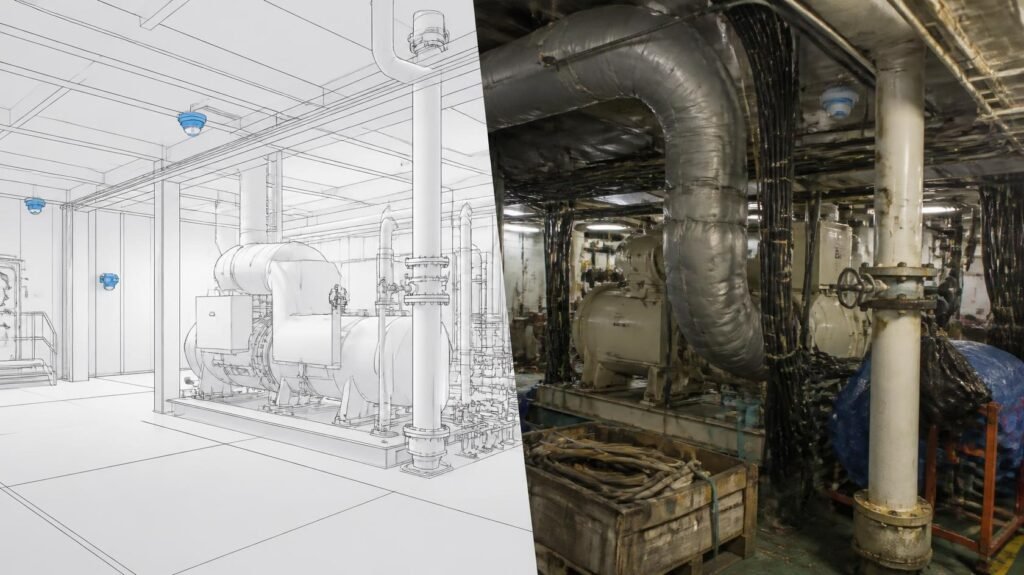
Every barrier in a risk assessment includes an implicit assurance that it will still be operational in year seven. For most barriers that promise is reasonable, for a bulkhead does not move. A sensor cell does . The only major mitigation in the fuel chain that continuously degrades, consumes spares, requires regular care and can fail in an undetectable manner is a “ammonia gas detection system”. The asymmetry is why detection warrants design effort commensurate with its importance, not its cost.
The gap between the drawing and the ammonia gas detection system in service
In the general configuration each detector is a neat symbol in empty space. On the vessel itself, the same detector may be behind a lagged pipe run, up above a walkway where no one can reach it without staging, or in the wash-down route of a cleaning hose. None of the conditions are anywhere in the danger analysis, yet each one decides if the device is actually maintained. A reviewer who accepts a detection schedule without enquiring how a rating will physically go to each device is accepting a promise that cannot be fulfilled.
Detection as a barrier the ammonia gas detection system must actually prove
Barrier thinking only works if each barrier can be shown to be independent. The proof is a pressure test on a gastight border. For detection it is availability across time, which is much more difficult to demonstrate. Ammonia Detection System Standards and Design Specifications fixes placement, setpoints and calibration intervals, but not whether anyone kept to them. The honest questions are how many detector-hours were lost to problems last year, how many alerts were checked, how many were disregarded. Most operators can’t answer, because no one planned the reporting. Barrier availability assumed is barrier availability never measured. One hurdle on paper is a “ammonia gas detection system” that nobody audits.
Sensor technologies and what each can genuinely do
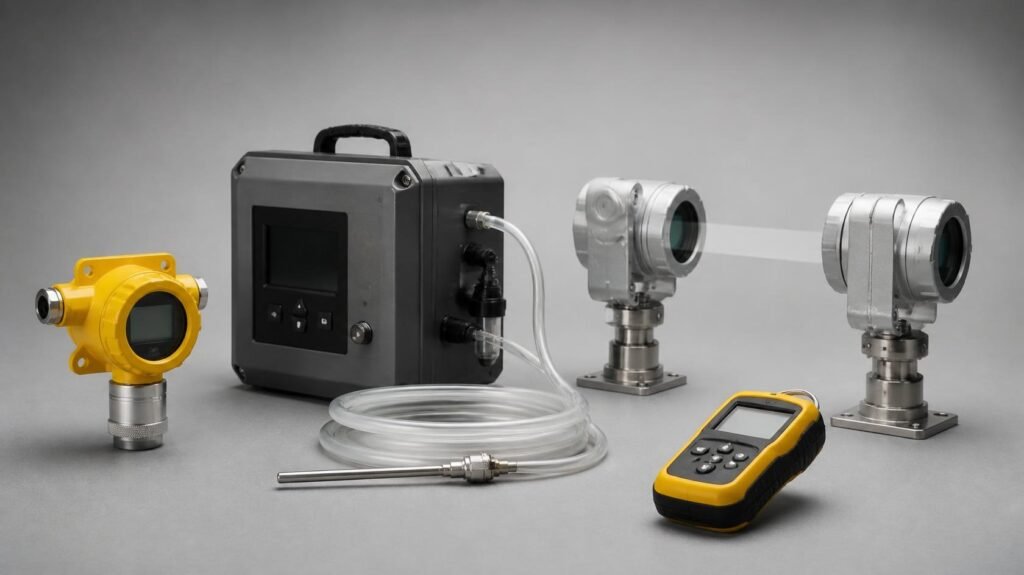
No one technology provides the whole variety of concentrations that an ammonia vessel needs. So a credible “ammonia gas detection system” is one that purposefully mixes technologies matching each to the range and environment it has to survive in. Personnel protection at low ppm levels is dominated by electrochemical cells. Higher bands are handled via catalytic bead and infrared techniques. Open-path laser instruments measure lines of sight over open spaces. Acoustic devices listen for pressurised escapes that no point sensor could reach in time. This is a conscious architecture decision, not a catalogue decision.
Electrochemical cells at the heart of the ammonia gas detection system
Electrochemical sensing is suitable for most marine applications below around one thousand parts per million, has limited cross-sensitivity, rapid response and adequate service life. Typical published specifications indicate a detection limit of five ppm, alarm response in seconds at several times the alarm threshold, and default measuring ranges of one hundred ppm configurable upward for higher-setpoint spaces. Those values are important since they define what your lowest alarm can realistically be, and a setpoint below the detection limit is worthless, no matter what the “ammonia gas detection system” schedule may say.
Infrared, laser and acoustic layers within an ammonia gas detection system
Photoacoustic infrared sampling devices extract air from many sites to a central analyser and provide good sensitivity over several zones from one instrument. Open-path laser detectors shoot a beam across a region and detect ammonia by its spectral fingerprint, eliminating nuisance alarms and covering places no point sensor can. Ultrasonic acoustic detectors are sensitive to the noise of a pressured release rather than concentration, and hence alarm before any gas reaches a sensor at all. Each layer addresses a separate question. A complete “ammonia gas detection system” requires several.
Fixed installation versus portable instruments
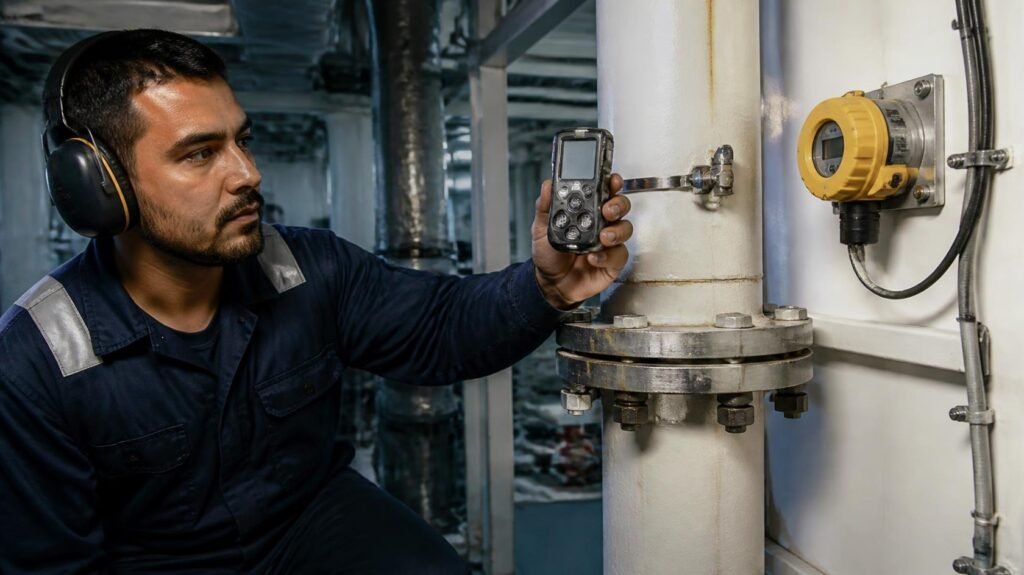
They are complements, not substitutes, and mistaking the two leads to dangerous gaps. Fixed detection is continuous, unattended, logged coverage linked into the control system and is the portion of the “ammonia gas detection system” that can trip a shutdown. Portable devices allow measurements to be taken where ever a person happens to be standing, even where no fixed sensor is present. A vessel needs both and the safety argument should make it clear what specific danger each of the two is there to address.
What fixed coverage asks of an ammonia gas detection system
The regulatory weight is on fixed detection. First of all, the layout has to meet class standards that specify the locations of the detectors, the alert levels and the reactions necessary. Also, fixed units are burdened with automation, as only a hard wired signal can shut a master valve or start an extraction fan. The design implication is that fixed detection must be stated before the cable routing is frozen and not negotiated into leftover space later. The “ammonia gas detection system” in the residual volume is damaged before to commissioning.
Portable instruments as the human layer of the ammonia gas detection system
People go where sensors are not . Hence the existence of portables . Somebody has to know the concentration at that area at that moment before they go into a poisonous space, before they break a flange, before a confined space permit is issued.” This leads to constant individual protection with personal monitors affixed to coveralls. The design choice is how many instruments, where they are stowed, who calibrates them and if the docking stations that verify them are put wherever a watchkeeper will really walk. Portables are the “ammonia gas detection system” portion carried by individuals.
Placement logic, source spaces first
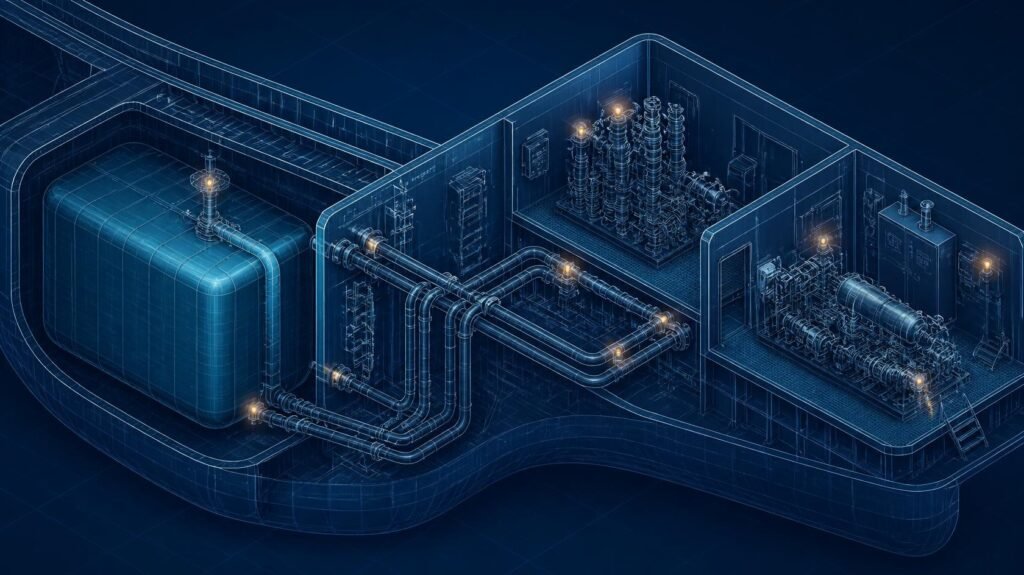
Placement is the most typically delegated component to an electrical draughtsman and deserves a process engineer. Logic is out of source. An “ammonia gas detection system” should be in every area where a release can occur, every direction that released gas will travel, and every opening through which it could enter anywhere people dwell. Miss any of the three and coverage seems comprehensive on a schedule but leaves a corridor of blindness in reality.
Source spaces the ammonia gas detection system cannot omit
“Start with the enclosures that were purposely built to contain a release. The annular space of double-walled piping needs to be monitored, because the void is there *to capture the first leak*. There are credible release points in the tank connection space, the gas valve unit room and the fuel preparation room in the form of flanges, valves and instrument connections. Detection turns an assumption into knowledge someone can act on . The containment philosophy expects that a leak will be captured somewhere. “ammonia gas detection system” is blind when you miss one where issue was to be predicted.
Travel paths and ingress points across the ammonia gas detection system
Then follow the gas. Extraction outlets and ventilation ducts sweep released vapour away and are natural sample places. Bilge wells collect both the liquid and the vapour above it. They are low, which is important since a cold flashing discharge acts as a dense gas, but ammonia vapour is lighter than air. That one physical truth means sensors are needed at the top and bottom, not one or the other. The last line of the ‘ammonia gas detecting system’ protecting the people is the accommodation air intakes. Who happens to be asleep.
Voting, cascades and the shutdown decision

Detection is engineering when it is coupled to consequences. The interim rules provide for localised alarms around 25 ppm, broad alarms at around 110 ppm and system shutdown at about 220 ppm. Underneath that waterfall is the voting algorithm that says how many sensors have to agree before something happens. Together they decide if the “ammonia gas detection system” is crying wolf all the time, shutting the ship down for no good reason or waiting too long to respond. The real design challenge is avoiding all three at the same time.
Voting logic and redundancy inside the ammonia gas detection system
A single detector commanding a shutdown is a single point of failure in either direction – it can trip the plant on a malfunction, or miss a release when it drifts. Two-out-of-three voting needs a majority of independent sensors to agree before taking any consequential action, suppressing spurious trips while preserving detection. The cost is three times hardware and three times maintenance at each voted location, therefore voting is employed when an unnecessary shutdown is expensive and a missed release is not acceptable. Where a “ammonia gas detection system” votes is commercially important.
Cascades and shutdown thresholds an ammonia gas detection system must justify
There is a tiered cascade – the appropriate treatment to a weeping gland and to a burst line are radically different. Low alarm- Investigate. intermediate alarm indicates collect, ventilate and prepare. If the alarm is high, isolate the fuel system and exit the space. Each threshold should have: a stated justification, a stated assumed reaction time, and evidence that the chosen sensor can really provide that reading in the time required. One of the most typical review findings reported by class surveyors is setpoints inherited from a sister vessel’s “ammonia gas detection system” without that justification.
Drift, calibration and the maintenance burden nobody costs
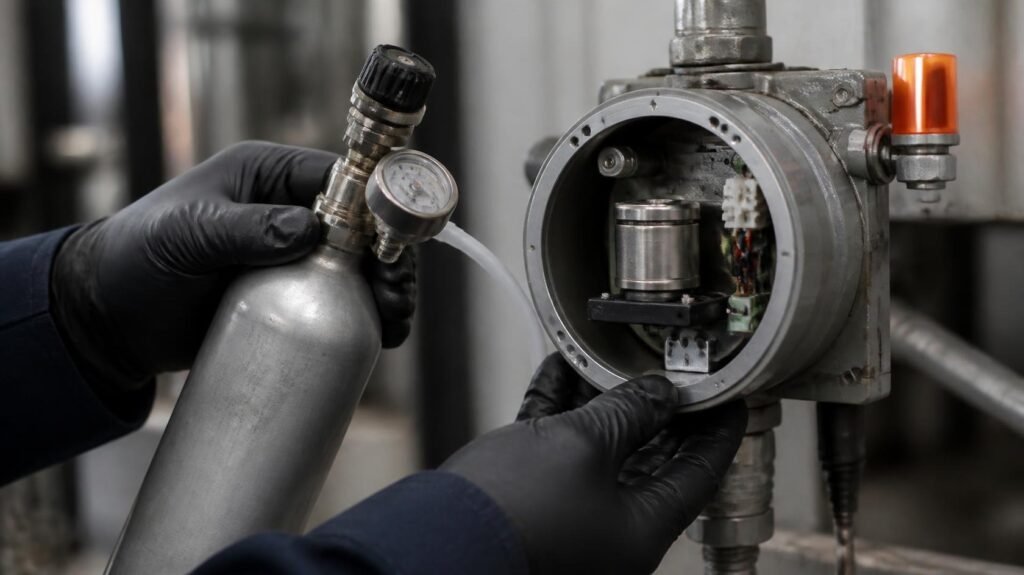
This is the figure you should use to guide your maintenance plan: published sensor data usually shows a sensitivity loss of about fifteen percent per year, default calibration interval of six months, and cell life expectancy of more than two years. An “ammonia gas detection system” is a consumable installation and not a fitting. Every cell on board has a date by which it must be replaced, a cost and a lead time. None of those three facts are anywhere in the risk registry.
Drift and calibration intervals across the ammonia gas detection system
slow, silent and directional movement A desensitised cell does not declare itself, it only reports low until a known gas is applied and the truth is found out. That’s why calibration interval is a safety parameter, not a maintenance option. A twelve-month period of remote trading for the vessel is an unreported decline in barrier performance and it is exactly the sort of decision that never gets to the person who owns the safety case ashore. Either way the “ammonia gas detection system” deteriorates.
Bump tests, spares and the true manning cost of an ammonia gas detection system
Calibration is the obvious duty. The invisibles mount up: bump testing portables before to use, servicing docking stations, monitoring cell expiration dates, stocking calibration gas with its own shelf life and carrying extra cells for every sensor type attached. Multiply that by the fixed and portable population and that’s genuine engine department hours per month. Specifying three separate sensor technologies looks good on a drawing, it triples the spares inventory that a superintendent has to actually pay for. A simple “ammonia gas detection system” that is always maintained is better than a complicated one that is disregarded.
False alarms and the fatigue that disables detection

The human response can overcome the most thorough detecting arrangement on board and the mechanism is widely understood. Alarm after alarm that’s nothing teaches folks to treat the next as nothing. Humidity swings, wash-down water, cross-sensitive vapours and a drifting cell all trigger alarms that signify no release. Each of them takes away a little more from the credibility of the “ammonia gas detecting system,” and credibility is the attribute upon which depends all its protective efficacy.
How false alarm fatigue disables an ammonia gas detection system
Fatigue is not defiance. A sensible reaction to a bad signal to noise ratio. A watchkeeper who has already admitted to eleven nuisance alarms this month has learned properly that the twelfth is likely annoyance too. The engineering answers are selectivity, environmental robustness, and honest setpoints: ammonia-specific detecting devices, enclosures that are rated for humidity and wash-down, and low alarms that are placed where a real leak sits rather than where a clean laboratory reading predicts. None of that is retrofittable. And that is why nuisance alarms in a detection scheme like this are a design concern.
Designing an ammonia gas detection system the crew will actually trust
Trust is not trained, it is built. Sensors that can be accessed without staging are kept. Confidence is retained in cells that self-diagnose, reporting their own failure as a distinct problem instead of a false reading. Alarm annunciation that tells the watchkeeper which detector and what concentration, rather than guesswork. A number only helps if the crew know what it means, which is why Ammonia toxicity exposure limits, the numbers that decide your entire machinery space layout sit underneath every setpoint on the panel. Logging that allows a supervisor to look at every occurrence ashore closes the loop. None of them are expensive enhancements if specified early enough and all are virtually impossible to retrofit once the ship starts trading.
Conclusion
Detection is the only other barrier upon which all other ammonia mitigation rests and the only one that fades quietly and keeps the documentation legitimate. Pick the technologies you really need for the ranges, install sensors from the source out, justify every single setpoint, and price the calibration load honestly. Design the “ammonia gas detection system” early enough that it drives the arrangement rather than being forced into it. Because a detector that nobody can access, and nobody really believes, protects nobody at all.
People Also Ask
What sensor technology should an ammonia gas detection system use?
Usually a combination of several. Electrochemical cells are used for low-ppm personnel protection, infrared or catalytic approaches for higher bands, open-path lasers for open spaces, and acoustic devices for pressurised releases before any concentration builds up anywhere near the nearest point sensor.
Where must detectors sit in an ammonia gas detection system?
Follow the gas. Seal off release sources, e.g. annular spaces, tank connection spaces and fuel preparation rooms, travel paths, e.g. ventilation outlets and bilges, and entrance points, e.g. accommodation air intakes. Mounting positions, high and low, are important.
How often does an ammonia gas detection system need calibration?
Usually every six months however sensor data published allows for periods of one day to twelve months. Sensitivity can go away by about fifteen percent a year, and so you can discreetly lengthen that interval, and lessen the level of protection your authorised safety case really claims.
Why do crews stop trusting an ammonia gas detection system?
Almost always false alarms. Alarms indicating no release are generated by humidity, wash-down water, cross-sensitive vapours and floating cells. After a sufficient number of them, acknowledgement becomes reflex, the barrier is effectively disabled but still seems completely operational in the control room.