Introduction
The “BERT vs GPT” argument is one of the most exciting topics in artificial intelligence. They are two giants of AI that have radically changed the way machines comprehend and synthesise human language. “BERT vs GPT” is not merely a technical comparison, it is a philosophical gap between comprehending language and making words, between reading profoundly and writing fluently. “As powerfully explored in BERT vs GPT: Comparing Modern AI Language Models, this architectural divide between understanding and generation is not a limitation of either model — it is the deliberate design philosophy that makes BERT and GPT the two most complementary and commercially valuable AI language models ever created.
“ Both models are founded on the groundbreaking transformer architecture, but they take drastically different design decisions that lead to complimentary strengths and drawbacks. In this blog, we’ll walk you through each essential dimension of “BERT vs GPT” to enable any AI enthusiast make informed, confident decisions about which model will be best for their individual needs and goals.
Table of Contents
What Are BERT vs GPT?
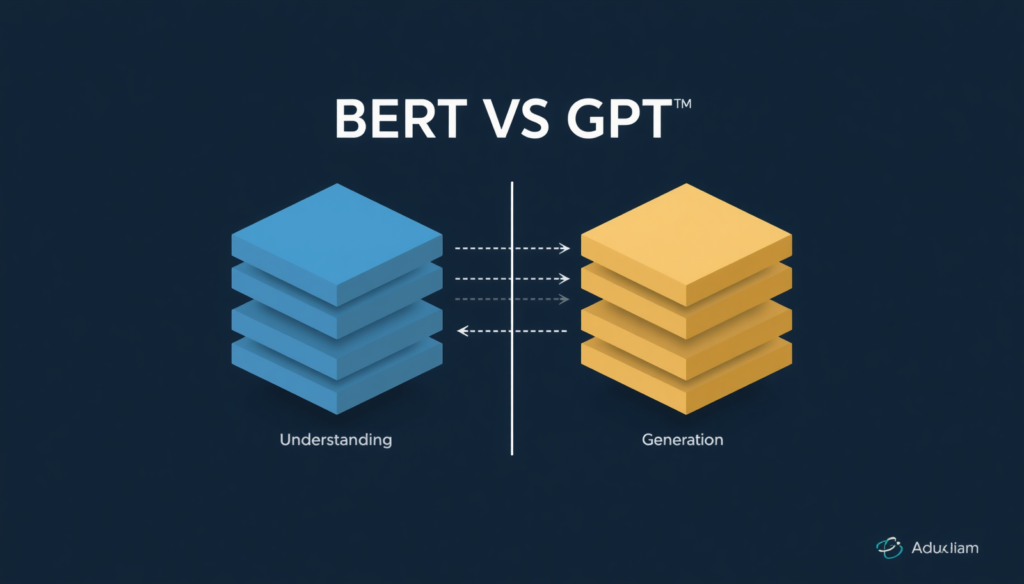
To understand BERT vs GPT we need to understand what they are at their core – two language models built on transformers that are trying to reach the same goal of language understanding from absolutely opposed paths architecturally. BERT ( Bidirectional Encoder Representations from Transformers) was launched by Google in 2018. It employs a bidirectional encoder that reads text in both ways concurrently. OpenAI developed GPT – Generative Pre-trained Transformer. GPT is a unidirectional decoder that produces text token by token from left to right. “So “BERT vs GPT” basically summarises the fundamental NLP difference between language understanding and language production, two equally important capacities that enable today’s AI applications.
The Origin Story of BERT vs GPT
The founding tales of “BERT vs GPT” show how two of the world’s most powerful AI organisations took the same transformer architecture, and followed radically different research objectives and practical goals. BERT was developed in October 2018 by Jacob Devlin and colleagues from Google Research, with the purpose of enhancing language understanding on a variety of NLP tasks. GPT started at OpenAI in June 2018 with GPT-1, by Alec Radford and collaborators, with the goal of showing that language modelling alone could create strong transferable representations. Thus, “BERT vs GPT” began as a fruitful side-by-side examination of the transformer design space by two world-leading research teams.
Architectural Philosophy of BERT vs GPT
The most basic difference between BERT and GPT is the underlying architectural philosophy – a choice that dictates everything about what each model can and can’t accomplish well. BERT simply takes the encoder stack of the original transformer that processes the whole input sequence bidirectionally (where each token attends to each token in both directions concurrently). GPT uses only the decoder stack with causal masking , meaning each token can only attend to previous tokens . This constraint leads to the fundamental tradeoff between full context awareness and autoregressive generation capabilities that defines modern language model design : BERT vs GPT .
Pre-Training Objectives in BERT vs GPT
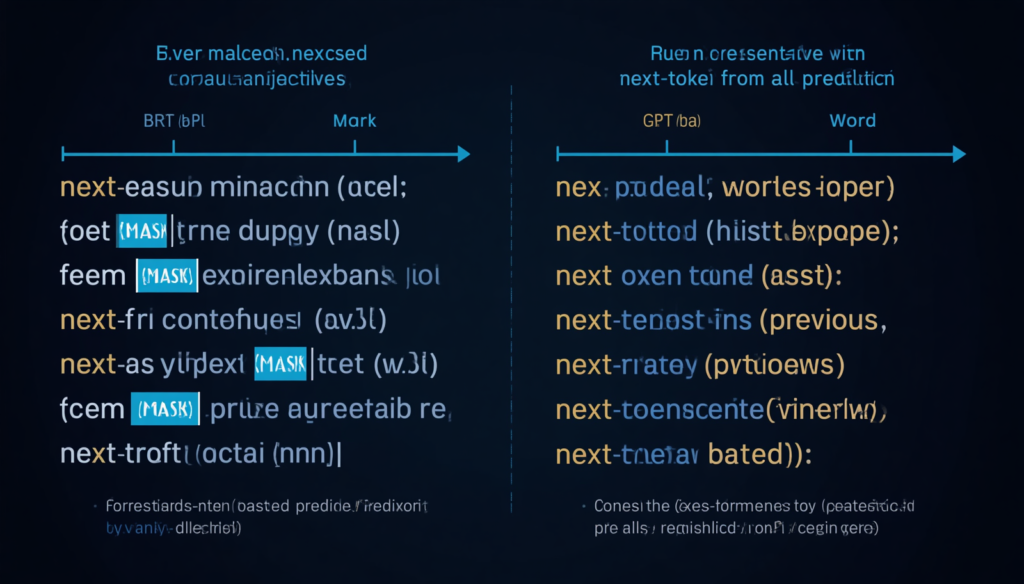
The pre-training objectives utilised by BERT vs GPT are arguably the most consequential design choices in their separate architectures, since they dictate what the models learn from raw text during training and how well those learnt representations transfer to downstream tasks. BERT is pre-trained with Masked Language Modelling and Next Sentence Prediction, aims which force the model to gain strong bidirectional knowledge. GPT is pre-trained using autoregressive next-token prediction, an objective that naturally develops the capacity to generate fluent text. The pre-training distinction of “BERT vs GPT” precisely explains why each model performs extremely well on fundamentally different real world NLP applications.
BERT's Masked Language Modeling
On the understanding side , in the ” BERT vs GPT ” competition , the most distinctive flavour is the clever pre-training aim called Masked Language Modelling . For MLM pre-training, BERT randomly masks 15% of the input tokens and then trains the model to predict the masked tokens using their context, taking into account both the left and right side at the same time – a bidirectional signal which is not possible with GPT’s autoregressive goal. That two-way training signal is what makes BERT so powerful for learning tasks that require the entire context of a sentence. Comprehension benchmarks: BERT evaluation against GPT shows that BERT’s MLM pre-training leads to better contextual representations for tasks demanding holistic grasp of the sentence.
GPT's Autoregressive Pre-Training
The pre-training objective, deceptively simple but incredibly powerful, that gives “BERT vs GPT” competition its most unique generative element is autoregressive next-token prediction. The left-to-right language modelling objective in pre-training is to predict each successive token given all previous tokens, which naturally leads to the model being able to generate coherent, fluent and contextually appropriate text sequences of arbitrary length. This objective forces GPT to not attend to future context, as BERT does. However, work on “BERT vs GPT” has demonstrated that autoregressive pre-training at massive scale leads to emergent capabilities — reasoning, instruction following, incontext learning — that cannot be obtained by bidirectional pre-training alone.
Performance Comparison in BERT vs GPT
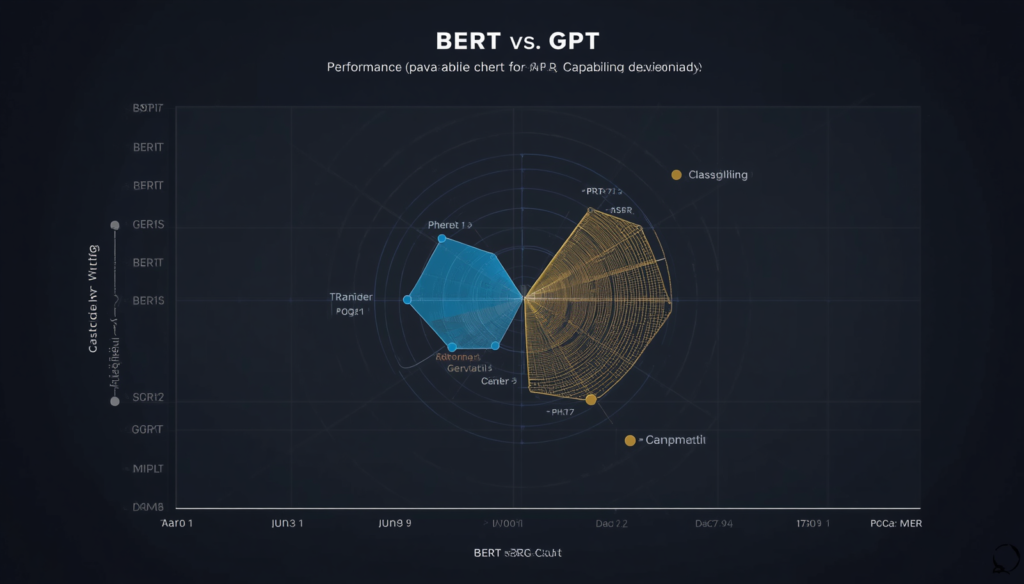
If we examine the performance of “BERT vs GPT” in several categories of NLP tasks, we can see a pattern – each model has a distinctive area of advantage, reflecting its pre-training goal and architectural design philosophy. BERT regularly beats GPT on discriminative understanding tasks – text categorisation, named entity recognition, question answering and textual entailment — where the ability to analyse the complete input context bidirectionally is a crucial advantage. On generative tasks, GPT consistently beats BERT: open-ended text production, creative writing, dialogue, and code synthesis. The autoregressive decoder architecture gives natural fluency that BERT’s encoder cannot match.
Where BERT Wins in BERT vs GPT
In the “BERT vs GPT” performance fight for language understanding tasks, BERT’s bidirectional architecture turns out to be a game-changer, giving a clear and persistent edge over almost every comprehension-focused NLP benchmark. On the GLUE and SuperGLUE benchmarks — the standard evaluation suites for natural language understanding — BERT and its variants frequently outperform GPT models of similar size. “In all comparisons of BERT vs GPT on named entity recognition, sentiment analysis and reading comprehension, BERT comes out ahead. This is because to determine the correct answer you need to understand the relationship between all parts of the input simultaneously, which is something that bidirectional attention handles much more naturally.
Where GPT Wins in BERT vs GPT
In terms of language generating jobs in the BERT vs GPT performance duel, BERT’s encoder cannot generate text that is as fluent, coherent, and creative as what GPT’s autoregressive decoder architecture can produce by design. The GPT models thrive at open-ended questions, where the output is a whole, coherent paragraph of text, not just choosing between possibilities. When you compare BERT and GPT on creative writing, code generation, dialogue systems, and summarisation, GPT always wins by a wide margin — because generating high-quality extended text requires exactly the sequential generation capability that GPT’s left-to-right language modelling objective was explicitly designed and trained to develop at scale.
Fine-Tuning Approaches in BERT vs GPT
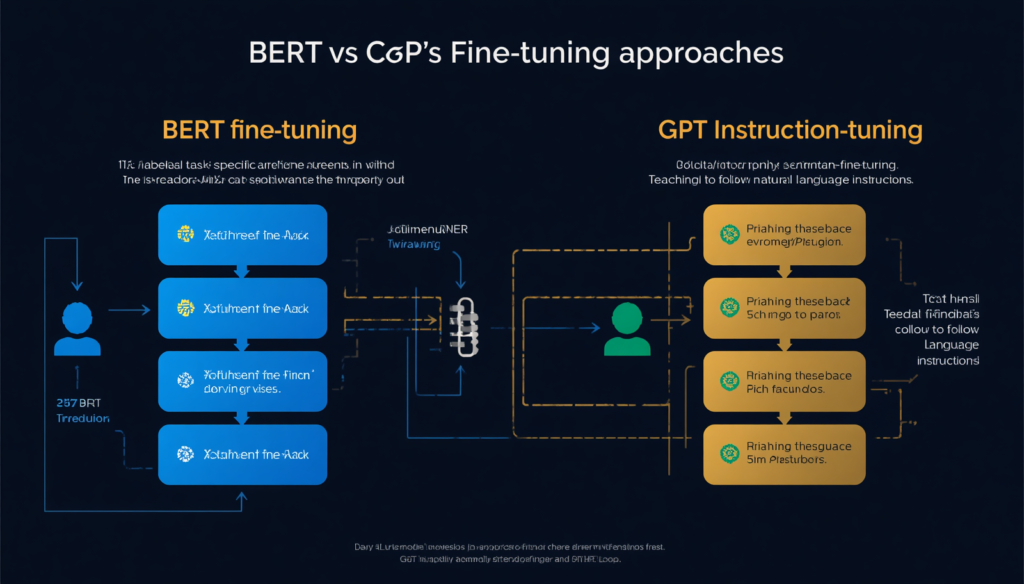
The methodologies for fine-tuning “BERT vs GPT” are quite diverse, reflecting their varied pre-training objectives and the different types of tasks they are best suited for in production NLP systems. Fine-tuning BERT usually means adding a small classification head on top of the pre-trained encoder and training the entire model using labelled task data. This is a simple and extremely successful strategy that regularly yields state-of-the-art results on classification problems. Studies of BERT vs GPT reveal that GPT’s generative architecture is especially suited to instruction tuning and reinforcement learning from human feedback, which are increasingly used to fine-tune GPTs to obey natural language instructions.
BERT Fine-Tuning in BERT vs GPT
BERT Fine tuning is one of the simplest and most successful paradigms of model adaptation in all of current NLP, and understanding it is key to comprehending the complete BERT versus GPT contrast. To use BERT for a classification problem, practitioners add a single linear layer on top of the representation of the [CLS] token, a special token that BERT inserts at the beginning of every input sequence to summarise sentence-level information. BERT vs GPT fine-tuning comparisons repeatedly reveal that BERT needs much less task-specific labelled data than training from scratch, reaching outstanding performance on NER, sentiment analysis and question answering with only hundreds of labelled examples per class.
GPT Fine-Tuning and RLHF in BERT vs GPT
The biggest innovation in fine-tuning on the GPT side of the “BERT versus GPT” war is Reinforcement Learning from Human Feedback, the training methodology that turned GPT-3 into the astoundingly powerful ChatGPT that entranced the globe in late 2022. RLHF trains GPT models to produce responses that human judges find helpful, harmless, and honest – an achievement that plain vanilla supervised fine-tuning cannot reach. Research on “BERT vs GPT” has demonstrated that RLHF fine-tuned GPT models significantly surpass base GPT models in instruction following, safety, and real-world utility, establishing RLHF as the signature fine-tuning approach for contemporary generative AI deployment.
Real-World Applications of BERT vs GPT
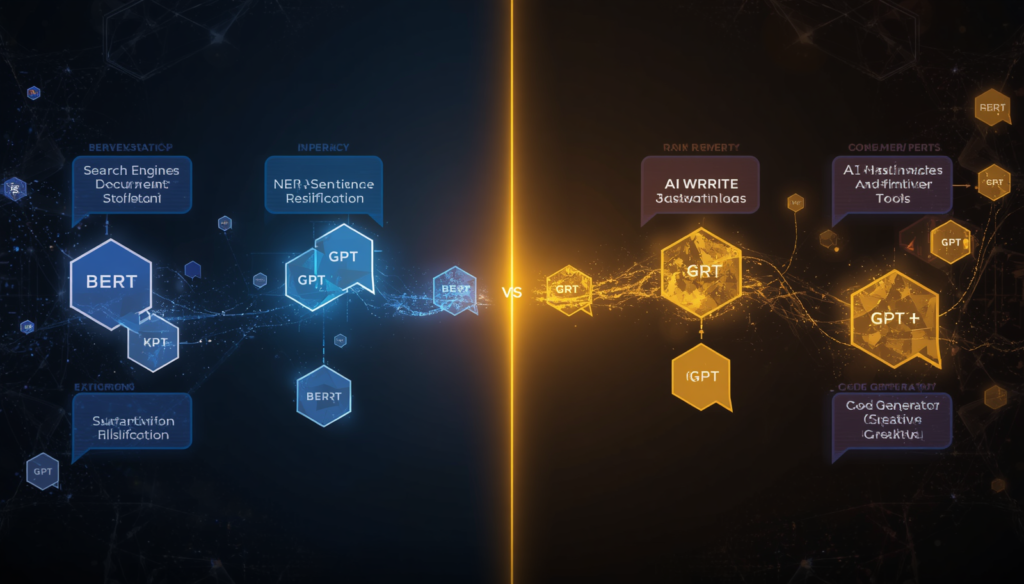
In practice, the split between BERT and GPT is stark, and commercially relevant. BERT is used for the intelligence layer of corporate NLP systems, whereas GPT is used for the generative interface that end users directly interact with. BERT is the king of search engine optimisation. In 2019, Google implemented BERT to increase the relevancy of search results for more than 10% of all English searches overnight. GPT powers conversational AI, enabling ChatGPT, Microsoft Copilot and thousands other AI writing helpers that are utilised by hundreds of millions of people every day. Understanding this “BERT versus GPT” application split is critical for organisations trying to select the best model for their specific production NLP use case
BERT Applications in BERT vs GPT
The generative capability of GPT has led to new types of AI-powered goods that didn’t exist before, making it the clear victor of the user-facing application dimension of the “BERT vs. GPT” comparison. ChatGPT, the fastest-growing consumer application of all time, was developed on GPT-3.5 and 4 and hit 100 million users in two months after introduction. Microsoft Copilot adds GPT-4 to the Office 365 suite, helping hundreds of millions of professionals to write emails, summarise documents and create presentations. Analysis of developer ecosystems “BERT vs GPT” demonstrates that since 2022, the use of GPT’s API has skyrocketed compared to BERT for new AI product development.
GPT Applications in BERT vs GPT
The generative capability of GPT has led to new types of AI-powered goods that didn’t exist before, making it the clear victor of the user-facing application dimension of the “BERT vs. GPT” comparison. ChatGPT, the fastest-growing consumer application of all time, was developed on GPT-3.5 and 4 and hit 100 million users in two months after introduction. Microsoft Copilot adds GPT-4 to the Office 365 suite, helping hundreds of millions of professionals to write emails, summarise documents and create presentations. Analysis of developer ecosystems “BERT vs GPT” demonstrates that since 2022, the use of GPT’s API has skyrocketed compared to BERT for new AI product development.
Variants and Evolution of BERT vs GPT
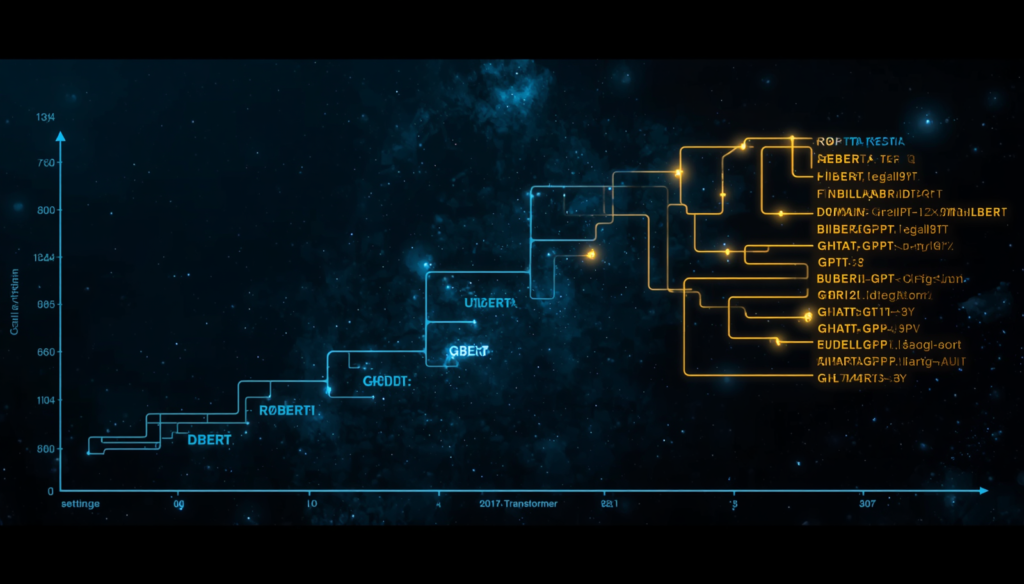
The initial “BERT vs GPT” comparison has extended tremendously, as both model families have created extensive ecosystems of variants and successors, each addressing particular limits or extending capabilities in new ways. RoBERTa improved BERT pre-training by removing Next Sentence Prediction and training longer on more data. ALBERT reduces the model size by parameter sharing. DeBERTa: Decoding-enhanced BERT with Disentangled Attention.
“As brilliantly demonstrated in Transformers & Attention: The Architecture That Shocked the World, the shared transformer foundation that powers every BERT and GPT variant is the single most important architectural innovation enabling each new generation of language models to achieve capabilities that previous generations could not even remotely approach.” On the GPT side, the lineage went from GPT-1 to GPT-4. Each generation showed huge gains in capabilities due to increased size. The “BERT vs GPT” family tree has now expanded to include hundreds of specialised variations for every imaginable area and application.
BERT Family Variants in BERT vs GPT
In the “BERT vs GPT” model family, the BERT side has generated an astounding variety of variants that overcome specific shortcomings of the original architecture or adjust it to specialised domains and resource constraints. RoBERTa – Robustly Optimised BERT – showed that BERT was severely under-trained, and that just training longer on more data but without Next Sentence Prediction gave major performance increases. DistilBERT shrinks BERT down to 60% of its original size, preserving 97% of its performance, enabling “BERT vs GPT” deployment for organisations lacking enterprise-grade GPU technology. Specialised variations like BioBERT, SciBERT, LegalBERT, and FinBERT achieve state-of-the-art results on specialised professional NLP tasks.
GPT Family Evolution in BERT vs GPT
The BERT vs GPT model family’s GPT side has shown the most dramatic capability scaling in the history of AI, with each successive generation revealing whole new emergent capabilities that prior versions lacked entirely. At first, OpenAI’s team was hesitant to disclose GPT-2 publicly due to fears about misuse, as the model convincingly exhibited the ability to generate fluent long-form prose. 175 billion parameter GPT-3 introduced the ability to learn to execute new jobs from just a few instances without any fine-tuning, what we call in-context learning. The “BERT vs GPT” comparisons become all the more sophisticated with the addition of multimodal comprehension, complex reasoning and professional-level performance in legal, medical and coding fields in GPT-4.
The Future of BERT vs GPT

The “BERT vs GPT” contest is heating up quickly as the lines between understanding and generating models blur in the next generation of massive language models. Encoder-decoder hybrid models like T5 and FLAN-T5 provide the middle ground between BERT versus GPT by combining bidirectional encoding and autoregressive decoding into a single sequence-to-sequence framework. Claude, Gemini and LLaMA are examples of decoder-only models that show that when autoregressive models are big enough they can meet or surpass BERT on comprehending tasks by size alone. The “BERT vs. GPT” discussion might go away when single foundation models capable of both understanding and generation become standard.
Emerging Unified Models Beyond BERT vs GPT
The future of language models is increasingly moving beyond the “BERT vs. GPT” conflict towards designs that combine the best of both worlds into a single unified framework. T5 — Text-to-Text Transfer Transformer — takes all NLP problems and treats them as text-to-text conversion. It uses an encoder-decoder architecture, where the input is read bidirectionally (like BERT), and the output is generated autoregressively (like GPT). We show that the distinction between BERT and GPT becomes less relevant at scale; large models trained on diverse instruction datasets can deliver competitive performance on both understanding and generation benchmarks without architectural compromise, as demonstrated by FLAN-T5 and other instruction-tuned encoder-decoder models.
What BERT vs GPT Means for AI Practitioners
For AI practitioners working in the fast-moving universe of language models, the “BERT vs GPT” framework remains a powerful conceptual tool for making principled model selection decisions in production settings. For applications like categorisation, NER, question answering from a document, where the task demands accurate information extraction, BERT and its variations remain the computationally efficient, well understood choice that performs reliably in production. If the job is open-ended generation — chatbots, creating content, helping with coding, creative writing — the GPT-family models win, hands down. Thinking that compares BERT with GPT helps practitioners avoid costly mismatches between model design and application needs that waste time and computing resources in development.
Conclusion

The “BERT vs GPT” debate doesn’t have a one-size-fits-all winner — and this is precisely the most essential lesson any AI practitioner can learn from this exhaustive comparison. BERT wins the understanding game decisively, offering dependable, efficient and accurate language understanding across enterprise NLP applications that require accuracy. GPT is fantastic at the generation game, and is the engine behind the conversational AI revolution that’s introduced artificial intelligence into the daily lives of hundreds of millions of people across the world. The winner of “BERT vs GPT” is actually the area of NLP itself, which has been altered beyond all recognition by these two remarkable complimentary architectures, operating in tandem in a very effective way to drive human-machine communication forward.
People Also Ask
What is the main difference between BERT verses GPT architectures?
The architecture defines everything. “BERT employs a bidirectional encoder to read text in both directions for deep understanding, while GPT uses a unidirectional decoder to generate text left-to-right, making them complimentary champions of comprehension and generation.
Which model is better for NLP tasks — BERT verses GPT?
Your task type determines it. “BERT verses GPT” show that GPT dominates text production, creative writing, and conversational AI, whereas BERT dominates categorisation, NER, and question responding with bidirectional comprehension.
How does fine-tuning differ between BERT verses GPT models?
Fine-tuning theories differ greatly. A “BERT verses GPT” fine-tuning adds classification heads for labelled task data, whereas GPT employs instruction tuning and RLHF to produce helpful conversational behaviour, making each approach best for its understanding or generation application domain.
What are the real-world applications of BERT verses GPT today?
Both power distinct AI products. ChatGPT, Microsoft Copilot, and AI writing helpers used by hundreds of millions of professionals and consumers everyday differ from “BERT verses GPT” applications. BERT supports Google Search, document classification, and healthcare NLP.