Introduction
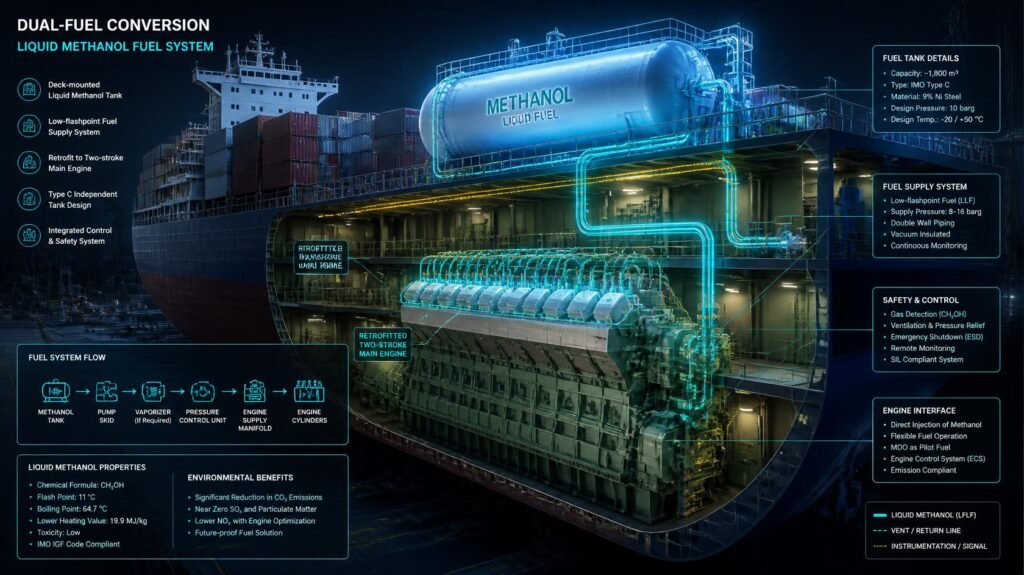
With international shipping heading toward the 2027-2028 compliance window, the annual Carbon Intensity Indicator (CII) reduction trend line falls below 13.6%, mathematically ruling out traditional Heavy Fuel Oil (HFO) operation for mid-life vessels. Alternative Fuel Retrofitting: Assessing the Engineering Feasibility of Dual-Fuel Conversions for Mid-Life Vessels lies at the very heart of this technical transformation.
As technical operators look to Drive decarbonization through dual-fuel conversions, deep structural assessments for deck-mounted fuel storage tanks, explosion-proof Fuel Preparation Rooms (FPR), and upgrading cylinder covers with low-flashpoint injection valves may all turn existing 10 to 15-year-old tonnage into low carbon assets. “Alternative Fuel Retrofitting” is a clear engineering pathway to extend vessel operational life, retain asset capital value and ensure long-term regulatory compliance
The Regulatory Tipping Point and Economic Lifespan Extensions
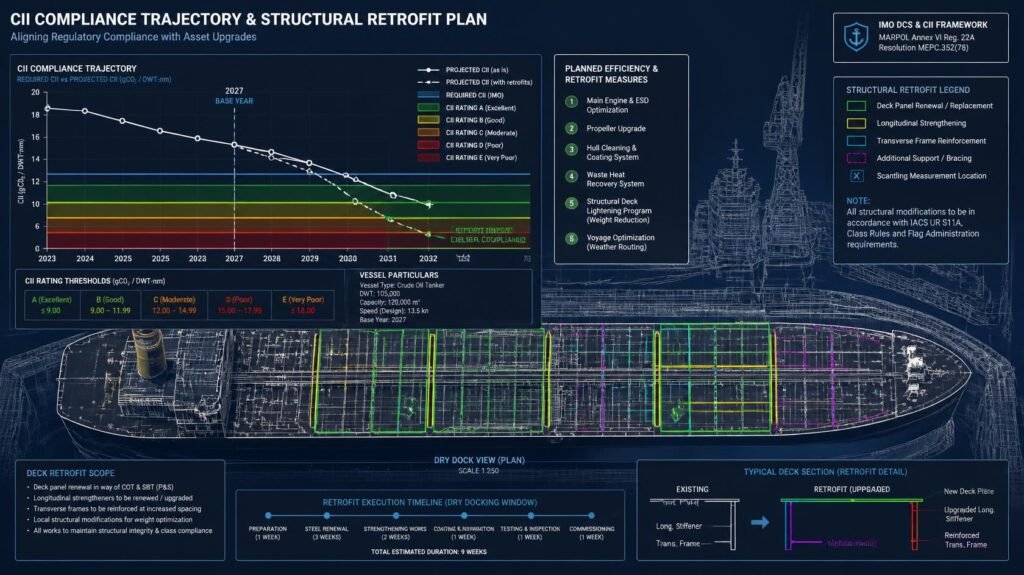
Ships built between 2010 and 2018 will need to be replaced or retrofitted soon enough as the world moves to speed up carbon reduction targets. Operational solutions such as slow steaming and hull coatings reach thermodynamic limits, leaving mid-life ships exposed to continuous ‘D’ or ‘E’ rating downgrades. Thorough Alternative Fuel Retrofitting extends mid-life tonnage’s commercial life by 10 to 15 years, avoiding premature scrap write-offs. “Alternative Fuel Retrofitting” for dual-fuel operation brings mid-life assets back into competitive charter market status, enabling shipowners to amortise the conversion expenses over long term time charter contracts.
The Math of Impending CII Non-Compliance
The 2% yearly reduction target becomes more aggressive from 2026, causing mid-life boats using conventional fuels to move into non-compliant operational levels. Flag states require quick Corrective Action Plans to be implemented after a ship has three consecutive ‘D’ ratings or one ‘E’ grade, which limits the ship’s trading flexibility. Systematic “Alternative Fuel Retrofitting” directly reduces the fuel carbon intensity factor to achieve clean ‘A’ or ‘B’ environmental ratings. Alternative Fuel Retrofitting enables mid-life boats to take proactive actions to avoid commercial fines and continue to trade on main routes.
Capital Expenditure versus Scrap Depreciation Realities
A scrapping of a 12-year-old vessel for carbon non-compliance is a devastating loss of capital investment for ship management businesses. Although retrofitting dual-fuel engines requires a big initial capital expenditure, conversion costs are still much lower than ordering replacement newbuildings. Evaluation of capital allocation models for “Alternative Fuel Retrofitting” shows good long-term financial returns over a 10 year time horizon. “Alternative Fuel Retrofitting” is a strategic way to protect core asset value and convert ageing fleets to sustainable, high earning commercial assets.
Deck-Mounted Fuel Tank Integration and Structural Naval Architecture
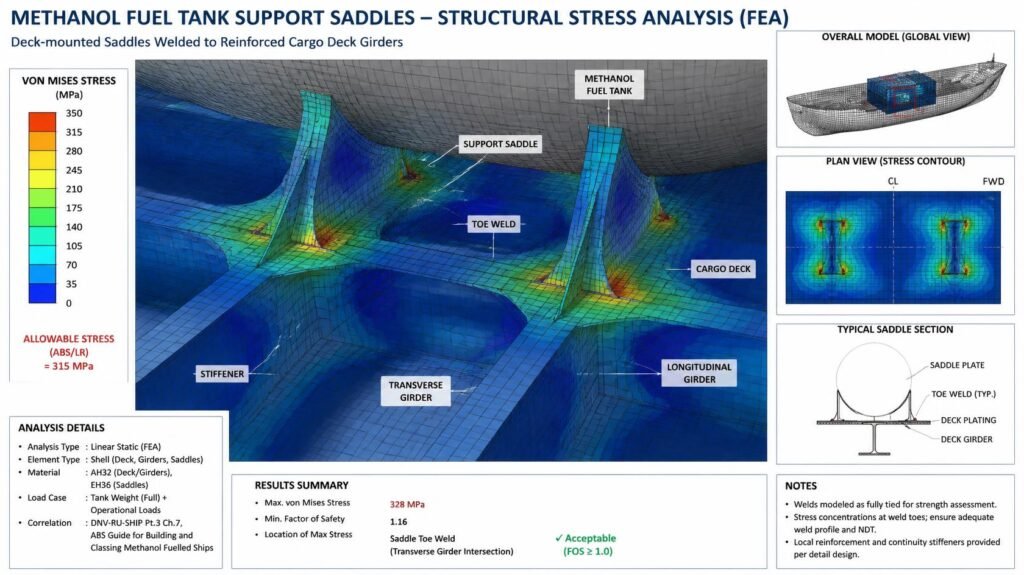
The installation of alternate fuel storage tanks on existing warships poses considerable naval design issues in volumetric capacity, weight distribution, and longitudinal strength. Low-flashpoint fuels like methanol or LNG have to be stored in special Type C independent pressure vessels or membrane containment tanks, not in the normal double-bottom tanks used for heavy fuel oil. These massive fuel tanks on the primary weather decks change the vessel center of gravity, metacentric height (GM), and sightline visibility. In the Alternative Fuel Retrofitting, structural reinforcement study is performed to verify that the tank support saddles and hull girders can handle dynamic wave stresses.
Naval Architecture and Metacentric Height Balance
The placement of twin 1,000-cubic-meter methanol or LNG tanks on the cargo decks adds hundreds of tonnes to the vessel’s top weight and raises the vessel’s vertical center of gravity. Naval architects have to re-calculate damage stability and GM margins for all loading conditions to avoid extreme rolling motions. “Alternative Fuel Retrofitting” designs incorporate structural steel reinforcements to ensure the structural hull girder integrity under high sea conditions. “Alternative Fuel Retrofitting” manages vessel stability and safe cargo operations without compromising deadweight capacity.
Fire Safety Distances and Hazardous Area Zoning
The hazardous area zoning around tank vents, bunkering manifolds and pipe flanges is quite stringent for low flash point fuels to avoid explosion dangers. Safety distances from accommodation blocks, air intakes and navigation bridge sightlines are specified in international codes. Explosion-resistant barriers are included in the “Alternative Fuel Retrofitting” plans to segregate hazardous areas from living quarters and non-certified electrical equipment. “Alternative Fuel Retrofitting” has very high safety distances; this secures class approval and protects the health of the crew.
Engineering Fuel Preparation Rooms and Double-Walled Piping
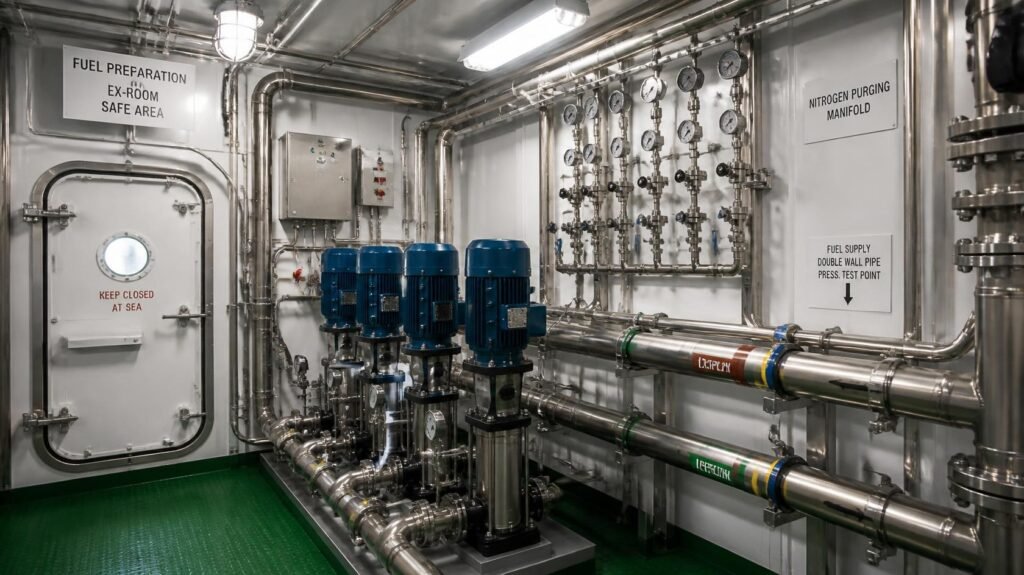
Low-flashpoint alternative fuels require transfer from storage tanks to the engine room via specialist Fuel Preparation Rooms (FPR) with high-pressure supply pumps, heat exchangers and inert gas purging systems. All fuel lines flowing through the engine room shall have double-walled stainless steel piping with continually vented exterior annular spaces to eliminate gas leak concerns inside machinery rooms. Advanced safety devices can be installed in the ‘Alternative Fuel Retrofitting’ frameworks that ensure the automatic rapid shutdown in case of the gas leak detection.
Explosion-Proof Ventilation and Gas Detection Arrays
Fuel Preparation Rooms are categorised as dangerous rooms and should be provided with negative pressure explosion-proof ventilation systems capable of performing a minimum of 30 air changes per hour. Vapour sensors and Optical infrared gas detectors continuously monitor air quality and will close emergency shutoff valves if fuel gas concentrations approach 20% of the Lower Explosive Limit (LEL). Incorporate multi-redundant safety sensors in ‘Alternative Fuel Retrofitting’ projects to eliminate buildup of flammable gas. “Alternative Fuel Retrofitting” design of sound safety architectures prevents engine room machines from disastrous explosion hazards.
Nitrogen Purging Protocols and Double-Walled Pipe Safety
Double-walled fuel piping has an outside duct that is either filled with pressurised inert nitrogen or continuously removed by redundant exhaust fans to promptly detect inner pipe leaks. Automated systems for nitrogen purging remove any remaining fuel from the supply lines before maintenance is performed on the engine or the fuel mode is changed. Automated purging manifolds reduce the work flow in the engine room for “Alternative Fuel Retrofitting” installations. “Alternative Fuel Retrofitting” enforces double-walled safety regulations to safely feed fuel to the main engine cylinder covers.
Engine Top-Cover Conversion and Fuel Injection Retrofits
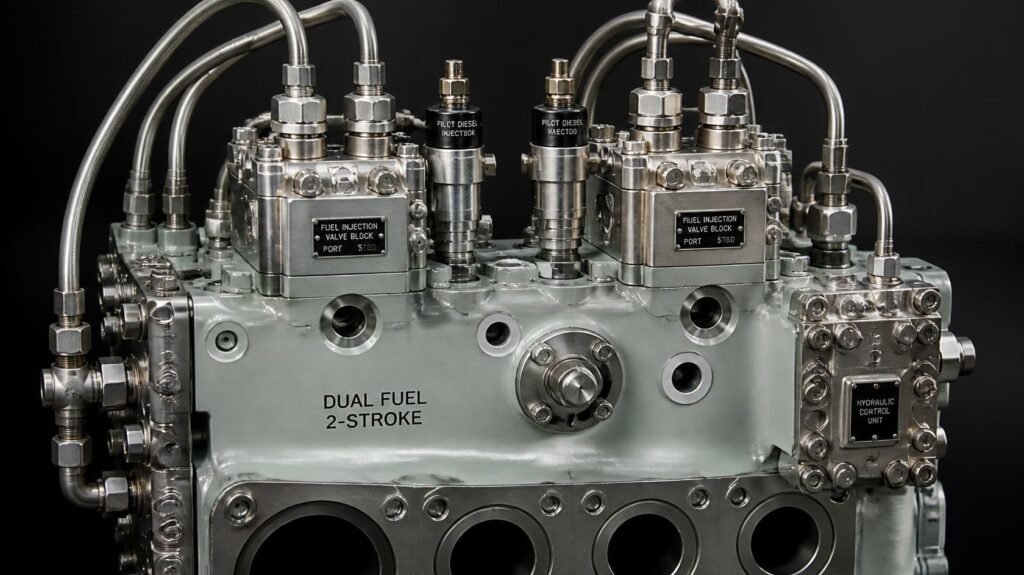
The conversion of a standard two-stroke diesel engine to dual fuel operation requires extensive changes in cylinder covers, fuel injection systems and hydraulic control schemes. The technicians replace the normal cylinder heads with modified heads that are fitted with additional fuel injection valves for low flash-point alternative fuels and pilot diesel injectors. The “Alternative Fuel Retrofitting” upgrading of hydraulic actuation systems allows switching of engine control unit between alternative fuel and heavy fuel oil modes without any problems.
Low-Flashpoint Injection Valves and Hydraulic Actuation
Methanol and other alternative fuels need specialised high-pressure injection valves that can handle the low viscosity and corrosive nature of these fuels without leakage inside. Special sealing mechanisms and hydraulic sealing oil systems prevent alternate fuel contamination of the main engine lubricant oil circuits. The “Alternative Fuel Retrofitting” includes unique injection components designed for perfect fuel atomisation through the whole load range. High-precision injection valves in “Alternative Fuel Retrofitting” ensure clean combustion with minimum pilot fuel use.
Seamless Fuel Switching and Load Control Algorithms
Dual fuel engine control system should be able to govern quick and smooth switching from alternative fuel to the traditional diesel fuel mode without speed fluctuations and power losses. If the pressure of the alternate fuel supply drops rapidly, the control algorithms will immediately switch to pilot diesel to ensure propulsion stability. The software control algorithms of “Alternative Fuel Retrofitting” are calibrated to ensure reliable engine performance during manoeuvring. “Alternative Fuel Retrofitting” offers responsive control systems for total vessel safety in confined port waters.
Bunkering Infrastructure, Fuel Supply Chains, and Compatibility
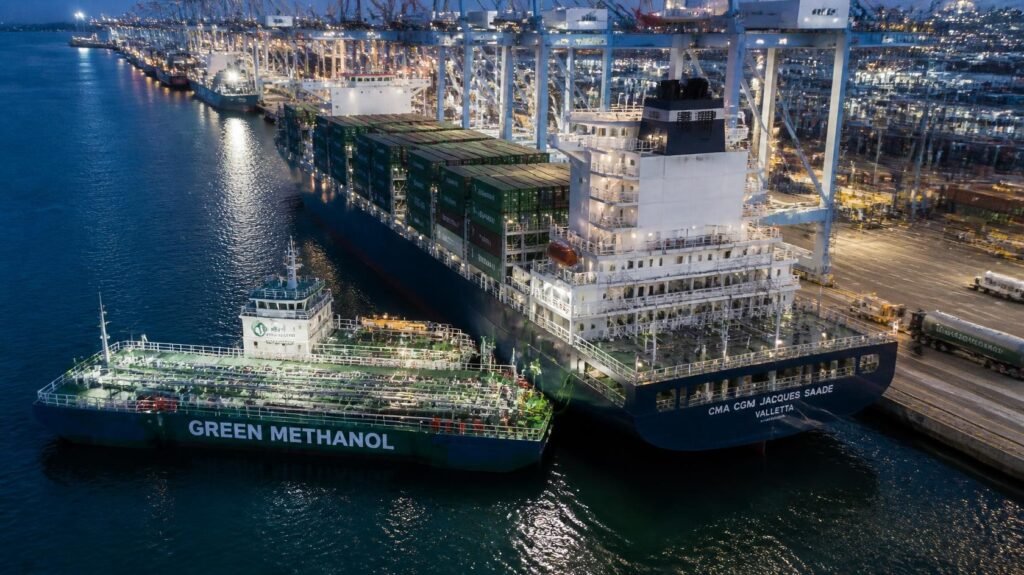
The availability, density and worldwide distribution of alternative fuels such as green methanol or LNG are a key operational consideration in dual-fuel conversions. Alternative fuels have lower volumetric energy densities than HFO, hence ships require bigger storage quantities to obtain the same sailing ranges. “Alternative Fuel Retrofitting” focuses on the development of flexible bunkering manifolds that can be connected to truck-to-ship, shore-to-ship and ship-to-ship bunkering methods. “Alternative Fuel Retrofitting” and knowledge of global fuel logistics eliminates interruptions in major trade routes.
Volumetric Energy Density Calculations and Range Planning
The volumetric energy density of methanol is about half that of conventional heavy fuel oil, meaning that twice the storage volume is needed to provide the same endurance of a voyage. They have to weigh up tank capacity against the loss of cargo space and optimise bunkering frequency along set trading loops. Adding energy density calculations to “Alternative Fuel Retrofitting” plans can prevent unexpected fuel exhaustion at sea. “Alternative Fuel Retrofitting” enables the optimisation of storage volume to maintain lucrative cargo capacity while achieving operational range targets.
Standardized Bunkering Manifolds and Vapor Return Lines
Alternative fuel bunkering manifolds need dry-disconnect couplings, emergency release collars (ERC) and specific vapour return lines to avoid escape of poisonous or flammable gas during fuel transfer. Nitrogen purging systems are utilised to remove residual environmental pollution from bunkering lines before and after fuel transfer. “Alternative Fuel Retrofitting” calls for the installation of standardised bunkering stations that speed up port turnaround times. Robust bunkering practices using ‘Alternative Fuel Retrofitting’ can assure safe and spill-free fuel transfer at worldwide bunker hubs.
Crew Training, Safety Management Systems, and Class Approvals
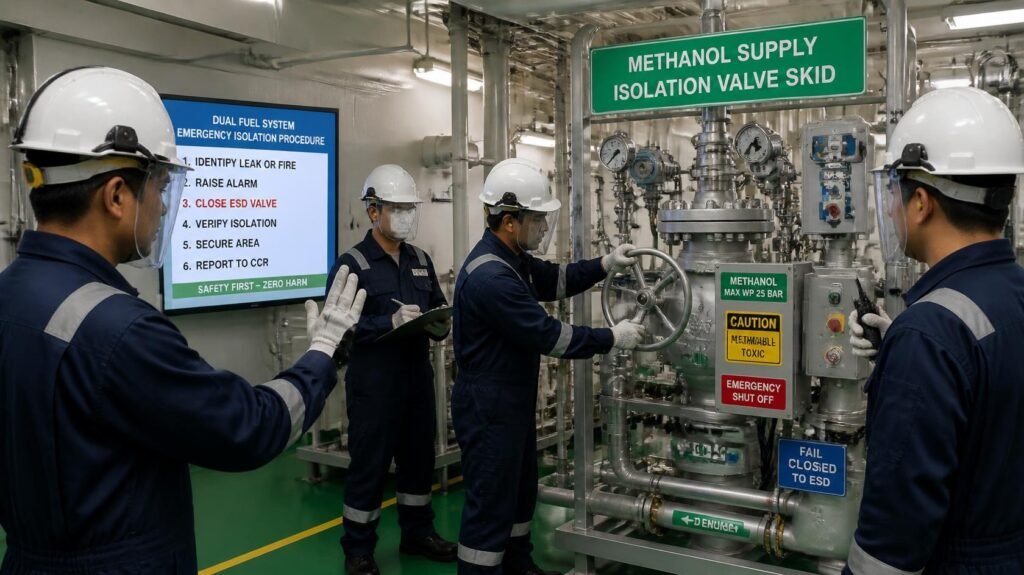
Dual-fuel vessels require dedicated crew competency and updated Safety Management Systems (SMS) and strict classification society approval procedures under the International IGF Code. Engineers are trained in the handling of low flashpoint fuel, cryogenic or chemical dangers, emergency response and firefighting procedures. “Alternative Fuel Retrofitting” initiatives should incorporate training for the entire crew to facilitate smooth transitions into operations. “Alternative Fuel Retrofitting” offers a chance to revise shipboard SMS protocols and to meet international marine safety requirements.
IGF Code Compliance and Class Certification
The International Code of Safety for Ships Using Gases or Other Low-Flashpoint Fuels (IGF Code) addresses all aspects of dual-fuel design, installation and operation. Classification societies carry out detailed risk assessments such as Hazard and Operability (HAZOP) studies before giving class designation. Engineering parameters are tailored to “Alternative Fuel Retrofitting” guidelines to get first-time class approval. “Alternative Fuel Retrofitting” ensures that the vessel is safe and maintains insurance cover, achieving full class certification.
Updating Emergency Response Procedures and SMS
The use of alternative fuels with low flash points creates new emergency situations such as chemical spills, petrol leaks and the risk of cryogenic frostbite. Ship managing organisations must update onboard SMS manuals, including full emergency isolation checklists and specific firefighting drills. Embedding safety procedures into the work processes of “Alternative Fuel Retrofitting” creates a strong safety culture for the crew. “Alternative Fuel Retrofitting” emphasises crew proficiency, removing human error and delivering operational readiness.
Future-Proofing Fleet Assets for Net-Zero Horizons
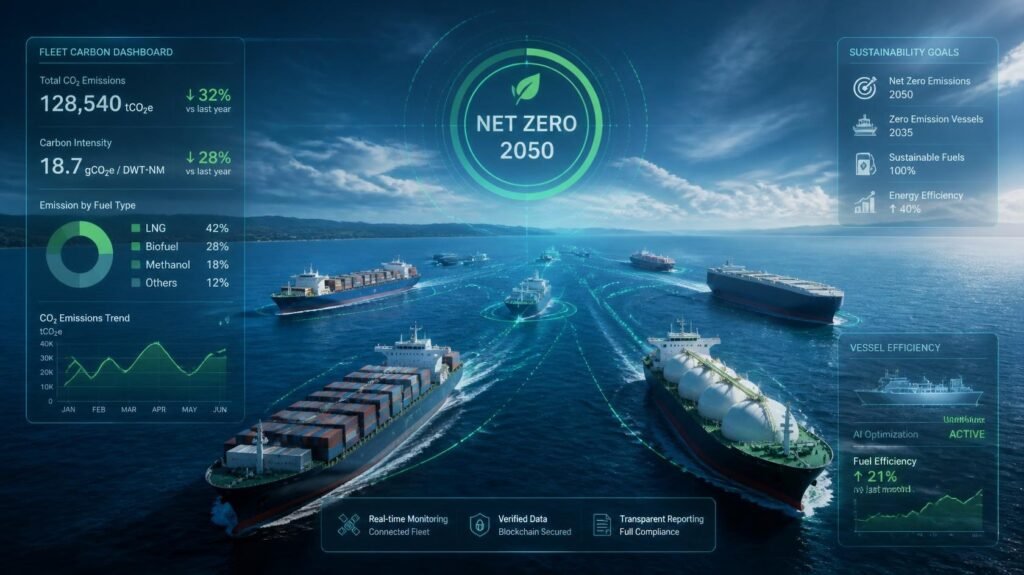
Dual-fuel conversions are an immediate bridge to zero emission marine commerce by allowing ships to run on bio-methanol, e-methanol or synthetic green fuels without further mechanical adjustments. “As the global production of green fuels increases, vessels retrofitted to operate on dual fuels can easily increase their blend ratios to achieve full carbon neutrality.” A commitment to “Alternative Fuel Retrofitting” converts mid-life vessels into future-proof assets ready to navigate increasing environmental demands. Retrofit of alternative fuel is an investment in long term asset value and charter market leadership.
Transitioning from Fossil-Based to E-Fuels
Dual-fuel engines running on either conventional methanol or LNG offer near-term GHG reductions relative to heavy fuel oil. The real benefit of dual-fuel is its seamless compatibility with carbon-neutral e-methanol or synthetic methane as supply chains develop. “Alternative Fuel Retrofitting” Developing flexible technologies for seamless switching to renewable fuels. “Alternative Fuel Retrofitting” provides drop-in fuel compatibility and safeguards shipowners against potential fuel obsolescence
Securing Long-Term Commercial Superiority
As the world’s markets decarbonise, charterers and financial institutions are aggressively favouring vessels with confirmed low emission capability. Dual-fuel retrofitting tonnage earns premium charter rates, good financing arrangements and sidesteps hefty regulatory fines. Making “Alternative Fuel Retrofitting” a key pillar of the fleet strategy ensures commercial supremacy on global trade routes. Strategic focus on “Alternative Fuel Retrofitting” guarantees long term profitability and sustainable fleet expansion.
Economic Valuation and Lifecycle Return on Investment (ROI)
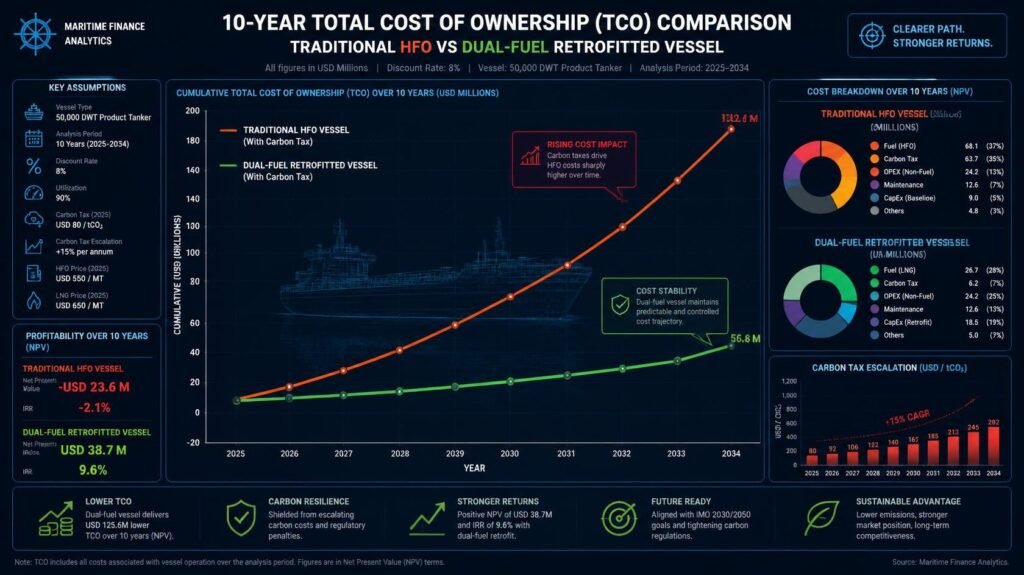
The technological feasibility alone for a mid-life dual-fuel conversion is not enough to justify the large upfront capital outlay and a stringent financial framework is needed. “By adding alternative fuel capabilities, a vessel moves from an increasing depreciation curve to a premium earning asset class. The financial model is based on the offset of conversion costs with reduced carbon levies, avoided operating penalties and better daily time-charter rates. “Alternative Fuel Retrofitting” techniques have been subject to rigorous lifecycle ROI assessments that show that capital invested in dual-fuel conversions delivers substantially higher risk-adjusted returns than newbuilding tonnage under volatile market conditions.
Monetizing Regulatory Compliance and Penalty Avoidance
Unmitigated heavy fuel oil burning is becoming subject to daily financial fines under emerging carbon pricing schemes such as the EU Emissions Trading System (EU ETS) and regional carbon intensity fines. Switching to alternative fuels dramatically reduces carbon liability while protecting operational cash flow that would otherwise be paid out as non-compliance costs. Incorporating the penalty avoidance into the “Alternative Fuel Retrofitting” financial models indicates immediate operational expense reductions at commissioning. “Alternative Fuel Retrofitting” can be measured to translate environmental compliance directly into bottom-line corporate protection by quantifying reductions in carbon taxes.
Time-Charter Earnings Premiums and Asset Liquidity
The global charterers continue to incentivise eco-friendly tonnage, paying premium time-charter rates for vessels that can operate on low-carbon alternative fuels. Additionally, dual-fuel converted assets—especially when paired with port compliance solutions like Alternative Marine Power Retrofits: Eliminating the “Zero-Distance” Anchor Penalty via Shore-Side Connectivity—have improved liquidity in secondary sale and purchase markets, commanding high resale values, while older single-fuel vessels are subject to severe sharp scrap discounts. Adding charter rate premiums to “Alternative Fuel Retrofitting” business cases reduces capital payback timelines to 4 to 6 years of continuous operation. Alternative Fuel Retrofitting also guarantees long-term charter party agreements, ensuring financial stability and maximising asset value for shipowners
Conclusion
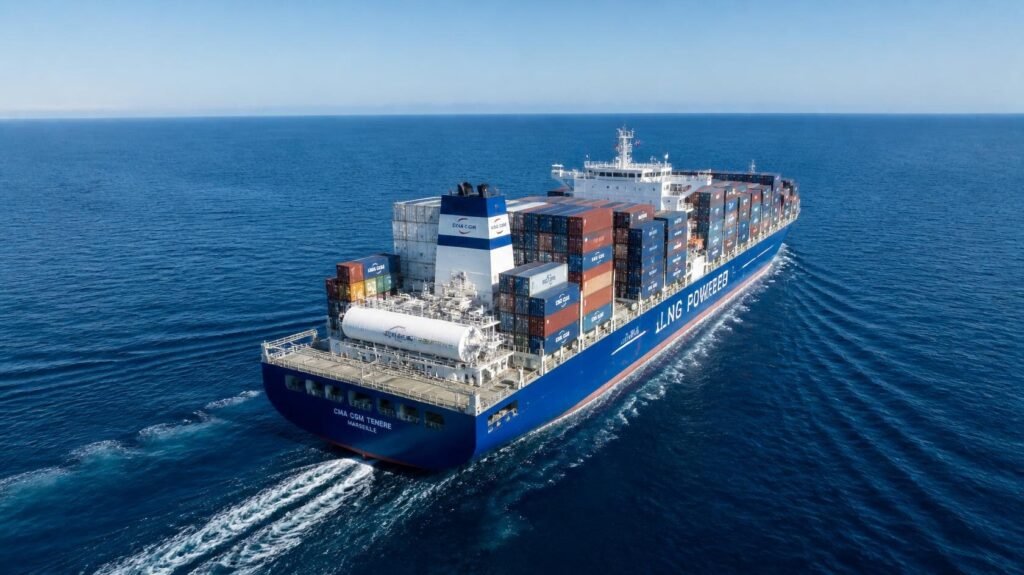
Today, the most important decision for a technical management of a mid-life vessel is to evaluate the engineering viability of dual-fuel conversions. Beyond 13.6% after 2026, as regulatory reduction hurdles fall away, reliance on conventional heavy fuel oil spells commercial obsolescence. Deck-mounted storage tanks, constructing explosion-proof Fuel Preparation Rooms and modernising main engine injection systems give a proven way for long-term compliance. Investment in “Alternative Fuel Retrofitting” can help to lengthen vessel operational life, improve environmental ratings and guarantee commercial success in the green shipping era.
People Also Ask
Why is Alternative Fuel Retrofitting necessary for mid-life vessels after 2026?
Alternative Fuel Retrofitting – This is the conversion of conventional engines to dual-fuel operation. This lowers carbon intensity, allowing mid-life vessels to achieve steep 13.6%+ CII reduction targets without commercial ratings downgrades.
What are the main structural challenges of Alternative Fuel Retrofitting?
Key issues with “Alternative Fuel Retrofitting” include deck tank load distribution, naval architectural stability (GM) balance, hazardous area zoning, and double-walled fuel supply pipe installation.
How do double-walled pipes enhance safety in Alternative Fuel Retrofitting?
In “Alternative Fuel Retrofitting” double-walled pipes, nitrogen-purged outer ducts are used. This keeps low-flashpoint fuels segregated in the engine areas and automatically senses and captures any fuel leaks inside.
Can "Alternative Fuel Retrofitting" use existing engine components?
Alternative Fuel Retrofitting keeps the main engine blocks but replaces the cylinder heads, the fuel injection valves, and the hydraulic control systems to allow the engine to run on two fuels.