Introduction

Anytime you Google someone’s name, book a vacation by naming a location, or ask a virtual assistant about an event happening soon, there’s an invisible AI system working quietly in the background, trying to understand what you mean. That is “Named Entity Recognition” — an amazing NLP ability for machines to automatically detect and classify real world objects mentioned in the text such as names of people, organisations, locations, dates, dollar amounts, and more.
“How Named Entity Recognition Helps Machines Identify People, Places, and Things” is not merely a technical question — it is the defining capability that transforms billions of daily human interactions with search engines, virtual assistants, and intelligent platforms into genuinely meaningful and accurate AI-powered experiences.” Entity Extraction is not some academic fancy. This is an AI tool for production use, powering search engines, news aggregators, healthcare systems and financial intelligence platforms around the world. In this blog we will go through every important aspect of Entity Identification, from basics to its most advanced deep learning implementation, bringing to every AI enthusiast a complete and practical knowledge about how machines learn to identify the most important information hidden in human language, everyday.
Table of Contents
What is Named Entity Recognition?
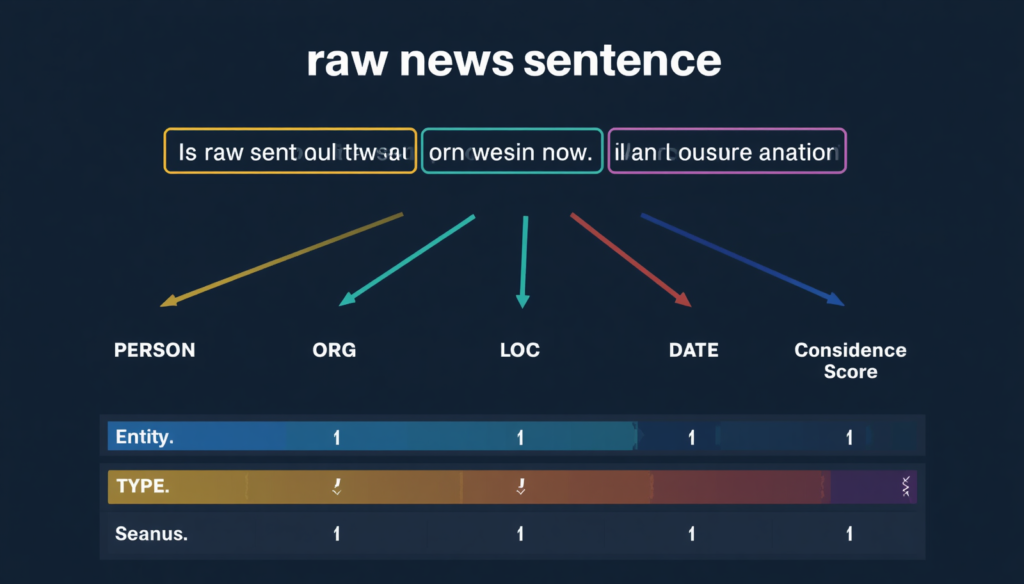
Named Entity Recognition (NER) is a basic natural language processing (NLP) task that tries to automatically find mentions of certain real-world entities in text and to classify them into a predefined set of classes, such as PERSON, ORGANIZATION, LOCATION, DATE, TIME, MONEY or PERCENTAGE. Entity Tagging converts unstructured material — such as a news story, legal document or a social media post — into structured, machine-readable information by identifying all entity mentions with their relevant semantic category.
This structured output can be very useful for downstream AI tasks such as information retrieval, question answering, knowledge graph development, and document summarisation. Without Entity Extraction, an AI system cannot understand who did what, where that happened, and when it took place. These are the fundamental building blocks of human factual understanding on which almost all intelligent information systems that operate at scale in today’s modern digital world rely.
The Core Categories of Named Entity Recognition
The power of “Named Entity Recognition” is to map entity mentions to distinct semantic classes . These classes correspond to the basic types of entities in the real world that are mentioned in language. The most common NER kinds include PERSON for the names of specific humans, ORGANIZATION for companies and institutions, LOCATION for geographical places, DATE and TIME for temporal expressions, MONEY for financial values and PERCENT for numerical ratios.
Entity Tagging systems based on huge news corpus frequently identify these standard categories with good accuracy. Domain-specific Entity Classification models enhance the collection of labels with domain-specific entity types: DRUG and DISEASE in biological NER, STATUTE and COURT in legal NER, and TICKER and COMMODITY in financial NER. Any practitioner putting Semantic Entity Labelling systems into production should first learn these category structures.
Named Entity Recognition vs Simple Keyword Matching
Another myth about NER, especially among novices, is that “Named Entity Recognition” is some kind of smart keyword matching — keep a list of known names and see if they appear in the text. In actuality, Entity Identification is a far harder problem than simply matching keywords because it has to deal with ambiguity, context dependence, and things that have never been seen before in any training data.
“Apple” can mean the technological business or the fruit depending on the context, and only Entity Detection with real context awareness can disambiguate this reliably. Unlike keyword lists that need to be maintained manually all the time, well-trained NER models generalise to new entity mentions that they have never seen before. Entity Extraction is a truly intelligent and scalable solution to the problem of entity extraction from diverse and constantly evolving real-world text data at any scale.
How Named Entity Recognition Works
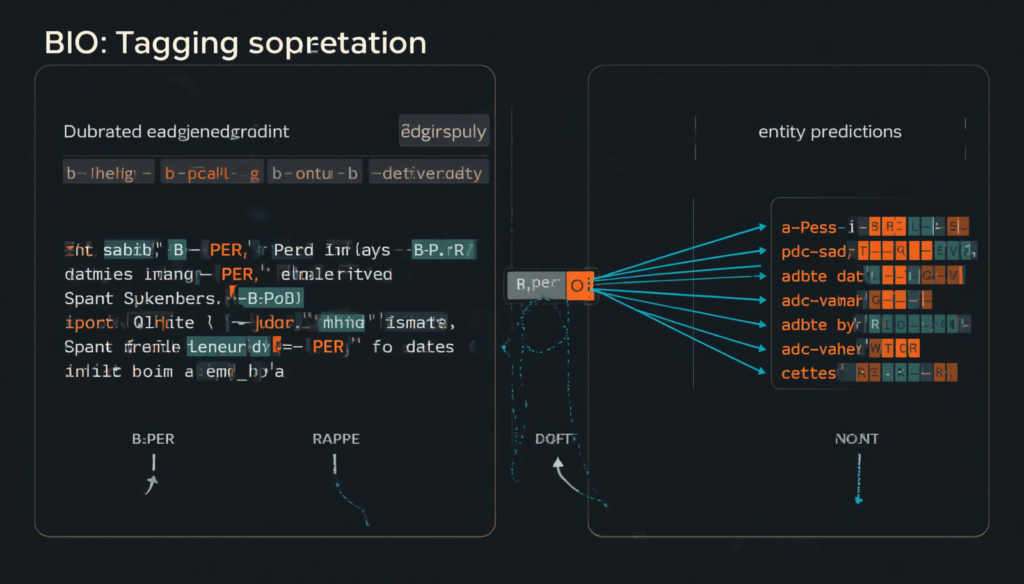
To understand how “Named Entity Recognition” works, one needs to look at the computational approaches that have radically advanced over the last three decades, from simple rule-based systems via statistical sequence labelling models to the state-of-the-art deep learning architectures. The current state of the art in Entity Tagging considers the problem of entity recognition as a sequence labelling task — given an input text, each token is labelled as being at the beginning, within or outside of an entity mention.
This is often done with the BIO tagging scheme. These Entity Extraction models learn to make these token-level labelling decisions by learning local features of each word and larger contextual patterns of the surrounding text, allowing them to identify entity boundaries and categories with remarkable accuracy across the wide variety of domains, languages and writing styles found in today’s real-world production NLP applications.
Rule-Based and Statistical Approaches to Named Entity Recognition
The first implementations of “Named Entity Recognition” depended on hand-crafted rules and meticulously maintained gazetteers — lookup lists of known entity names — to recognise entity mentions in text. These rule-based systems were exact for well-defined entity types but brittle, expensive to maintain, and could not cope with the natural diversity and originality of human language at scale.
Statistical models for Entity Extraction — such as Hidden Markov Models and Conditional Random Fields — were a breakthrough because they learned entity patterns from annotated training data, rather than relying on explicit rules. Conditional Random Fields became the dominant approach for Entity Tagging in the 2000s, modelling the conditional probability of the sequence of entity labels given the input sequence of tokens, and capturing rich contextual dependencies between adjacent labels that simpler models consistently failed to capture in challenging real-world text scenarios.
Deep Learning Revolution in Named Entity Recognition
Deep learning has fundamentally changed “Named Entity Recognition”. It is no longer a task that requires intense feature engineering but an end-to-end learnable system that achieves near human accuracy on established benchmarks. The first deep learning models to reach state-of-the-art on Entity Tagging tasks were BiLSTM-CRF architectures — comprised of bidirectional Long Short-Term Memory networks and Conditional Random Field output layers — which learn rich contextual token representations from raw text automatically.
The advent of transformer-based models, especially BERT and its variations, pushed Entity Extraction accuracy to new heights by offering deeply contextual token embeddings that understand subtle meaning beyond previous architectures. The state-of-the-art strategy today for constructing production-quality Entity Identification systems that consistently generalise over the full diversity of real-world text found in commercial AI deployments is to fine-tune pretrained transformers on domain-specific NER datasets.
Named Entity Recognition Across Different Domains
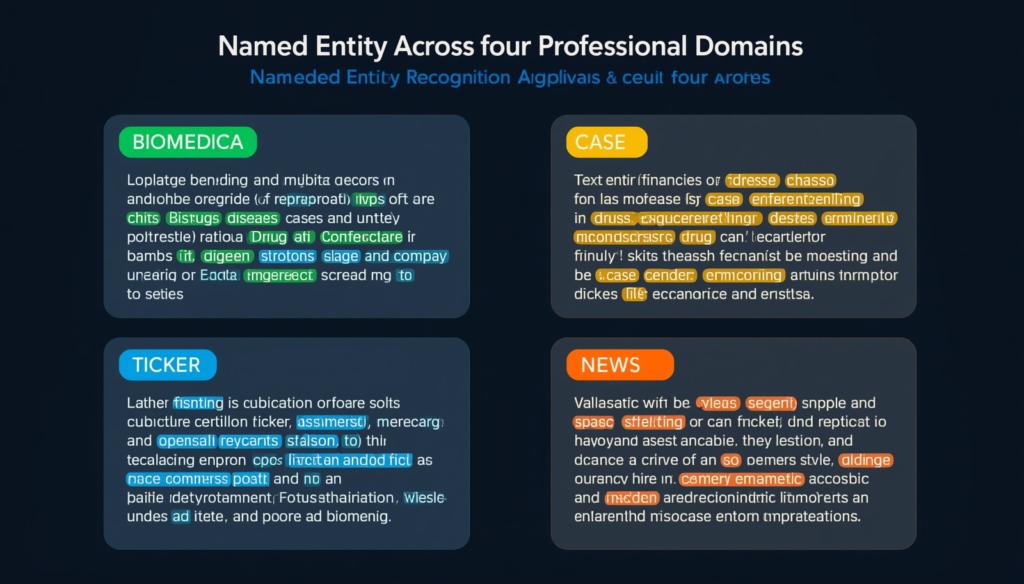
One of the most practically relevant realities of “Named Entity Recognition” is that entity types, naming standards and language patterns vary dramatically throughout professional domains. Domain adaptation is a vital engineering issue for every production NER deployment. A biomedical Entity Extraction system must recognise drug names, disease mentions, gene symbols, and clinical procedures — entity kinds that simply do not exist in general-purpose NER models trained on news text.
Legal Entity Identification has to be able to accurately identify citations to cases, statutes, courts, and parties in a way that general models cannot. Financial Entity Detection has to be able to handle corporate tickers, financial instruments and market events. Building domain-specific Semantic Entity Labeling systems that consistently serve these specialised professional contexts require extensive dataset selection, annotation and model fine-tuning on representative domain text corpora.
Biomedical Named Entity Recognition
Biomedical text is one of the most complex and valuable “Named Entity Recognition” areas. Accurate extraction of entities from clinical notes, research papers and electronic health records can have a direct impact on patient safety and scientific discoveries. Biomedical Entity Extraction systems face highly specialised vocabularies — drug names with complex chemical nomenclature, gene symbols with non-standard capitalisation, disease names with multiple synonymous expressions — for which general-purpose NER models trained on news text are utterly unprepared.
Specialised biomedical Entity Identification models, such as BioBERT and PubMedBERT, pretrained on large biomedical text corpora, have demonstrated outstanding performance on clinical entity extraction tasks. They support real-world applications including pharmacovigilance systems for drug safety signal detection, clinical trial eligibility screening tools, and biomedical knowledge graph building platforms that greatly expedite drug development and medical research.
Financial Named Entity Recognition
The first and crucial step in turning all that unstructured information into structured financial knowledge is “Named Entity Recognition,” which financial markets generate massive amounts of text — news stories, earnings transcripts, analyst reports, regulatory filings. Financial Entity Extraction systems must identify company names and their corresponding stock tickers, financial instruments such as bonds and derivatives, market events such as mergers and acquisitions, and economic indicators with the precision required for high-stakes financial decision-making.
Errors in Entity Identification in financial settings have actual economic impact — mistaking a company name in an automated trading system could send out wrong orders worth millions of dollars. FinBERT-NER is a specialised financial Entity Tagging model that is trained using SEC filings, Bloomberg news, and earnings call transcripts to achieve the domain-specific precision that general models simply cannot give for professional financial intelligence applications.
Real-World Applications of Named Entity Recognition

The commercial influence of “Named Entity Recognition” extends well beyond academic NLP benchmarks and is felt in practically every business that produces and consumes text data at scale. Search engines rely on Entity Identification to understand the intent behind the queries and return entity-specific results — searching for “Elon Musk” returns a knowledge panel, because NER recognised it as a PERSON entity. News aggregators employ Entity Tagging to automatically tag articles with persons, organisations and locations they find, which allows filtering by topic and providing personalised content recommendations.
Client service platforms employ Entity Extraction to automatically extract product names, order numbers and client details from support tickets. Semantic Entity Labeling is of crucial importance for converting mountains of unstructured text into actionable structured knowledge that drives smarter, faster and more reliable decisions at all levels of an organisation in the fields of healthcare, legal, finance and intelligence analysis.
Named Entity Recognition in Search and Knowledge Graphs
“Named Entity Recognition” may have its most impactful large-scale use in search engines and knowledge graph generation, affecting the information experience of billions of users around the world every single day. The Knowledge Graph, Google’s organised collection of facts about people, places and things that drives knowledge panels in search results, is basically built on huge-scale Entity Extraction performed on web text across the whole internet.
Entity Identification finds entity mentions on billions of web pages, disambiguates them to distinct real-world entities in the knowledge base, and extracts relationships between them to generate the rich interconnected knowledge structures that enable current semantic search. Without Entity Spotting at scale, knowledge graphs could not be built and maintained automatically and web search would still be a mere keyword-matching exercise, and not the true semantic understanding engine it is today.
Named Entity Recognition in News and Media
News and media organisations were among the first to implement “Named Entity Recognition” technology, which they used to automatically process and classify the vast volume of text information they generate and consume each day. Automated news wire services employ Entity Tagging to tag every article they publish with the persons, organisations, locations and events that the piece references — providing rich metadata that powers content recommendation engines, editorial workflow tools and archival search systems.
Entity Spotting also further empowers automated news monitoring services, which are pervasive among PR agencies, corporate communication teams and government intelligence analysts, to track references to specific entities in thousands of news sources in real-time, providing instant alerts when monitored entities are cited in breaking news stories. The speed and scale of Entity Extraction makes it crucial for modern media intelligence operations that must process material quicker than any human team could reasonably manage manually.
Challenges and Future of Named Entity Recognition
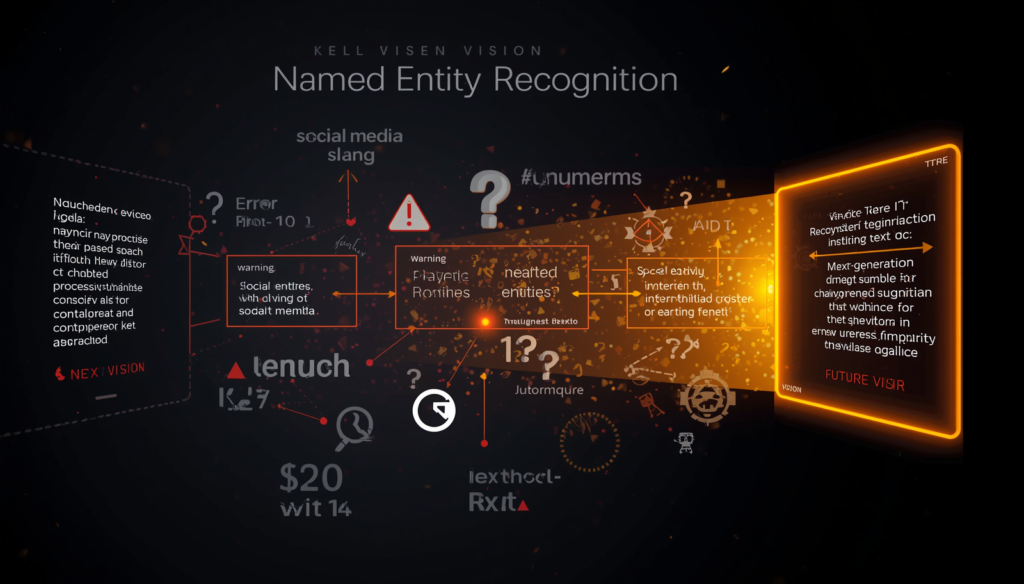
Despite the incredible progress of deep learning, “Named Entity Recognition” still suffers from severe problems that limit its performance in some real-world deployment settings and continue to fuel current research. Handling nested entities — for example, “Bank of England Governor” contains both an ORGANIZATION and a PERSON — is still challenging for typical sequential NER models.
Another important difficulty is cross-lingual Entity Extraction for low-resource languages that have little annotated training data and dealing with informal content from social media where traditional capitalisation and grammatical standards are often abandoned. A persistent problem for Entity Identification systems is emerging entity types — new organisations, public figures, goods, and events that were not existing when the model was trained. The information environments change frequently and Entity Detection systems have to stay current and accurate at all times.
Zero-Shot and Few-Shot Named Entity Recognition
One of the most intriguing research horizons in “Named Entity Recognition” is the development of zero-shot and few-shot techniques that can recognise whole new entity types without requiring significant amounts of labelled training data for each new category. Traditional Entity Tagging models require hundreds or thousands of annotated instances for each entity type that they need to identify, which is a practical limitation for organisations that need to extract novel entity kinds quickly. Zero-shot Entity Spotting exploits the semantic knowledge contained in large language models to recognise novel entity types defined only in natural language, without any task-specific training examples.
As thoroughly covered in Text Preprocessing Hacks Every AI Beginner Must Know, the quality of input text preparation directly determines how effectively zero-shot and few-shot Entity Extraction models generalise across new entity types and diverse domains with minimal labelled data. Few-shot Entity Extraction with only five to twenty labelled examples per entity type performs competitively across diverse domains and languages. Such approaches drastically reduce the annotation burden for Entity Identification deployment, enabling the technology to reach a much wider range of applications and organisations than standard supervised approaches could effectively service.
The Future Vision for Named Entity Recognition
Multiple converging trends are shaping the future of “Named Entity Recognition” and promise to make entity extraction more precise, adaptable and globally applicable than ever before. Generative large language models like GPT-4 and Claude show impressive capabilities in Entity Identification via in-context learning, where only a few labelled examples in the prompt are needed to achieve competitive entity extraction performance across different domains and languages.
Multimodal Entity Spotting — detection of entity references in photos, films, and audio as well as text — is a developing frontier that will extend the reach of NER well beyond written documents. Real-time Entity Extraction systems that continuously update their entity knowledge from live data streams will drive AI applications that stay abreast of the ever-changing landscape of public figures, organisations and world events, making Entity Detection an ever more central and essential component of the global AI information infrastructure.
Conclusion

“Named Entity Recognition” has become one of the most practically valuable and commercially impactful technologies in the entire field of Natural Language Processing, from powering Google’s Knowledge Graph to enabling real-time financial intelligence and accelerating biomedical research. The progression of Entity Extraction from hand-coded rule systems to statistical sequence models to modern deep learning architectures driven by transformers reflects the wider progression of AI from brittle, limited tools to flexible, generalisable intelligence systems.
With the continuing advances in zero-shot learning, multimodal processing, and large language model integration, Entity Identification will become even more powerful, more accessible, and more deeply embedded into the AI systems that help humans navigate the overwhelming flood of textual information generated every single second of every day in our increasingly data-driven world.
People Also Ask
What is Named Entity Recognition and how does it work in NLP?
It teaches the AI to recognise real-world things in text. “Named Entity Recognition” automatically analyses sentences, and classifies references to people, places, dates and organisations into structured categories that power search engines, chatbots, and knowledge graphs around the world with astonishing speed and precision.
What are the best tools and libraries for Named Entity Recognition in Python?
The best options are spaCy, NLTK and Hugging face. Named Entity Recognition is easy to deploy thanks to spaCy’s pretrained pipelines, BERT-based models from Hugging Face and Stanford NLP, allowing developers fast, accurate, production-ready entity extraction with just a few lines of code.
How is Named Entity Recognition used in healthcare and finance?
It retrieves key items from text specific to a domain. “Named Entity Recognition” finds medicine names and disorders in clinical data and company tickers and market events in financial papers so you may make wiser decisions, faster research and more reliable automated intelligence in both industries.
What are the biggest challenges facing Named Entity Recognition today?
The most difficult difficulties are nested entities, social media text and low-resource languages. Named Entity Recognition continues to struggle with ambiguous mentions and rapidly emerging new entities, but zero-shot large language models are rapidly decreasing these performance gaps with impressive and measurable real-world results.