Introduction
Welcome back to the AI Mastery Series . In Blog #4 i.e. “Large Language Models (LLMs): How ChatGPT, Claude & Gemini Actually Work” we drew back the curtain on Large Language Models – the foundational technology behind ChatGPT, Claude, and Gemini. Now in Blog #5 we look at two of the most practical, most widely deployed and most genuinely interesting branches of AI that are revolutionising industries right now. Combined, these two domains tackle one of the largest difficulties in all of artificial intelligence: how do you educate a machine to see and interpret the world as humans do, with sight and language? Inside “Computer Vision & NLP” is the answer.
“Computer Vision & NLP” – Computer Vision and Natural Language Processing – are the two sensory superpowers of modern AI. With computer vision, machines can see and interpret images and video. Natural Language Processing enables machines to read, comprehend and produce human language. Computer Vision & NLP together are the two most information dense routes for people to observe and communicate about the world. Learn these two areas and you will comprehend the technology behind facial recognition, medical imaging, voice assistants, sentiment analysis, real-time translation and so much more.
This site is your full, simple English guide to both. We will cover “Computer Vision & NLP” from scratch – what they are, how they operate, where they are utilised, what the latest advancements look like and how you may start researching them yourself. No technical experience required. Bring your curiosity, Computer Vision & NLP will do the rest.
Table of Contents
What Is Computer Vision and Why Does It Matter?
We take sight for granted. You look at a street scene and immediately identify the automobiles, the people, the signs, the shadows, the feelings—all in an instant. For decades machines have found this incredibly hard challenge. To teach a computer to “see” is to solve a huge number of complex challenges concurrently. We start with vision in “Computer Vision & NLP” because it is one of the oldest and most fully developed disciplines of AI—and because its real-world influence is already obvious in almost every business on the planet. From smartphones to surgical robots, computer vision is transforming not just what machines can accomplish, but how humans interact with the world.
How Machines "See" the World
A digital image is simply a matrix of integers. In an image each pixel has a numerical value that specifies its colour and brightness. A computer can’t see a face, it sees a grid of millions of numbers. The Problem of Computer Vision is to educate a machine to interpret the statistics in a meaningful way. Early attempts involved rules that were hand-built – programmers would write code that explicitly looked for edges, forms, colours.
These approaches were brittle and limiting. When deep learning, i.e. Convolutional Neural Networks, came into the scene, “Computer Vision & NLP” really exploded. CNNs learn to automatically identify pixel patterns from millions of labelled instances, with an accuracy that astounded even the scientists who designed them.
The ImageNet Moment That Changed Everything
In 2012, a deep learning model named AlexNet entered the ImageNet competition, a worldwide challenge to categorise one million photos into one thousand categories. The margin by which AlexNet won shocked the entire scientific community. It lowered the mistake rate by approximately half compared to the prior state-of-the-art approaches. This is the time that “Computer Vision & NLP” historians mark as the starting pistol of the modern AI age.
It established beyond any doubt that deep learning could solve genuine, big scale visual recognition issues better than any prior approach. In just a few years, the internet titans were pouring billions into computer vision research and the technology quickly moved from academic labs into cameras, phones, hospitals, industries and autonomous vehicles throughout the world.
Core Tasks in Computer Vision
Computer vision is not a single task, but a series of linked capabilities, each solving a separate facet of visual cognition. “Computer Vision & NLP” is about all these tasks and comprehending each one offers you a clear picture of what machines can and cannot achieve with visual data right now. “Introduction to Computer Vision: Teaching Machines to See and Understand“ A complete beginner friendly guide to how machines learn to see and interpret the visual world.
Each of these tasks, from just recognising what’s in an image to monitoring moving objects in a live stream, builds on the others and unlocks a whole new set of possibilities. In each of these areas, the progress accomplished over the last decade has been nothing short of astounding.
Image Classification, Object Detection, and Segmentation
Image categorisation is about answering the question: “What is in this image?” — that is, assigning a single label like “cat” or “traffic light.” Object detection takes things a step further and finds numerous items in a picture, forming a bounding box around each one. This matters for self-driving cars, which have to follow pedestrians, automobiles, bicycles and traffic signs simultaneously. Image segmentation goes this a step further, categorising every pixel in an image, allowing medical AI to create an accurate outline of a tumour in an MRI scan.
These three characteristics are the basic toolset of visual AI as seen in “Computer Vision & NLP”. They are all building blocks for increasingly sophisticated applications and all three are currently running in production systems that impact millions of actual lives every single day.
Facial Recognition, Pose Estimation, and Video Understanding
Facial recognition detects certain people from photos or video. It is used to unlock phones, in airport security and law enforcement, but it raises major ethical problems. Pose estimate tells us the location of human body joints in real time – enabling fitness applications to guide your form, gaming systems to monitor your motion and physical therapy devices to oversee recuperation of patients.
Video understanding extends beyond single images to recognise sequences of frames — empowering AI to identify suspicious activity in surveillance footage or make sports highlights automatically. Computer Vision & NLP notes that these capabilities are some of the most powerful and most contentious in all of AI. They demonstrate the awe-inspiring promise and the grave responsibility of bringing visual AI into practice.
Real-World Applications of Computer Vision
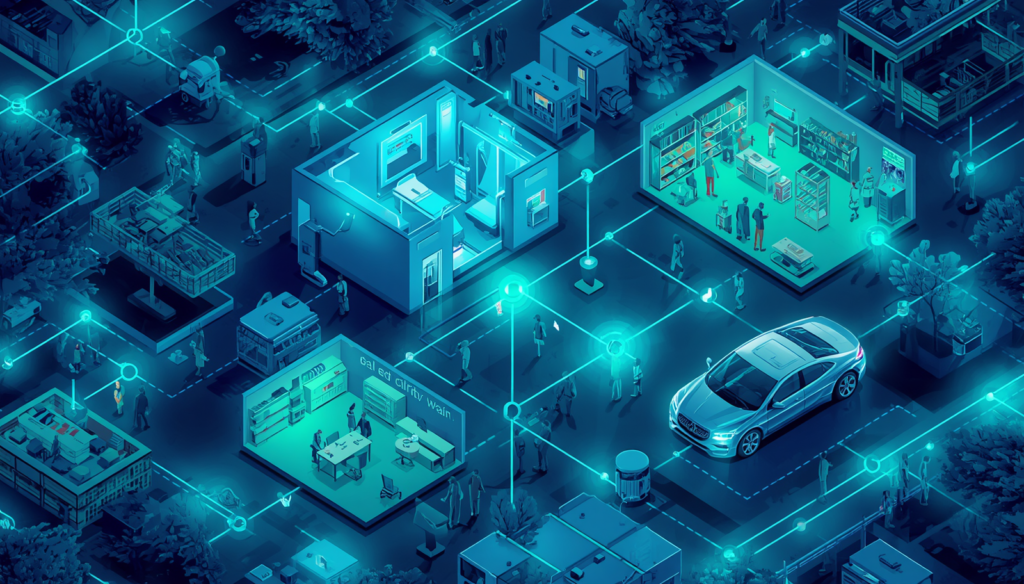
Learning the theory of Computer Vision is good — but seeing where it exists in the real world really brings it to life. “Computer Vision & NLP” is not only a research paper or a university lab. They are implemented at huge scale solving real issues, saving real lives and producing real economic value now. Computer vision is quietly revolutionising the way humans and machines operate together, from the hospital to the manufacturing floor and from the farm field to the retail store. The range of applications is one of the most convincing reasons as to why studying about “Computer Vision & NLP” is one of the best investments of time and attention you can make today.
Healthcare, Manufacturing, and Agriculture
In healthcare computer vision systems analyse medical pictures — X-rays, CT scans, MRI scans, pathology slides — with accuracy that meets or exceeds experienced specialists in specialised jobs. AI algorithms can look at photos and identify early stage malignancies, diabetic eye problems and bone fractures in seconds. In manufacturing, computer vision provides quality control on production lines – finding faults that slow human inspectors, after hours of recurrent visual inspection.
In farming, drones equipped with computer vision cameras are employed to assess crop health, detect pest infestations and predict harvests across vast expanses of thousands of acres. Just these three domains of “Computer Vision & NLP” mean hundreds of billions of dollars of economic impact and — more significantly — verifiable benefits in human health, food security and industrial efficiency.
Retail, Autonomous Vehicles, and Security
In retail, Amazon Go stores utilise computer vision to monitor what shoppers pick up, billing them immediately when they walk out – no checkout needed. For self-driving cars, computer vision systems concurrently receive feeds from many cameras and identify lane markings, traffic lights, pedestrians and objects in real time to navigate the car safely. In security and surveillance, computer vision is used to monitor public environments, detect anomalies, and potentially identify individuals or behaviours of interest.
The fast-paced growth of “Computer Vision & NLP” applications in these sectors also brings up significant problems concerning privacy, consent, and the ethical deployment of surveillance technologies. Today, anybody who works in and near AI-powered systems needs to understand the possibility and the obligation.
What Is Natural Language Processing (NLP)?
Computer Vision offers robots the gift of sight, Natural Language Processing gives them the gift of language. NLP is the subfield of AI concerned with the interaction between computers and human language, in all its forms and complexities. “Computer Vision & NLP” brings together two deeply intertwined fields: both are concerned with teaching machines to comprehend high-dimensional unstructured input – pixels for vision, words for language – and gain useful understanding from it. NLP is the engine behind your voice assistant, your email spam filter, Google Translate, emotion analysis tools, and the chatbots you engage with every day on the web.
Why Language Is Hard for Machines
The complexity of human language is astonishing. The same phrase might have very diverse meanings in different circumstances – ” I saw her duck ” could indicate that you saw a lady stoop , or that you saw her pet waterfowl . Sarcasm , irony , cultural references , idioms , inferred meaning . All those things , start from zero , making language interpretation exceedingly tough for robots . Early NLP systems relied on hand-crafted rules and statistical methodologies that succeeded in narrow domains but quickly broke down in real-world discussions.
The field of ‘Computer Vision & NLP’ significantly changed when deep learning, especially the Transformer architecture, was applied to language tasks. Suddenly robots could understand context, ambiguity, complexity in ways that felt really impressive. One of the most dramatic leaps in all of technology is going from brittle rule-based systems to conversational AI today.
Core NLP Tasks: From Tokenization to Understanding
NLP is a pipeline of more difficult activities. Tokenisation divides the text down into individual pieces, either words or sub-words, for processing. Part-of-speech tagging finds out what part of speech each word is, such as noun, verb, adjective, etc. Named entity recognition is the task of identifying individuals, locations, organisations, and dates in text. Sentiment analysis is about working out the emotional tone of a piece of text, whether it’s good, negative or neutral.
Machine translation is the automatic translation of text between languages. Text summarisation extracts significant points from long papers. Computer Vision & NLP. It uses all these activities as building pieces. They’re useful on their own, and strong AI products are created by smartly integrating them. Understanding these basic objectives provides you with a useful framework for thinking about what NLP systems can and cannot perform in practical applications.
Breakthroughs That Transformed NLP
The history of NLP is a tale of steady growth punctuated by abrupt and stunning leaps forward. The most dramatic achievements in all of AI research have come from “Computer Vision & NLP”, occasions in which a new technique or architecture suddenly made jobs that had been impossible normal. Knowing these breakthrough moments offers you a broader appreciation for where the field is today, and why the tools you use — from Google Translate to ChatGPT — perform as effectively as they do. And the development has been advancing, not decelerating, for the last decade, each discovery building upon the next.
Word Embeddings, LSTM, and the Road to Transformers
One of the first big successes in modern NLP was “word embeddings,” methods such as Word2Vec that converted words into numerical vectors in a way that captured semantic links. Words with comparable meanings were close to one another in mathematical space. In these vector spaces, famously, “King” – “man” + “woman” = “queen”.
Then Long Short-Term Memory networks (LSTMs) helped models to handle sequential material better by providing them a form of memory across longer stretches. These were big milestones, but both had serious limitations when it came to really long texts. The 2017 Transformer breakthrough really started the contemporary era of “Computer Vision & NLP” – dealing with context across entire documents at the same time, at an unprecedented scale.
BERT, GPT, and the Era of Pre-trained Language Models
Google’s 2018 introduction of BERT — Bidirectional Encoder Representations from Transformers — was a breakthrough that changed NLP by reading text in both directions at once, allowing for much better contextual comprehension. BERT became the core of Google Search’s capacity to understand natural language enquiries. Meanwhile OpenAI’s GPT series went a different route – training gigantic generative models that can produce human quality prose.
In 2020, GPT-3 shocked the world with its few-shot learning capacity – generating outstanding outcomes with just a few samples in the prompt. These models profoundly changed “Computer Vision & NLP”. Pre-training on huge datasets, followed by fine-tuning for specific tasks became the prevailing paradigm — the same paradigm that is behind every major AI product you use today.
Where Computer Vision and NLP Come Together
Some of the most powerful and interesting AI applications today are at the confluence of “Computer Vision and NLP” – machines that can see and comprehend words about what they perceive. This is where “Computer Vision & NLP” becomes larger than the sum of its parts. Multimodal AI systems that integrate visual and linguistic understanding are enabling totally new categories of products and services that were unimaginable just a few years ago. The overlap of these two areas is one of the defining themes in AI research and commercial development right now.
Image Captioning, Visual Q&A, and Document AI
Image captioning systems analyse an image and produce a written description of what they perceive, a crucial function for accessibility tools that assist visually challenged users in comprehending visual material. Visual Question Answering (VQA) allows users to ask natural language enquiries about images – “How many people are in this photo?” or “What colour is the car on the left?”
Document AI uses computer vision to interpret the layout and language of scanned documents, and uses NLP to understand and extract the relevant information. “Collaborating in Document AI, Computer Vision & NLP is revolutionising industries such as law, finance and insurance — where millions of pages of unstructured documents formerly demanded hordes of human readers to process and analyse at great expense and time.
Multimodal Models: GPT-4o, Gemini, and Claude
The newest generation of AI models are inherently multimodal, supporting text, graphics, audio and video all in a single unified framework. You can show GPT-4o a picture and have a deep chat about it. Gemini Ultra has been developed from the ground up to support many modalities at the same time. Claude can read documents you submit, photos, data files, and text conversations.
These systems are effectively combining “Computer Vision & NLP” – the barrier between “vision model” and “language model” is blurring. This convergence is creating AI helpers that are much more flexible and useful than any one-modality system could ever be. The future of AI is multimodal and that future is here today, running in the technologies millions of people use every single day.
How to Start Exploring Computer Vision and NLP Yourself

While it’s inspiring to learn about what ‘Computer Vision & NLP’ can do, the real excitement is constructing things yourself. Neither field has ever been more open to the novice. Free tools, pre-trained models and beginner friendly libraries mean that you can have your first working computer vision or NLP project in a matter of hours of deciding to attempt. “Computer Vision & NLP” is no longer a domain of PhD researchers with access to costly computing clusters. This is a field that any motivated student, with a laptop and an Internet connection, can begin to understand right now — today — using tools that are absolutely free and amazingly easy to use.
Getting Started with Computer Vision Projects
Get started quickly for Computer Vision.ai course – you’ll be training an image classifier on a custom dataset in the first class. Use Google Colab to get free GPU access. Choose a project that interests you personally – train a model to identify your favourite sort of flower, recognise different types of birds, or find things in photographs from your own camera. The Hugging Face model hub has thousands of pre-trained computer vision models available that you may use without training from start.
Beginners in “Computer Vision & NLP” should experiment, not aim for perfection. Test, look, snap, repair, test again. Every experiment, whether it works or not, teaches you something that no tutorial can ever teach. But the hands-on experience is unmatched and so fulfilling.
Getting Started with NLP Projects
If you are into NLP, Hugging Face Transformers is your best friend, giving you access to BERT, GPT-2, and hundreds of other pre-trained language models with just a few lines of Python code. Building a sentiment analyser is a wonderful first NLP project. A sentiment analyser is a model that scans product reviews or social media postings and classifies them as positive, negative or neutral. Another good project for beginners is a text summariser or a simple question answering system.
Computer Vision & NLP Beginners in the NLP arena might also check out spaCy, a fast, production-ready NLP library that makes it easy to do things like named entity recognition, part-of-speech tagging, and dependency parsing. Now add some real datasets from Kaggle or Hugging Face Datasets, and you have everything you need to construct projects that are seriously amazing and thoroughly informative at the same time.
Final Thoughts

We’ve taught machines to spot faces in a crowd, to read, translate and comprehend human writing in dozens of languages; ‘Computer Vision & NLP’ are two of the most powerful and most humanly resonant achievements of current AI. They provide machines with something akin to human senses – the ability to see and comprehend the world through sight and language.
“Computer Vision & NLP” are not merely academic achievements. These are technologies being used today impacting billions of lives – in hospitals diagnosing diseases, in phones that open with a glimpse, in translation applications breaking down language boundaries, in voice assistants that understand natural speech. And the pitch is moving faster than it ever has before.
In Blog #6 we get hands-on and practical with MLOps and AI Tools – learning how to actually develop, train and deploy your own AI models using the professional tools that real data scientists and AI engineers use every day. This is where theory turns into craft.
From here the journey becomes more fun and more hands on. “Go ahead.
People Also Ask
"What is Computer Vision and how do machines actually see?"
“Machines do not have natural sight like humans. “Computer Vision & NLP” describes how cameras collect pixels, computers identify patterns and neural networks interpret images – giving robots the amazing ability to recognise faces, read signs and understand visual scenes correctly.
"What is Natural Language Processing and how does it work?"
Humans speak language with a richness and contextual depth. “Computer Vision & NLP” describes how computers learn to read, comprehend and generate text that drives voice assistants, translation tools, sentiment analysers and any chatbot that understands your words and reacts intelligently today.
"What are the best real world applications of Computer Vision in 2026?"
Computer vision is gradually changing every major sector. “Computer Vision & NLP” shows how hospitals discover cancer in scans, manufactures find problems in an instant, shops do away with checkout lines and self-driving cars traverse roads—all with machines that truly see and understand.
"How are Computer Vision and NLP coming together in modern AI?"
The most powerful AIs today mix sight and language concurrently. “Computer Vision & NLP” demonstrates how multimodal systems such as GPT-4o and Gemini understand images, respond to visual questions, and produce descriptions – combining the two powerful AI fields into a single, unified and astonishingly sophisticated intellect.