Introduction

Welcome back to the AI Mastery Series. In the first five blogs including no.5 blog i.e. “Computer Vision & NLP: Teaching Machines to See, Read, and Understand” we have outlined the complete conceptual landscape of AI – what it is, how computers learn, deep learning, huge language models, computer vision and natural language processing. You now have a good grasp of the theories that drive modern AI. But now is where everything changes. Blog #6 moves us out of the classroom and into the workshop. This is when theory turns to craft. This is where “MLOps & AI Tools” comes into play.
“MLOps & AI Tools” is the practical side of AI – the discipline of actually constructing, training, testing, and deploying machine learning models in the real-world. MLOps is short for Machine Learning Operations. MLOps is the difference between a model that works in a research notebook and a model that works dependably in a live product for real users, every single day. The difference between an AI enthusiast and an AI professional: MLOps & AI Tools They’re the skills, processes, and platforms that make AI production-ready, scalable, and maintainable over time.
In this blog, we’ll unpack “MLOps & AI Tools” into everything you need to know—from the must-have programming tools and frameworks to the cloud platforms where models are trained and hosted—to the whole lifecycle of a genuine AI project from raw data to live deployment. If you’re into building AI products, a job in data science, or simply want to learn how AI systems really work in the real world, “MLOps & AI Tools” is the most practical, immediately applicable article in the whole series. Let’s get to it.
Table of Contents
What Is MLOps and Why Does It Exist?
You can build the most precise machine learning model in the world. But if it only works on your laptop notebook and comes apart the moment real users engage with it, it is pointless. This is the challenge that the MLOps & AI Tools was built to answer. MLOps is the combination of machine learning, software engineering and DevOps to build systems that are accurate, reliable, scalable, reproducible and maintainable. It’s the discipline that moves AI from experiment to production—and in the real world output is everything. A model that doesn’t ship helps no one.
The Gap Between Research and Production
In research , a data scientist trains a model on a clean dataset , gets remarkable accuracy , and writes a report . In production, that same model has to deal with real-time streaming of messy and inconsistent real-world data. It must to work reliably under severe load . It has to be updated as the data distribution shifts. It needs to be monitored for drift, bias and failure. It has to interface with existing software systems and databases.
“MLOps & AI Tools” exists specifically to bridge this gap — often called the “last mile” problem in AI. The studies indicate, again and over again, that more than 85 percent of AI initiatives never make it from prototype to production. There are MLOps approaches to solve that statistic by adding technical discipline and operational rigour to the entire machine learning lifecycle.
The Machine Learning Lifecycle
The machine learning lifecycle is the whole end-to-end process of constructing and operating an AI system. It starts with problem description – understanding exactly what you want the model to perform and why. Then data collection and preparation, model training and evaluation, deployment into a live environment, and continued monitoring and maintenance. There are tools, problems and best practices at each step.
“MLOps & AI Tools” describes each of these phases as an interconnected, continuous loop rather than a single linear process. In practice, models are continuously re-trained with fresh data, benchmarked against new benchmarks, and redeployed with improvements. The difference between a data scientist who produces demo models and an AI engineer who builds actual products is understanding the whole lifecycle, not just the training step.
The Essential Programming Environment for AI

To construct anything in AI, you first need to set up the correct working environment. The good news is that the tools used by the world’s greatest AI engineers are virtually entirely free and open source. “MLOps & AI Tools” starts with the environment since if you don’t get this right from day one, it will create huge amounts of confusion and wasted time later. A good AI development environment is not just about having the necessary tools installed, it’s about having a configuration that fosters experimentation, makes collaboration easy, tracks your work reproducibly and scales effortlessly from your laptop to powerful cloud infrastructure when you need it.
Python, Conda, and Virtual Environments
Python is the default language for AI and machine learning . It is simple, easy to use, and has a huge ecosystem of scientific libraries, making it the appropriate tool for the job. But developing Python applications involves good control of environments – separate projects sometimes require different versions of libraries and conflicts between libraries can create annoying failures. This problem is solved by conda and virtual environments, which provide isolated spaces for each project with its own set of dependencies.
The people that do “MLOps & AI Tools” always work inside virtual environments – it’s a basic professional habit. Anaconda is the most popular distribution for data science, pre-installing Python, conda and dozens of scientific libraries. The first practical skill every AI practitioner should learn is how to setup a clean, organised Python environment.
Jupyter Notebooks and Google Colab
The bulk of the AI exploration takes place in the interactive coding environment, Jupyter Notebooks. You can write code in cells, execute them one by one, see the output immediately, add explanatory text and visualisations next to your code, and share your full analysis as a self-contained document. This makes them well suited for inquiry, learning, and communicating outcomes. Google Colab makes Jupyter Notebooks available in the cloud — for free! That means we can tap into ultra-powerful GPUs and TPUs that would cost hundreds of dollars an hour.
“MLOps & AI Tools” – heavy usage of Google Colab for training models too computationally intensive for a regular laptop. For novices in particular, Colab removes every barrier to entry – no installation, no hardware requirements, just open your browser and start constructing genuine AI models right away.
The Core AI Frameworks — TensorFlow and PyTorch
If Python is the language of AI, then TensorFlow and PyTorch are the two major dialects of that language: the deep learning frameworks that give the building blocks to create, train, and deploy neural networks. The choice between the two used to be a big controversy in the AI world. Both are mature, powerful and widely used today – and if you are serious about “MLOps & AI Tools” then you need to know at least one. Each framework has its own philosophy, strengths, and ecosystem and knowing the differences helps you pick the correct tool for your specific project and career goals.
TensorFlow and Keras: Production-Ready Deep Learning
TensorFlow is an open source machine learning library developed by Google in 2015. It rapidly became the main framework for production AI systems at scale. TensorFlow is known for its performance, scalability and strong deployment tools – especially TensorFlow Serving and TensorFlow Lite for delivering models to servers and mobile devices accordingly.
Keras, now coupled with TensorFlow as its high-level API, simplifies the process of developing neural networks – you can specify a full deep learning model in just 10 lines of code. Practitioners like TensorFlow in enterprise environments, mobile AI, and Google Cloud infrastructure because of its production ecosystem and deployment possibilities across a wide variety of devices, servers, and browsers.
PyTorch: The Researcher's Framework That Won Industry
Meta AI developed PyTorch, and launched it in 2016 with a different philosophy behind it. The philosophy is focused on flexibility, intuitive debugging and a dynamic computation graph that makes it seem much more like writing standard Python code. Researchers appreciated it immediately, because it made experimenting with novel architectures rapid and intuitive. What was once a research tool quickly became the industry’s preferred framework as well.
Now, the vast majority of new AI research papers are written using PyTorch, and organisations from Tesla to OpenAI develop their models with it. Learners of “MLOps & AI Tools” are more and more encouraged to start with PyTorch because of its more understandable code, straightforward debugging, and superb community resources. If you have to learn just one deep learning framework today, PyTorch is the one that most specialists would recommend.
The Most Important Ingredient in Any AI System

In AI, there’s a saying that’s become almost a cliché because it’s so utterly true: “garbage in, garbage out.” The quality of your data dictates the quality of your model; no amount of computational sophistication can make up for poor, biased, or insufficient training data.”MLOps & AI Tools: Build, Train, and Deploy Your First AI Model” — Starting With Clean Quality Data.
In real-world AI projects, data labour (gathering, cleaning, labelling, and maintaining data) takes up the majority of a practitioner’s time and effort.
This is why the book “MLOps & AI Tools” devotes a lot of time to data. Knowing this fact in advance is the way to avoid the rookie mistake of wasting all your energy in model architecture, ignoring the basis on which everything else is built.
Data Collection, Cleaning, and Feature Engineering
Data collection is the process of collecting raw data from databases, APIs, web scraping, sensors, surveys, or public datasets. Raw data is seldom clean – it has missing values, duplicate entries, inconsistent formatting, outliers and errors that need to be found and fixed before training. This operation is called data cleaning, and it is arduous but vital work. Feature engineering is the practice of changing raw data into the particular numeric input data that a machine learning model can learn from well.
Professionals in “MLOps & AI Tools” will often utilise Pandas for data processing, NumPy for numerical calculations, and Matplotlib or Seaborn for visualisation. These three libraries are the bread and butter of data science in Python, and knowing them is as crucial as knowing any machine learning method or deep learning framework.
Data Versioning, Labeling, and Data Pipelines
Rising complexity of AI programs makes data management a science of its own. Tools for data versioning, such as DVC – Data Version Control – enable teams to track changes to datasets over time, much like Git tracks changes to code. This makes trials reproducible in the sense that you can always go back and know exactly which version of the data produced which model results.
Data labelling, the process of manually annotating training data with the correct answers, is one of the most time-consuming and expensive parts of supervised learning. Tools like Label Studio and Scale AI help to organise this procedure efficiently. MLOps & AI tools at scale rely on automated data pipelines that continuously gather, clean, validate and feed fresh data to models to retrain. One of the most valuable skills in all of AI engineering is building robust data pipelines.
Training, Experiment Tracking, and Model Evaluation

Training a machine learning model is not a one shot affair. In practice you train dozens or hundreds of variations trying alternative architectures, hyperparameters, data preprocessing methodologies, training strategies. Keeping track of all these trials, comparing outcomes and figuring out what actually made a difference is a core part of becoming a competent AI engineer. And how do you manage this process of experimentation in a methodical way and not chaotic way ? ” MLOps & AI Tools ” offers a rich range of tools and methods . Without good experiment recording, you can get into a position where you have a terrific result, but have no idea what combination of choices led to it – and so can’t duplicate or improve on it.
Hyperparameter Tuning and Experiment Tracking with MLflow
Hyperparameters are the knobs you get to configure before you start training — learning rate, batch size, number of layers, dropout rate, etc. Choosing the right hyperparameters can be the difference between a poor model and a state-of-art one. Automated hyperparameter tuning programs like Optuna and Ray Tune explore thousands of permutations to find the best values.
MLflow is an open source platform for recording experiments, capturing hyperparameters, metrics and model artefacts for each training run so you can plainly and reproducibly compare outcomes. MLflow is seen as building block infrastructure by MLOps & AI Tools professionals. It makes wild experimentation a disciplined, queryable history of every effort – making it easy to understand exactly what works, why it works and how to build on it reliably.
Model Evaluation Metrics and Validation Strategies
Getting a high accuracy on your training data is merely the beginning. The real test is how it does on data it has not seen before. A good evaluation strategy is to separate data into training, validation and test sets, then use cross-validation techniques to derive credible estimates of real-world performance. Which assessment measure is correct depends entirely on the problem you are trying to solve – accuracy is OK for balanced classification, but for imbalanced datasets (think fraud detection or medical diagnosis), precision, recall, F1-score and AUC-ROC become important.
In “MLOps & AI Tools,” you’ll learn to be sceptical of impressive-sounding metrics and always question, “What does this metric actually mean for real users in the real world?” If the dataset is significantly skewed, a 99% accurate model in a fraud detection task may miss 90% of the real fraud cases.
Deploying AI Models — From Notebook to the Real World

It is satisfying to train a superb model. That’s when the true magic happens – deploying it so real consumers can interact with it. Deployment is the process of making your trained model available as a service that can take input, execute the model and deliver predictions – at scale, reliably and fast. “MLOps & AI Tools” views deployment as a first class citizen, not a secondary consideration, because a model that never reaches users is worth nothing. The landscape of deploying models has changed drastically over the past few years and there are presently more alternatives, and more accessible solutions, for deploying AI models than ever in the history of the field.
APIs, FastAPI, and Serving Models as Web Services
The most popular means of deploying a machine learning model is through a REST API, an endpoint that takes in input data over the web, runs it through the model, and produces a prediction. Today, FastAPI is the most popular Python framework for constructing these APIs: it’s fast, easy to use, automatically creates documentation, and efficiently handles high numbers of queries.
Now your model is wrapped in a FastAPI application and any other software system can talk to it over the internet – a website, a mobile app, another backend service. MLOps & AI Tools practitioners wrap their API and all dependencies into a Docker container, a standard, portable unit that will execute the same on every system. Docker solves the “it works on my laptop” problem forever, and is an essential skill for every serious AI engineer today.
Cloud Deployment: AWS, Google Cloud, and Azure
Once your model is containerised, you need a dependable, scalable and accessible place to run it. All three major cloud platforms, Amazon Web capabilities, Google Cloud Platform, and Microsoft Azure, have specialised capabilities for deploying and scaling machine learning models.”MLOps & AI Tools” — Choosing the Right Cloud Platform for Your AI. AWS SageMaker, Google Vertex AI, and Azure Machine Learning all offer managed infrastructure for model hosting, automatic scaling, monitoring, and training at scale.
Hugging Face Spaces is a free and straightforward way to deploy models publicly – great for demos and portfolios. Those who practise “MLOps & AI Tools” choose their cloud platform based on pricing, existing infrastructure and unique service requirements. Learning to deploy on at least one major cloud platform is not optional for a professional career in AI — it’s a baseline expectation in practically every data scientist and AI engineer job description today.
Monitoring, Maintenance, and the Future of MLOps
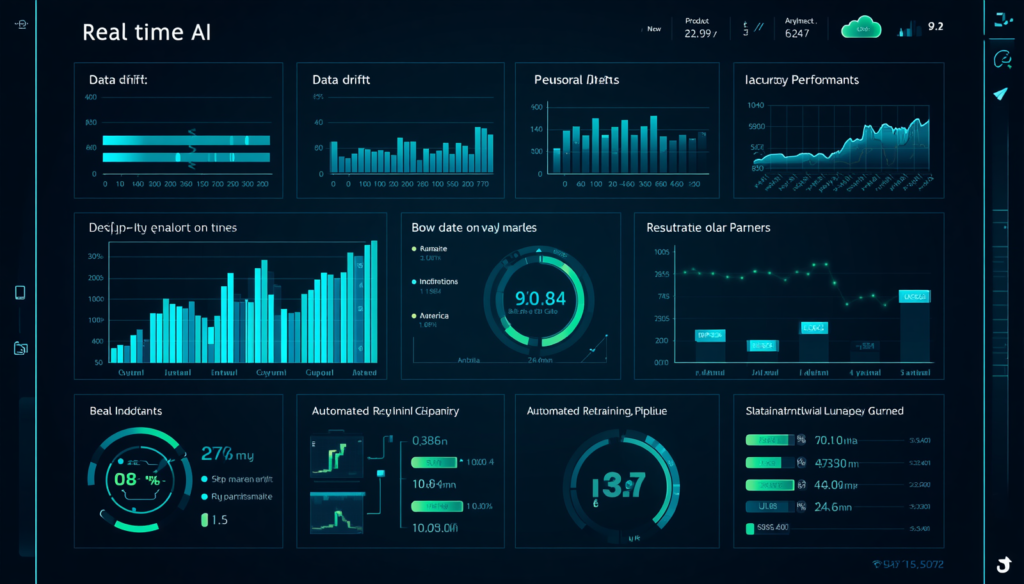
Deploying a model is not the end of the journey, it is the beginning. Models get worse over time when the real world changes and the data they see diverges from what they were trained on. “MLOps & AI Tools” takes the monitoring and maintenance phase of the AI lifecycle seriously, because this is where production systems succeed or fail in the long run. A launched-and-forgotten model is a liability. A model that is continuously monitored, reviewed and updated is a true asset, that gains value over time as it learns and adapts to an ever-changing world.
Model Monitoring, Data Drift, and Retraining Pipelines
Once the model is live you need to continue monitoring its performance. Model monitoring is about monitoring forecast accuracy, latency, error rates and importantly, data drift. Data drift happens when the data the model sees in the actual world starts to appear different than the data it was trained on. For example, a fraud detection model trained before a new form of scam appears will become less successful at catching that new scam. Examples of “MLOps & AI Tools” include Evidently AI, Arize and Weights & Biases.
These platforms feature dashboards that allow you to watch these metrics over time and set alarms when performance decreases. “MLOps & AI Tools”— Keeping Your AI Sharp and Production Ready. The gold standard for maintaining commercial AI systems accurate and relevant, without needing ongoing human oversight, is to have automated retraining pipelines – systems that automatically gather fresh data, retrain the model, evaluate it and redeploy it.
The Future of MLOps: AutoML and AI-Assisted Development
The future of MLOps & AI Tools is one where more and more of the pipeline is automated. Platforms such as Google AutoML, H2O.ai and AWS AutoPilot (AutoML) automatically search for the optimum model architecture and hyperparameters for a given dataset, significantly lowering the amount of skill needed to develop high-quality models. AI-powered development tools like GitHub Copilot build boilerplate ML code for you, and AI-powered debugging tools tell you why a model isn’t working well.
AI is reinventing “MLOps & AI Tools” itself — generating a virtuous circle where AI builds better AI quicker. For the students who will enter the area today, that implies the barrier to constructing advanced AI systems will continue to fall – making it one of the most fascinating and opportunity-rich subjects in all of technology for the foreseeable future.
Final Thoughts

You just took a stroll through the entire “MLOps & AI Tools” journey from spinning up your Python environment to deploying a model on cloud infrastructure. This is the nuts and bolts of AI development – the discipline that takes amazing ideas and well-trained models and turns them into real products that real people use and benefit from every single day.
“MLOps & AI Tools” isn’t glamorous in the way that talking about ChatGPT or generative art is beautiful. But this is where the real job is done. This is where AI goes from being remarkable to being useful. And the experts that learn “MLOps & AI Tools” are some of the most in-demand persons in the entire tech sector today.
In Blog #7 we dive into some of the most interesting and cutting edge territory in all of AI – Agentic AI and AutoML: systems that don’t just answer questions, but reason, plan and act autonomously to perform complicated multi-step tasks. This is the next frontier and it’s already here.
The deeper we go the stronger it become. Keep it up
People Also Ask
"What is MLOps and why does every AI team need it?"
But training AI models is only half the story. “MLOps & AI Tools” explains how machine learning operations bridge the gap between research and production, making AI systems dependable, scalable, monitored and continuously enhanced day in and day out in real world contexts.
"What are the best AI tools to build and deploy machine learning models?"
The correct tool for the right job can save a lot of time and effort. The “MLOps & AI Tools” is a straightforward sign of Python, TensorFlow, PyTorch, Docker, FastAPI and cloud platforms – the key professional toolbox that data scientist and AI engineer needs to construct, train and deploy production ready models effectively.
"How do you deploy a machine learning model for real world use?"
AI finally delivers actual benefit in the field. “MLOps & AI Tools” teaches you to take your trained model and quickly make it a live, scalable, production ready service by wrapping it with FastAPI, containerising it with Docker and hosting it on AWS, Google Cloud or Azure.
"What is the difference between a Data Scientist and an MLOps Engineer?"
Most people are totally confused by these two roles. “MLOps & AI Tools” says it simply – data scientists design and train models, and MLOps engineers make sure those models function reliably, scale effectively, and improve constantly in live production environments serving actual users every day.