Introduction

Welcome back to the AI Mastery Series. In Blog #1 “Generative AI Demystified: What Is Artificial Intelligence and Why It’s Reshaping the World”we spoke about what Artificial Intelligence is and how it is changing the world around us. Now let’s move one step further, into the very heart of AI itself. That heart has a name: Machine Learning Roadmap. All you see AI doing today, recognising your face, predicting your next purchase, translating languages in real time, it all involves machine learning at its foundation.
But the reality is that when most people hear the words “machine learning” they immediately believe that it sounds too technical, too mathematical or too hard for them. The “Machine Learning Roadmap” is here to show that false. It doesn’t take a data scientist to grasp how robots learn You just need the proper guide, the correct language, the right place to start. This blog is just that. A straightforward, basic entry, step-by-step, into one of the most powerful ideas in modern technology.
By the time you finish this blog, you will know how machines learn from data, what are the many types of machine learning, what are the tools and languages that are used and most importantly — how you can start walking this route yourself. The “Machine Learning Roadmap” is not a myth. Your unique guide to what’s ahead.
Table of Contents
What Is Machine Learning and Why Does It Matter?

Machine learning is the method by which computers learn from experience, much like people do. A machine learning system is given data rather than being coded with fixed rules, and learns to detect patterns all by itself. Here the “Machine Learning Roadmap” starts. The basic premise is that machines do not have to be explained each and every rule. They can learn on their own, given enough instances and the correct teaching. This one idea revolutionised computers and gave birth to all the AI we use nowadays.
Learning from Data, Not Rules
Traditional computer programs are very much “if this, then that” instructions. Machine learning turns this on its head. Instead of defining rules you give the system thousands or millions of samples and it works out the rules automatically. You feed 10,000 photographs of cats and 10,000 pictures of dogs into a machine-learning model, and it learns to recognise the difference – without you ever specifying what a “cat” looks like.
One of the most essential principles in all of technology is highlighted in the “Machine Learning Roadmap”. That means computers can now handle issues that are too complex for humans to create rules for—like comprehending human speech, reading emotions or forecasting sickness.
Why Machine Learning Is the Foundation of All AI
Machine learning is under the hood of every major AI product you use today — ChatGPT, Google Translate, Netflix recommendations, Uber’s pricing engine. AI without machine learning would still be a bunch of stiff, constrained programs that break when confronted with anything unforeseen. If you want to comprehend AI in any meaningful sense, the “Machine Learning Roadmap” makes it obvious that you have to understand machine learning first. It’s not just a tool in the toolbox, it’s the toolbox. It is like the engine in the automobile. Sometimes you don’t see it, yet without it, nothing moves. If you study the engine, you study the machine.
The Three Main Types of Machine Learning
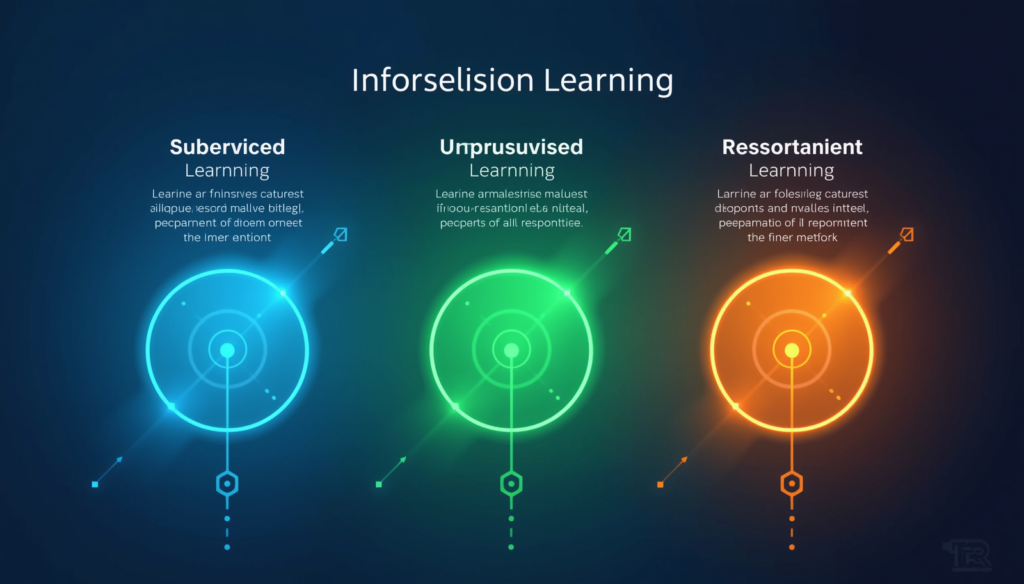
Not all machine learning is created equal. There are three basic ways . Each is for different types of difficulties . These three types are a key milestone on the “Machine Learning Roadmap” – if you know them, a huge amount of AI suddenly becomes clear. There are 3 categories . Supervised Learning Unsupervised Learning Reinforcement Learning All of them teach a computer something different at a fundamental level, and all of them power various families of real world applications you encounter every day.
Supervised Learning: Learning with a Teacher
Supervised learning is the most common type of machine learning. Here, you give the model labeled data — meaning each example comes with the correct answer already attached. You show it thousands of emails labeled “spam” or “not spam,” and it learns to classify new emails on its own. You show it thousands of X-rays labeled “healthy” or “cancerous,” and it learns to detect disease. The Machine Learning Roadmap treats supervised learning as the ideal starting point for beginners because it is the most intuitive. The model learns from examples — exactly the way a student learns from a teacher who provides correct answers and feedback throughout the learning process.
Unsupervised and Reinforcement Learning
In unsupervised learning, there are no labels. The machine simply looks at the raw data and tries to uncover hidden patterns in it. That’s how recommendation engines organise clients into categories. Or how Spotify clusters songs into playlists based on mood. Reinforcement learning is different again: an AI learns by trial and error, getting rewards for successful behaviours and punishments for bad ones.
This is how AlphaGo trained to beat the world’s finest chess and Go players . The “Machine Learning Roadmap” includes all three, because real-world AI systems commonly integrate these methodologies. Learning about all of these types will offer you a full picture of how machines can learn in different situations and for different reasons.
Key Concepts You Must Know on This Journey
Each field has its own jargon and machine learning is no different. But don’t let the jargon scare you. Learn a few basic ideas and the rest will fall into place. In the “Machine Learning Roadmap” these important ideas are presented in straightforward terms – no textbook explanations, no unneeded complication. These are the building pieces that every machine learning practitioner, from novice to expert, employ in their day to day work. Learn them and you’ll be able to read articles, follow courses, and have meaningful conversations about AI with confidence.
Models, Training, and Predictions
In machine learning, a model is a mathematical function that maps input data to an output, which is a prediction or conclusion. “Training” is the act of supplying data to a model so it can modify itself and get better over time. The trained model can then “predict” on new data that it has not seen before. For instance, a trained model may be able to forecast if a person who wants to borrow money will actually pay it back based on historical financial data.
The “Machine Learning Roadmap” employs this simple pattern of data comes in, training occurs, prediction is output as the mental model for comprehending practically any AI system. Once this happens, the whole field becomes way less frightening and way more accessible.
Overfitting, Underfitting, and Accuracy
These three terms are used all over the place in machine learning. “Overfitting” is when a model learns the training data too well — it memorises rather than generalises . And performs poorly on new data . The reverse is ” underfitting ” — the model is too simple , and does n’t learn enough from the data . “Accuracy” is a measure of how often the model gets it right.
“Machine Learning Roadmap” mentions that finding the sweet spot between overfitting and underfitting is one of the main issues that any machine learning engineer has to tackle. It’s a bit like studying for an exam – if you memorise all the prior papers word for word, you will fail if the questions change. If you’ve got the right stuff up here, then everything that comes along, you can manage it.
The Most Popular Machine Learning Algorithms

Machine learning models learn from data using particular approaches , called algorithms . There are many of them but a few of key algorithms are behind the great majority of actual world applications. The “Machine Learning Roadmap” doesn’t tell you to learn every algorithm – but knowing the most significant ones offers you a formidable mental toolset. Every algorithm has its strengths , flaws and best use cases . As you move farther on your AI journey you’ll learn when to utilise which tool – like a carpenter knows when to reach for a hammer vs a screwdriver.
Linear Regression, Decision Trees, and Random Forests
Linear regression is one of the oldest and simplest algorithms, which predicts a numeric value based on input features—for example, estimating a property price based on its size and location. Decision trees are easy to understand and visualise since they produce predictions by asking a sequence of yes/no questions. Random forests take this a step further by mixing hundreds of decision trees to make more robust and accurate predictions.
You will find these as the first algorithms to learn in the “Machine Learning Roadmap” since they are foundational, easy to comprehend, and truly applicable for a wide variety of real business situations. Begin here and you will develop a good sense for how machine learning models think and decide.
Support Vector Machines, K-Means, and Neural Networks
Support Vector Machines (SVMs) are sophisticated classifiers that discover the optimal boundary between two classes of data. K-Means is an unsupervised method that organises data into clusters . It has several applications such as customer segmentation , image compression , etc . And then there are Neural Networks – loosely inspired by the human brain, composed of layers of interconnected nodes that can learn amazingly complicated patterns.
The “Machine Learning Roadmap” sees neural networks as an intersection between classical machine learning and the area of deep learning that we will see in Blog #3. Each of these algorithms opens a new door. Behind each door is a whole new world of applications to be constructed.
Tools and Programming Languages for Machine Learning
The theory is crucial to know, but machine learning is ultimately a hands-on craft. You are going to require tools. You require languages. You need environments to write code, play with data and see models learn in real time. The good news is that the instruments at hand are more accessible than ever. The “Machine Learning Roadmap” cuts straight to the tools professionals use every day – many of them free and easy for beginners. You don’t need pricey software or a powerful machine to get started. To get started with your first machine learning project, all you need is a laptop and an internet connection.
Python: The Language of Machine Learning
If there is one skill the “Machine Learning Roadmap” stresses you learn, it’s Python. Python is the most popular programming language for machine learning and AI, not because it is the fastest language, but because it is easy, understandable, and has a massive ecosystem of libraries built expressly for data science. Libraries such as NumPy work with numbers, Pandas works with data tables, Matplotlib visualises data and Scikit-learn provides you with dozens of ready-to-use machine learning algorithms in just a few lines of code. Python is virtually like English this is why it is ideal for beginners. Millions of tutorials, classes and communities exist to assist you learn it, many for free.
Jupyter Notebooks, Google Colab, and Key Libraries
Jupyter Notebooks are an interactive coding environment where you can write code, see results, add notes, and visualise data all in one location. In machine learning, they are the standard tool for experimentation. Google Colab goes one step further. It is a free Jupyter environment that runs on the cloud, and offers you access to powerful computing resources (including GPUs) without having to install anything on your computer.
The “Machine Learning Roadmap” highly suggests starting with Google Colab, as it removes any technical barriers to access. Beyond these, the two most popular deep learning frameworks are TensorFlow and PyTorch, and Hugging Face offers pre-trained models for practically any task. These tools are your workshop. And they’re all free to use.
A Step-by-Step Beginner's Path Through Machine Learning

Knowing what machine learning is and knowing how to learn machine learning are separate things. Many newcomers get thrilled, start five different courses at once, get overwhelmed and stop. The “Machine Learning Roadmap” is here to stop it from happening. There’s a logical, achievable process to studying machine learning – and if you follow it, you will make actual, observable improvement every single week. The way is open. The resources are there. All it takes is consistency and courage to start small and expand gradually.
Months 1–3: Foundations and First Projects
In the first 3 months you should focus on 3 things: Learn some basic Python. Learn the key math ideas (enough statistics and linear algebra to follow along – nothing heavy) Do 1 end-to-end starter project. Classic first project is to estimate house prices or categorise emails as spam . A simple dataset . The “Machine Learning Roadmap” suggests venues like Kaggle, a free community where you can get real datasets and see how others solve challenges. Don’t attempt to create something great immediately. Create something complete. One successful project teaches you more than ten ambitious unfinished ones. Always consistency, not intensity.
Months 4–12: Intermediate Skills and Real Datasets
Once you get the basics down, move on to more complex algorithms, learn to clean and prepare messy real-world data (this is 80% of a real data scientist’s job), and start working on topics that you are genuinely interested in. Movie Recommender Build. Train an emotion classifier on twitter data Object detection in pictures. The “Machine Learning Roadmap” says personal interest is the best fuel for learning.
When you care about the problem, you have to power through the tough portions. Join communities on Reddit, Discord, and Kaggle Ask questions. Share your work The machine learning community is one of the most open and helpful communities in all of IT. Your network will teach you more than any class ever would, and faster.
Common Mistakes to Avoid on Your Machine Learning Journey
Mistakes are inevitable for beginners and that is alright. But some mistakes are so common and so costly in terms of wasted time and lost motivation that it’s worth recognising them ahead of time. This section is included in the “Machine Learning Roadmap” because understanding what NOT to do is as important as knowing what to do. Avoiding these errors will save you months of frustration and keep you on track to true expertise and confidence in machine learning.
Tutorial Hell and the Passive Learning Trap
“Tutorial hell” is when you go through course after course, following along with every example, feeling like you’re learning — and then you sit down to develop something own and you draw a complete blank. This is one of the most prevalent mistakes in machine learning education.
AI Learning Roadmap: From Beginner to Expert (2026)
The “Machine Learning Roadmap” is very much against passive learning. To see someone else make a model is not the same as building one yourself.
When you finish an instruction, close the video and try to reproduce what you just saw from scratch without looking at it. It’s going to be tough. You shall be fighting. But that fight is where the actual learning happens. Active, uncomfortable, hands-on practice is necessary to gain real skill.
Skipping the Basics to Chase Fancy Models
The latest and greatest AI models are fun for many beginners, and they want to get right to constructing something like ChatGPT. The “Machine Learning Roadmap” is clear: miss the fundamentals and it’s the fastest way to strike a wall you can’t scale. If you don’t comprehend how a simple linear regression works, you won’t understand why a neural network is failing. These essentials — data prep, model eval, bias-variance tradeoff — aren’t optional stepping stones. They are the ground of all higher ideas. Go after the complex before you learn the simple. Basics are not boring. These are the most powerful tools in your entire machine learning toolbox, and you will use them every day.
Final Thoughts

Congratulations, you’ve just finished a full tour of the “Machine Learning Roadmap” – from what machine learning is, to the types and algorithms, to the tools and learning path, to the mistakes you need to avoid. Machine learning isn’t some black magic reserved for PhDs and Silicon Valley engineers. It’s a learnable, practical talent and it’s super exciting. It’s for anyone who’s willing to put in the time and the effort consistently.
The “Machine Learning Roadmap” is your guide, not only for this blog but for the whole trip ahead. All of the concepts we spoke about today will circle back and develop and extend as the course proceeds. In Blog #3, i.e. “Deep Learning Explained: How Neural Networks Mimic the Human Brain” we explore Deep Learning – neural networks that go many layers deeper, and uncover the kind of AI that can write, see, speak and create.
The engine’s running. The road is open. Just keep going.
People Also Ask
"What is Machine Learning and how does it work?"
Machine learning is the science of teaching computers to learn from data. At the core of this journey, “Machine Learning Roadmap” unveils how algorithms discover patterns, forecast and learn over time, making every single use of every single current AI system smarter, faster and more accurate.
"What are the best steps to learn Machine Learning in 2025?"
It is overwhelming to start machine learning without the appropriate direction. The “Machine Learning Roadmap” provides a clear, structured, step by step path – from basics of Python to developing real models – making the entire learning trip reasonable, fascinating and truly achievable to absolute beginners.
"What is the difference between Machine Learning and Deep Learning?"
A lot of people mix these two terms all the time. The “Machine Learning Roadmap” describes it simply — machine learning is all about teaching computers with organised data and methods, whereas deep learning goes deeper with neural networks, solving much more complicated, unstructured and large scale artificial intelligence challenges.
"Which Machine Learning tools and languages should I learn first?"
Choosing the appropriate tools at the beginning will save a lot of time. Machine Learning Roadmap that effectively directs to Python, Scikit-learn, TensorFlow and Pytorch as your necessary beginning toolbox — effective, free, beginner friendly and used by each expert data scientist and AI engineer globally today.